Python for Teens Online in the UAE: Ages 13 to 18

Many teenagers in the UAE are curious about how the apps, games and websites they use every day are built. A teen who has moved past simple block-based coding often looks for something more substantial, and Python is one of the programming languages teens are most likely to hear about. For parents, the questions tend to be practical. Is my teen ready? Do they need strong maths? How long will it take? And how do I choose a course that is worth the time?
This guide answers those questions in plain language. It explains what teens typically learn, how live one-to-one online classes work and what to check before you book. Course content and resources change, so please check the current outline of any course with the provider before you enrol.
What teens learn in a Python course
Python is a text-based programming language. Students learn to write instructions that a computer follows, and to read and change code written by others. A typical beginner course covers variables, which store information, and data types such as numbers, text and lists. It then moves on to conditions, which let a program make decisions, and loops, which repeat an action without retyping it.
As skills grow, teens often start working with functions, which group instructions into reusable blocks, and with simple projects such as a quiz, a small game or a tool that processes a file. The real value is in the thinking behind the code: breaking a problem into steps, testing each step and fixing what does not work.
Ask any course you consider to show you its current outline. You want to see a clear progression from basics to projects, not a list of random topics.
What do teens build?
Projects are where ideas come together. A good course gives teens a chance to build something they can explain and show. Common examples include a number-guessing game, a simple calculator, a program that organises a list of tasks or a basic tool that reads information from a file. Some students go further and build small programs around their own interests, such as sport statistics or a study planner.
Projects also help parents see progress. Ask your teen to show you what their program does, and to explain one part of the code in their own words. If they can talk you through it, they are learning, even if the project is small.
Does a teen need strong maths?
Programming uses logic and careful thinking more than advanced calculation. Many beginner tasks rely on basic arithmetic, clear reasoning and an understanding of how sequences of steps work. Some topics, such as certain data or graphics projects, use more mathematics, and those can be added later.
If your teen is comfortable with everyday maths, they can usually start Python without a problem. If they find maths difficult, a good tutor can focus first on logic and the structure of code, and introduce the maths as it becomes relevant. Ask the tutor how they handle this, so your teen does not feel that coding is closed to them.
Is there a right age to start?
There is no single right age. Some teens start Python in their early teens after a basic coding course, and others start later with no prior experience. What matters most is curiosity, patience and a steady routine. A teen who enjoys problem solving, and who is willing to try, make mistakes and try again, is ready to start.
If your teen is younger than 13 and already enjoys coding, a course designed for their age group may suit them better at first. Ask a tutor to suggest a starting point based on your teen's current experience.
How live one-to-one classes work
Live online classes give teens direct feedback. A tutor can watch the code being written, spot a problem early and ask questions that help the teen find the answer themselves. This matters because programming often involves small errors that are hard to see alone, such as a missing colon or a variable used before it is set.
A typical session might begin with a short review of the last task, move to a new idea with a worked example, and finish with a challenge the teen attempts during the class. Between sessions, practice tasks help the new skills stick. Sessions are about one hour, which gives enough time to make real progress without tiring the student.
Keeping motivation going
Most teens lose momentum at some point, usually when a project stops working and the error message is hard to understand. This is normal. Encourage your teen to take a short break, then return and read the error line by line. Experienced programmers do this every day. Learning to debug calmly is one of the most valuable skills coding teaches, and it carries over into many other subjects.
Motivation also grows when a teen has a reason to build. Ask them what they would like their program to do. A small tool that solves a real problem for them, such as tracking homework or sorting a playlist, often keeps them going longer than an exercise set by someone else. A tutor can help turn that idea into a realistic first project.
Practice at home
Short, regular practice works better than occasional marathon sessions. Twenty to thirty minutes, three or four times a week, gives new ideas time to settle. Ask your teen to rewrite a small program from memory, or to change one feature of a project and predict what will happen before running it. Ask them to explain what each line does, out loud, before they run it. Speaking the logic aloud exposes gaps quickly, and a tutor can then focus on exactly the part that needs attention.
A checklist for choosing a course
1. Ask whether the tutor teaches Python, and how they structure the first month.
2. Ask how beginners are supported, and how they move on to projects.
3. Ask what your teen will build by the end of the first term, and how it will be shared.
4. Ask how the tutor checks understanding, for example through questions, short exercises or a small project review.
5. Ask whether any software or tools are needed at home, and how the teen will access them.
6. Book a free trial class and see whether your teen enjoys the teaching style.
How EdFlik can help
EdFlik runs live, one-to-one online classes for children and teens aged 3 to 18. Classes last about one hour, and pricing starts from AED 45 per class. Your teen can ask questions as they go, and the tutor can review their code in real time.
We confirm whether a tutor teaches a subject before we promise it. So please ask us whether a tutor teaches Python before you book. If they do, the next step is a free trial class. Visit www.edflik.com to get started, or write to support@edflik.com with your teen's age, current experience and goals. A free trial lets your teen see how the lessons feel before you commit.
Conclusion
Python gives teens a practical way to turn curiosity into real skills. The best courses combine clear basics, regular practice and projects that the student can explain and share. Check the current course outline, ask about the tutor's approach and look for a teaching style your teen enjoys. A free trial class is a simple way to find out whether Python is the right next step.
Frequently Asked Questions
What age should a teen start Python?
There is no fixed age. Many teens start in their early teens, after a basic coding course, but some begin later with no experience. Curiosity, patience and a willingness to practise matter more than age. Ask a tutor to suggest a starting point based on your teen's current skills.
Does Python need strong maths?
Python relies mostly on logic and step-by-step thinking. Beginner tasks use basic arithmetic and clear reasoning. Some advanced projects, such as those involving data or graphics, use more maths, and these can be added later. Teens who find maths difficult can still start with a focus on logic.
How long does a Python course take?
The length depends on the course outline, the teen's starting point and how often they practise. Many teens take several months to build solid basics, then continue to projects. Check the current course outline with the provider and ask the tutor for an estimated plan after the first session.
What projects do teens build?
Teens often build a number-guessing game, a simple calculator, a task list, or a small tool that reads information from a file. Some go on to projects linked to their interests, such as sport statistics or a study planner. Ask the tutor what projects they set and how they are shared.
Is there a free trial class?
Yes, EdFlik offers free trial classes so families can see how live one-to-one lessons work before they commit. Please confirm with us whether a tutor teaches Python before you book, and start at www.edflik.com or write to support@edflik.com.
More on Enrichment & Skills
- Financial Literacy for Kids and Teens in the UAE: An Age-by-Age Guide for Parents (2026)
- Public Speaking and Business Camp for Teens UAE 2026 — Build a Real Pitch, Present to Real Judges (Ages 13-15)
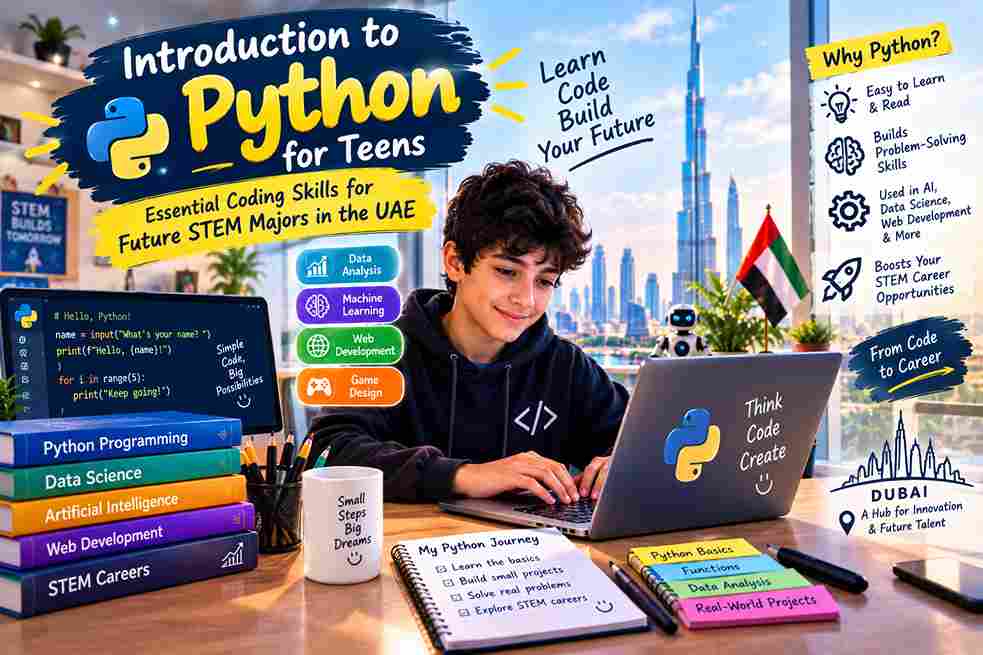
- Introduction to Python for Teens: Essential Coding Skills for Future STEM Majors in the UAE
- EdFlik Summer Camp UAE — Ages 13–15: Public Speaking, Business & AI
- All Enrichment & Skills articles