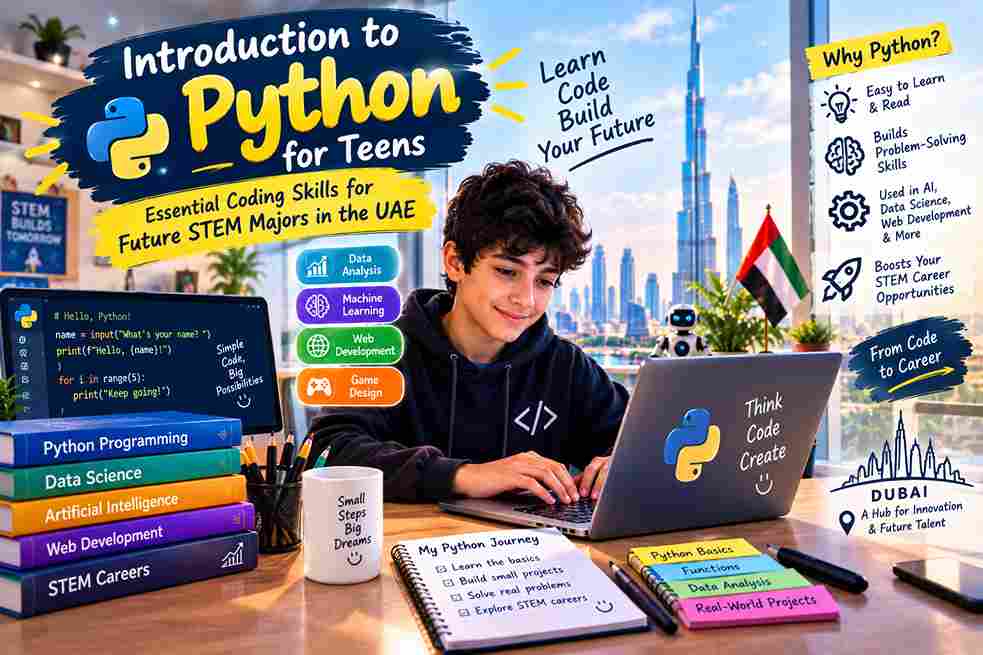
Introduction to Python for Teens: Essential Coding Skills for Future STEM Majors in the UAE
Last Updated: September 2026 | By EdFlik Education Team
For ambitious teenagers studying across international schools in the UAE—including thriving educational hubs in Dubai, Abu Dhabi, and Sharjah—preparing for future careers means looking far beyond traditional high school classrooms. As the UAE accelerates its ambitious National Strategy for Artificial Intelligence and digital transformation, coding and computer science have transitioned from niche electives into essential life skills.
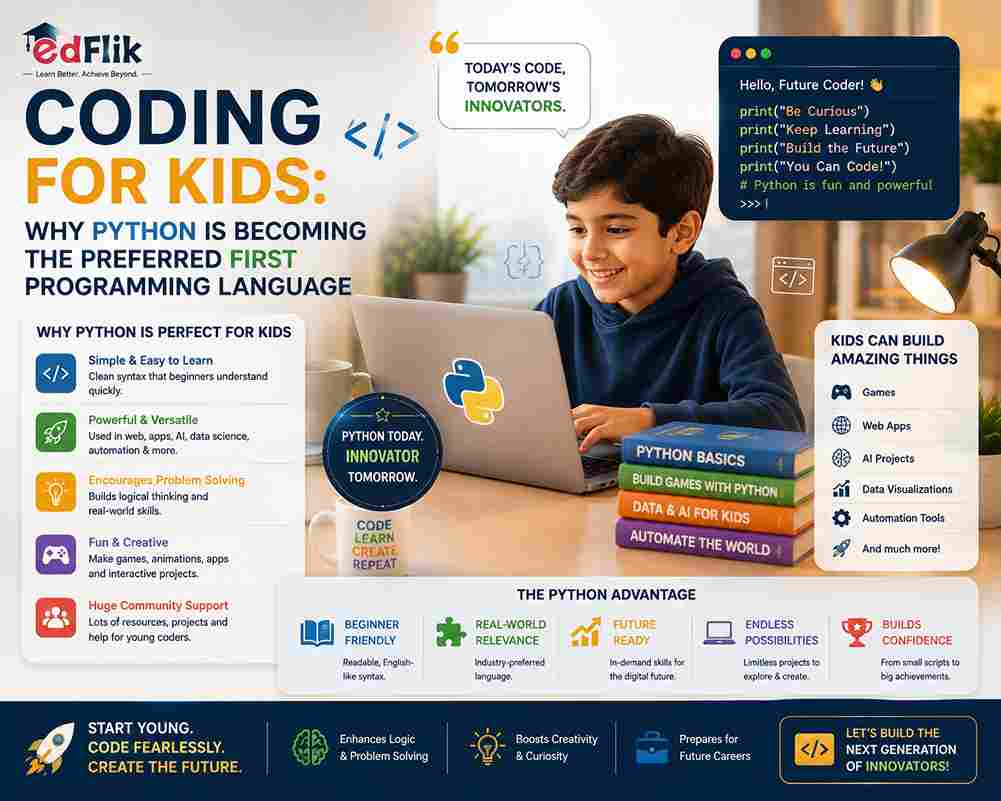
Among all programming languages, Python stands undisputed as the ultimate gateway for teenagers. Whether you aspire to major in computer science, mechanical engineering, biotechnology, artificial intelligence, or data analytics at a top global university, mastering Python in high school gives you an undeniable academic advantage.
In this comprehensive guide, our expert computer science educators break down why Python is the ideal first language for teens, explore foundational coding concepts, and outline how early programming experience paves the way for elite STEM success.
Part 1: Why Python is the Ultimate Coding Language for Teens
When students first encounter computer programming, complex syntax and rigid punctuation rules in languages like C++ or Java can cause immense frustration. Python was deliberately created with a different philosophy: readability, simplicity, and power.
1. English-Like Syntax
Python code reads remarkably like plain English. For example, writing a conditional check in Java requires curly braces, semicolons, and type declarations. In Python, it is wonderfully intuitive:
Python
age = 16
if age >= 16:
    print("Eligible for student STEM programs!")
This clean syntax allows teenage learners to focus on logic, problem-solving, and algorithmic thinking rather than getting bogged down by syntax errors.
2. The Language of Modern AI and Data Science
Python is the undisputed engine behind cutting-edge technological revolutions. From training artificial intelligence models and analyzing medical genomics data to automating financial algorithms and launching spacecraft, Python is the primary tool used by engineers at NASA, Google, Tesla, and OpenAI.
Part 2: Core Programming Pillars Every Teen Must Master
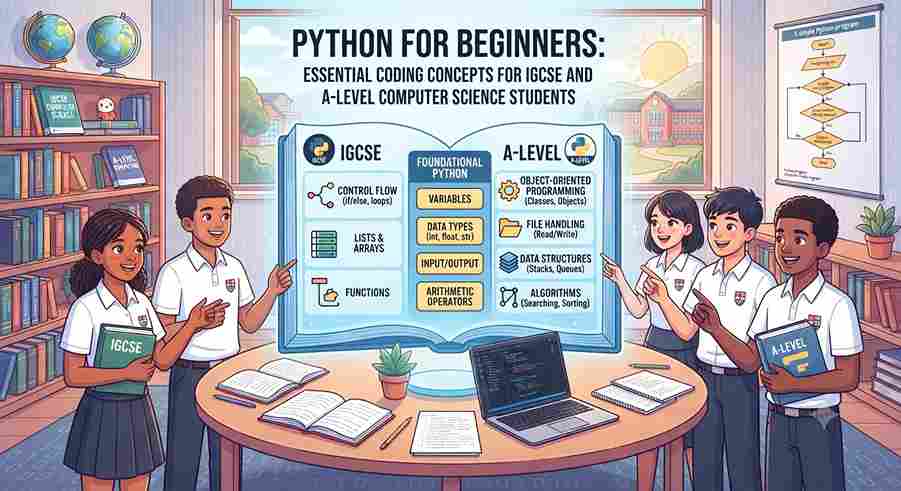
To transition from a casual beginner to a capable coder ready for AP Computer Science or IB Computer Science, teens should focus on mastering five foundational pillars:
1. Variables and Data Types
Variables act as labeled storage boxes in memory. Students learn how to store different types of data:
- Strings (
str): Text data (e.g.,student_name = "Fatima") - Integers (
int): Whole numbers (e.g.,grade_level = 10) - Floats (
float): Decimals (e.g.,gpa_score = 3.95) - Booleans (
bool): True/False switches (e.g.,is_enrolled = True)
2. Control Flow (Conditionals and Loops)
Logic is the heart of programming.
- Conditionals (
if,elif,else): Teaching programs how to make decisions based on changing inputs. - Loops (
forandwhile): Automating repetitive tasks efficiently without writing the same line of code fifty times.
3. Functions and Modularity
Functions are reusable blocks of code designed to perform a specific task. Writing clean functions teaches students how to break massive, complex problems down into small, manageable modules—a core principle of software engineering.
4. Data Structures (Lists and Dictionaries)
Real-world data is complex. Students learn how to organize collections of information using lists (ordered sequences) and dictionaries (key-value pairs, similar to a digital phonebook).
5. Object-Oriented Programming (OOP)
As students advance, they explore classes and objects, learning how to model real-world entities (like a virtual school database or a game character) inside code.
Part 3: Real-World STEM Projects for Teen Programmers
The best way to solidify coding skills is through project-based learning. Here are four engaging projects that high school STEM students can build using Python:
- A Scientific Calculator for Physics Formulas: Write a Python script that calculates kinetic energy, gravitational potential energy, or kinematic motion equations when user inputs are provided.
- A Weather Data Tracker: Use Python libraries to fetch live meteorological data from Dubai or Abu Dhabi and analyze temperature trends over a month.
- A Text-Based RPG Adventure Game: Combine conditionals, loops, and random number generators to build an interactive storytelling game where player choices dictate survival.
- A Simple Data Visualization Dashboard: Using libraries like
matplotlib, students can graph academic grades or economic statistics, turning raw data into compelling visual charts.
Part 4: How Coding Boosts University Applications and STEM Readiness
For students targeting elite universities in the US, UK, Canada, or Europe, demonstrating technical initiative sets college applications apart:
- Complementing AP and IB Curricula: Python provides immediate practical application for AP Computer Science Principles, AP CSA, and IB Computer Science internal assessments (IAs).
- Super-Curricular Distinction: Building a portfolio of GitHub projects or developing an automated research tool shows university admissions boards genuine intellectual curiosity beyond the classroom syllabus.
- Interdisciplinary Advantage: Modern biology, economics, physics, and architecture heavily rely on computational modeling. Knowing Python transforms how students approach scientific research.
Ready to give your teenager a head start in coding, Python, and STEM excellence? EdFlik connects international school students across Dubai, Abu Dhabi, and the UAE with expert 1-to-1 online coding tutors and computer science mentors, turning beginners into confident programmers.Book a Free Demo Class Today!
Frequently Asked Questions (FAQs)
Q1: Does my teenager need any prior coding experience to start learning Python?
Ans: Absolutely not! Python is specifically designed as an ideal first programming language for absolute beginners, requiring zero prior coding background.
Q2: How does Python help with school subjects like Math and Physics?
Ans: Python automates tedious calculations, allows students to test algebraic hypotheses instantly, and teaches algorithmic thinking, which directly strengthens logical reasoning in mathematics and science.
Q3: Can Python help students prepare for AP or IB Computer Science exams?
Ans: While AP Computer Science A traditionally uses Java, learning Python first builds foundational logic, syntax intuition, and problem-solving skills that make transitioning to any programming language significantly easier.
Q4: How does EdFlik support coding students in the UAE?
Ans: EdFlik connects international school students across the UAE with vetted, experienced 1-to-1 online coding tutors. Our personalized lessons focus on hands-on project building, logical problem-solving, and foundational computer science mastery.