Study Skills for Teens UAE | Exam Technique Guide
Study Skills and Exam Technique for UAE Secondary School Students: A Practical Guide
Strong study skills are the multiplier that determines how much value a student gets from any amount of study time. Two students can spend the same number of hours preparing for an IGCSE or IB examination and produce significantly different results — not because of different intelligence, but because of different study quality. This guide gives UAE secondary school students and their parents a practical, evidence-based framework for studying effectively and performing under examination conditions.
The Problem With How Most Students Study
Most students default to the same study approach they have always used: re-reading notes, highlighting textbooks, and copying out content into revision guides. These strategies feel productive because they create a sense of familiarity — the information looks recognisable after reading it several times.
The problem is that recognition is not retrieval. An examination does not give you the notes to recognise — it asks you to retrieve information from memory, apply it to a question structure you may not have seen before, and produce an answer under time pressure. Re-reading prepares students for a different task from the one they will face on the day.
The Study Techniques That Actually Work
Active Recall and Self-Testing
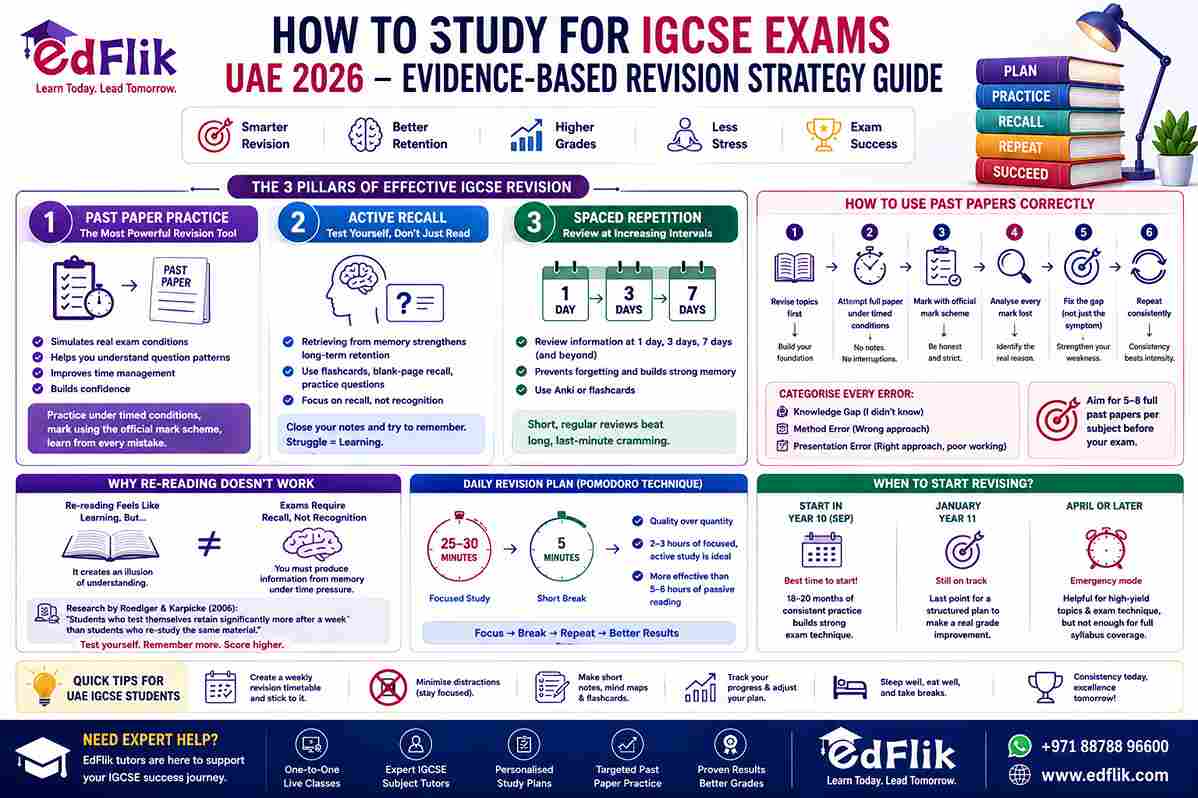
Active recall means retrieving information from memory rather than re-reading it. In practice: close your notes, write down everything you can remember about a topic, then check what you missed. Use flashcards — write a concept on one side, the answer on the other — and test yourself without looking at the card first. Work through practice questions without reference materials. Every act of retrieval strengthens the memory of that information more effectively than any amount of re-reading.
Spaced Repetition
Spaced repetition means practising content at increasing intervals over time rather than in a single concentrated block. Cover a topic, return to it three to four days later, then a week after that, then two weeks later. Each time you return, you are practising retrieval — and each successful retrieval strengthens the long-term memory trace. Digital flashcard tools such as Anki are designed specifically around spaced repetition principles and are used by students worldwide for exactly this purpose.
Past Paper Practice Under Timed Conditions
For IGCSE, IB, and A-Level students, past papers are the most examination-aligned study tool available. Completing a full paper under strict timed conditions — no notes, no breaks, strict time limit — and then marking it against the official mark scheme identifies exactly where marks are being lost and why. This is more valuable than any other single revision activity in the weeks before an examination.
Interleaved Practice
Rather than studying one subject all day, interleave different subjects within your study schedule. Forty-five minutes on Chemistry, then forty-five minutes on English, then forty-five minutes on Mathematics. This feels less productive than blocked practice but produces significantly better retention because the brain must work harder to retrieve information in a varied context — which is exactly what examinations require.
Exam Technique: How to Perform Under Pressure
Read the Question, Not What You Wish It Said
A significant number of marks are lost in IGCSE and IB examinations by students who answer a slightly different question from the one asked. Underline the command word (describe, explain, evaluate, calculate), identify what the question is specifically asking, and structure your answer around that specific demand.
Show Your Working in Maths and Sciences
Cambridge and IB mark schemes award method marks for correct working even when the final answer is wrong. A student who writes a neat, correct method and makes an arithmetic error at the end earns most of the marks. A student who writes only the wrong final answer earns zero. Always show your reasoning.
Manage Your Time From the First Question
Before writing a word, scan the full paper and allocate time per section based on mark weight. In a 75-minute paper with 75 marks, budget approximately 65 seconds per mark and leave five minutes at the end to review. If a question takes longer than budgeted, move on and return to it.
How a Tutor Improves Study Skills and Exam Technique
A specialist tutor does two things that self-study cannot: diagnoses why marks are being lost on past papers, and holds the student accountable to a structured revision schedule. EdFlik tutors work one-to-one with secondary school students across the UAE, helping them build effective study habits and refine examination technique. Sessions from AED 45, free trial at edflik.com.
Frequently Asked Questions
Why do some students study for hours but still perform badly in exams?
The most common reason is the quality of study rather than the quantity. Students who spend hours re-reading notes or highlighting textbooks are engaged in passive review — a strategy that creates a feeling of familiarity without building the retrieval strength needed under examination conditions. Effective exam preparation is characterised by active retrieval: working problems from scratch, writing answers without looking at notes, using flashcards, and completing past papers under timed conditions. The shift from passive to active study is the single most impactful change most underperforming students can make.
What is the best way to revise for IGCSE or IB exams?
The best revision approach combines spaced practice, active retrieval, and past paper analysis. Spaced practice means revisiting content at increasing intervals — covering a topic, revisiting it three days later, again a week later, and again three weeks later — rather than concentrated reviewing immediately before the exam. Active retrieval means testing yourself on the content from memory rather than reading about it. Past paper analysis means completing papers under timed conditions and reviewing every error against the mark scheme to identify patterns. Students who combine all three approaches in the months before an IGCSE or IB examination consistently outperform those who use only passive review methods.
How much sleep should a teenager get during exam preparation?
Sleep is not a study cost — it is a study investment. The neuroscience of learning consistently shows that memory consolidation occurs during sleep: material studied before sleep is retained more effectively than material studied at a similar time but followed by wakefulness. Teenagers need 8 to 10 hours of sleep per night for optimal cognitive function. Reducing sleep below 7 hours significantly impairs attention, working memory, and the ability to retrieve information under pressure. UAE students who are reducing sleep to study more hours are typically producing less effective study, not more.
Is it better to study one subject per day or switch between subjects?
Interleaving — switching between subjects within a study session or across adjacent days — produces better long-term retention than blocked study (spending an entire day on one subject). This is counterintuitive because blocked study feels more productive while it is happening. However, examination conditions require students to apply knowledge in a mixed, unpredictable order, and interleaved practice builds exactly the retrieval flexibility that examinations demand. A practical approach: study one subject per 45-minute block, then switch to a different subject for the next block, then rotate back.
Book a Free Study Skills and Exam Prep Session
EdFlik tutors help UAE secondary students build the study habits and exam technique that produce results. Sessions from AED 45. Free trial at edflik.com.