Understanding Your Child’s CAT4 Score Report: A Parent’s Guide to Standardized Testing in Dubai
Last Updated: October 2026 | By EdFlik Education Team
For families navigating the dynamic educational landscape of the United Arab Emirates, standardized testing is an unavoidable reality of school admissions and academic tracking. Whether your child is enrolled in a British curriculum school (IGCSE/A-Levels), an International Baccalaureate (IB) world school, or an American curriculum academy in Dubai or Abu Dhabi, you have likely encountered the CAT4 (Cognitive Abilities Test, Fourth Edition).
Every academic year, KHDA (Knowledge and Human Development Authority) inspection cycles and international school administrators rely heavily on CAT4 data. Yet, when parents receive a multi-page CAT4 score report filled with terms like SAS (Standard Age Score), Sten Bands, National Percentiles, and Verbal vs. Quantitative Mean Differences, it can feel like trying to decipher an ancient foreign language.
In this comprehensive parent masterclass guide, our expert educational advisors break down every single component of the CAT4 report, demystify what the numbers actually mean, and show you how to use this data to unlock your child’s true academic potential.
Part 1: What is the CAT4 and Why Do Dubai Schools Use It?
Developed by GL Assessment, the CAT4 is not a test of curriculum knowledge or school achievement. Unlike math exams or spelling tests, CAT4 is a cognitive ability test.
Think of it as a diagnostic scan of how your child’s brain processes information, solves problems, and reasons using different cognitive modalities. It measures potential rather than past performance.
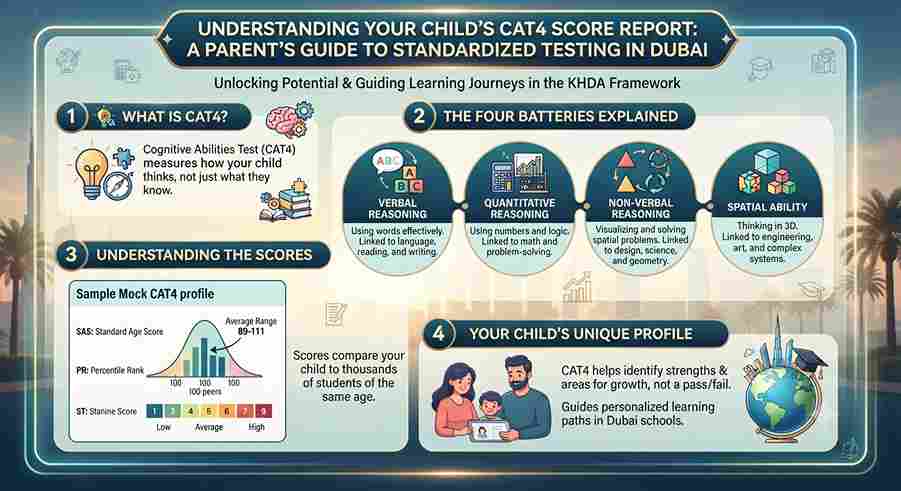
The Four Core Batteries of CAT4:
- Verbal Reasoning (Thinking with Words): Tests a student's ability to solve problems using words, recognize relationships, and understand vocabulary. (e.g., verbal classification, sentence completion).
- Quantitative Reasoning (Thinking with Numbers): Measures numerical fluency, ability to discover patterns in numbers, and apply mathematical reasoning. (e.g., number analogies, number series).
- Non-Verbal Reasoning (Thinking with Shapes): Evaluates problem-solving using visual shapes, diagrams, and figures, entirely independent of language skills. (e.g., figure classification, figure matching).
- Spatial Ability (Thinking with Space & Shape): Tests the capacity to visualize and manipulate shapes in two and three dimensions, critical for STEM, architecture, and advanced mathematics. (e.g., figure analysis, figure recognition).
Part 2: Decoding the Report Metrics — What Do All the Numbers Mean?
When you open your child’s CAT4 report, you will encounter several key statistical metrics. Here is how to interpret them without a degree in educational psychometrics:
1. The Standard Age Score (SAS) — The Gold Standard
The SAS is the most critical score on the report. It compares your child’s raw score against a massive, standardized international sample group of children of the exact same age (down to the month).
- The Mean (Average): The average score is set at 100.
- The Normal Range: Approximately two-thirds (68%) of all students score between 89 and 111.
- Above Average: Scores between 112 and 126 indicate above-average cognitive ability.
- Very High: Scores of 127 and above place a student in the top tier of the international population.
2. National Percentile Rank (NPR)
The National Percentile shows the percentage of students in the reference group who scored at or below your child’s score.
- An NPR of 75 means your child performed as well as or better than 75% of children their age globally. It does not mean they scored 75% on a test; it is a relative ranking.
3. Sten Bands (Standard Tens)
Sten scores divide the population into a 10-point scale ranging from 1 to 10.
- Stens 1–3: Below average potential.
- Stens 4–7: Average cognitive range (the vast majority of students fall here).
- Stens 8–10: High to exceptionally high cognitive ability.
Part 3: Understanding Profiles and Discrepancies (Verbal vs. Spatial)
One of the most valuable features of the CAT4 report is its ability to highlight cognitive profiles. Not every child thinks uniformly across all four batteries.
- Balanced Profiles: A student whose Verbal, Quantitative, Non-Verbal, and Spatial SAS scores are relatively close together (e.g., all hovering around 108–112) has a balanced cognitive profile.
- Strong Verbal vs. Weak Spatial (or vice versa): A student might score an impressive 120 in Verbal Reasoning but a 95 in Spatial Ability. This is not a "flaw"—it is crucial diagnostic insight! It explains why a student might excel in English literature and history while feeling overwhelmed by 3D geometry in math or technical design.
Part 4: Top 4 Parent Traps and Myths Regarding CAT4
- Treating CAT4 Like an Exam to "Revise" For: Because CAT4 measures innate cognitive reasoning and problem-solving aptitude rather than memorized curriculum facts, cramming past papers or vocabulary lists two days before the test yields negligible results and causes unnecessary student anxiety.
- Panicking Over an "Average" Score (SAS 100): Many high-achieving Dubai parents panic if their child scores an SAS of 100 or 105, viewing it as a failure. An SAS of 100 is literally the exact statistical average for children worldwide. It means your child is fully capable of accessing standard curriculum benchmarks.
- Ignoring the Spatial and Non-Verbal Scores: Focusing solely on English and Math (Verbal and Quantitative) while ignoring low Spatial scores. In modern STEM-driven international education, spatial reasoning is a powerful predictor of success in coding, engineering, physics, and design technology.
- Assuming CAT4 Dictates Lifelong Destiny: Cognitive scores provide a snapshot of current reasoning ability, but they are not a permanent ceiling. Growth mindset, quality teaching, targeted academic support, and diligent study habits can dramatically elevate a student's actual classroom performance well beyond initial test projections.
Navigating international school admissions or seeking targeted academic support in Dubai? EdFlik connects students globally with expert, 1-to-1 online tutors across all major curricula, helping your child build confidence, bridge learning gaps, and achieve excellence.Book a Free Demo Class Today!
Frequently Asked Questions (FAQs)
Q1: How often do Dubai schools administer the CAT4 test?
Ans: Most international schools in Dubai administer CAT4 in key transition years—typically Year 4 (Grade 3), Year 7 (Grade 6), Year 9 (Grade 8), and Year 10 or 12. KHDA uses this data alongside external examinations (like ISA, TIMSS, or PISA) to evaluate school value-add and teaching effectiveness.
Q2: Can my child practice for the CAT4 test?
Ans: While you cannot "study" for an IQ-style cognitive test, familiarizing younger children with the format of question types (such as matrix completions or odd-one-out shape patterns) through sample GL assessment material can reduce test-day anxiety and prevent silly mistakes caused by unfamiliarity.
Q3: What is a "Progress Indicator" on a CAT4 report?
Ans: Schools often use CAT4 scores in conjunction with predictive algorithms (like GL Progress Test data or IB/GCSE baselines) to establish target grades. It shows teachers what grade a student with that specific cognitive profile is statistically predicted to achieve in external exams.
Q4: How does EdFlik support students who need help bridging academic gaps highlighted by CAT4?
Ans: EdFlik connects international school students in the UAE and worldwide with vetted, expert 1-to-1 online tutors. Whether your child needs help reinforcing quantitative reasoning, boosting verbal comprehension, or mastering rigorous curriculum subjects, our personalized sessions ensure they reach their full potential.