Calculating Percentage Error and Percentage Difference in IB MYP Science Labs
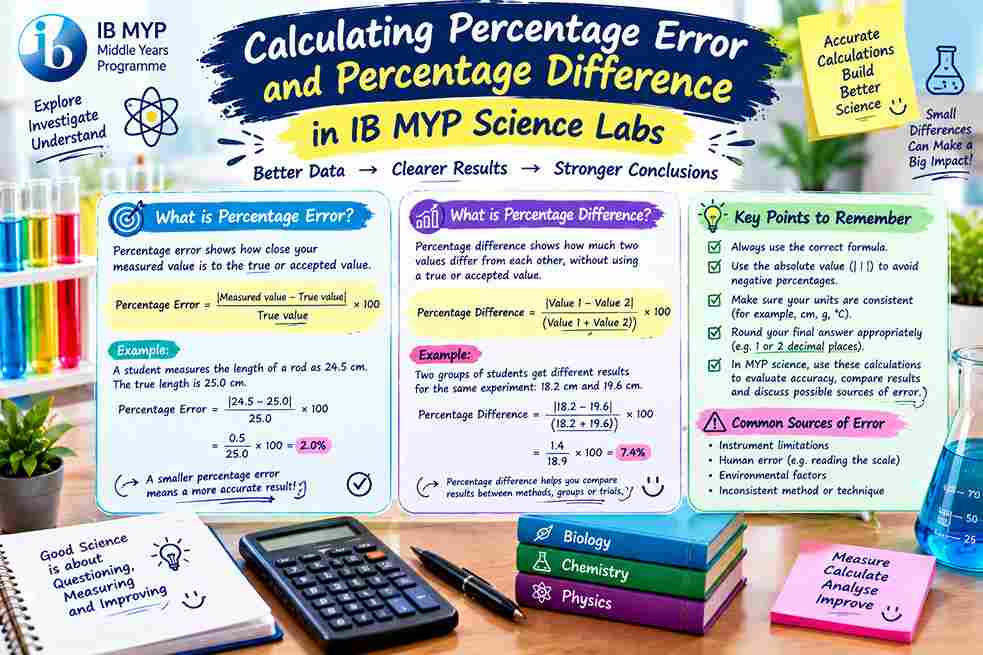
In the International Baccalaureate Middle Years Programme (IB MYP) Science framework (Years 1–5 / Grades 6–10), practical laboratory work forms the core of Criterion C: Processing and Evaluating.
When analyzing data collected in the lab—whether measuring the acceleration due to gravity, evaluating the specific heat capacity of water, or comparing enzyme reaction rates across different trials—students frequently confuse two fundamental metrics: Percentage Error and Percentage Difference.
Misapplying these formulas or failing to interpret what the final percentage value means for experimental accuracy and reliability can cost top-band marks in Criterion C.
This comprehensive guide breaks down the definitions, formulas, step-by-step worked examples, Criterion C rubric requirements, and common pitfalls to ensure your lab report scores in the Level 7–8 band.
Part 1: Defining the Core Concepts
To determine which formula to use in your lab report, ask yourself one simple question: Do I have an accepted theoretical value from a textbook, or am I comparing two experimental results?
                       DATA EVALUATION DECISION TREE
                                     |
      +------------------------------+------------------------------+
      |                                                             |
1. PERCENTAGE ERROR                                    2. PERCENTAGE DIFFERENCE
• Used when comparing an **experimental value**          • Used when comparing **two experimental values**
  against an **accepted theoretical value**               where no single "true" value is known
  (e.g., $g = 9.81\text{ m/s}^2$).                       (e.g., Trial 1 vs. Trial 2 or Group A vs. Group B).
• Measures **ACCURACY** (how close you are              • Measures **PRECISION / REPRODUCIBILITY**
  to the true value).                                    (how consistent measurements are).
Part 2: Percentage Error (Accuracy)
1. Definition and Formula
Percentage Error quantifies the discrepancy between your experimentally determined value ($V_{\text{exp}}$) and the true or accepted literature value ($V_{\text{acc}}$). It indicates the extent to which systematic or random errors affected the accuracy of your experiment.
$$\text{Percentage Error} = \left\vert{} \frac{V_{\text{exp}} - V_{\text{acc}}}{V_{\text{acc}}} \right\vert{} \times 100\%$$
Note: The absolute value brackets $\vert{} \dots \vert{}$ ensure that the percentage error is reported as a positive number in standard MYP scientific reporting.
2. Step-by-Step Worked Example: Acceleration Due to Gravity ($g$)
Scenario: In an MYP 5 Physics lab, a student drops a steel marble through a light gate to measure the acceleration due to gravity ($g$). After five trials, the average experimental acceleration is calculated as $V_{\text{exp}} = 9.24\text{ m/s}^2$. The accepted textbook value for gravity is $V_{\text{acc}} = 9.81\text{ m/s}^2$.
Step 1: Identify Known Values
- Experimental Value ($V_{\text{exp}}$) = $9.24\text{ m/s}^2$
- Accepted Value ($V_{\text{acc}}$) = $9.81\text{ m/s}^2$
Step 2: Substitute Values into the Percentage Error Formula
$$\text{Percentage Error} = \left\vert{} \frac{9.24 - 9.81}{9.81} \right\vert{} \times 100\%$$
Step 3: Calculate Absolute Difference
$$\vert{}9.24 - 9.81\vert{} = \vert{}-0.57\vert{} = 0.57\text{ m/s}^2$$
Step 4: Divide by Accepted Value and Multiply by $100\%$
$$\text{Percentage Error} = \left( \frac{0.57}{9.81} \right) \times 100\% = 0.0581 \times 100\% = \mathbf{5.81\%}$$
Conclusion: The experimental result is within $5.81\%$ of the accepted value, indicating a high level of accuracy.
Part 3: Percentage Difference (Precision / Relative Discrepancy)
1. Definition and Formula
Percentage Difference compares two experimental values ($E_1$ and $E_2$) when neither can be assumed to be the "true" or standard value. It measures the relative variation between two measurements or trial averages to evaluate consistency and precision.
$$\text{Percentage Difference} = \frac{\vert{}E_1 - E_2\vert{}}{\left( \frac{E_1 + E_2}{2} \right)} \times 100\%$$
2. Step-by-Step Worked Example: Enthalpy Change of Neutralization
Scenario: In an MYP 4 Chemistry lab, two student groups perform an acid-base neutralization reaction using different calorimeters (Glass Beaker vs. Styrofoam Cup) to measure temperature change ($\Delta T$).Group A (Glass Beaker, $E_1$): $\Delta T = 6.4^\circ\text{C}$Group B (Styrofoam Cup, $E_2$): $\Delta T = 7.8^\circ\text{C}$
Step 1: Identify Experimental Values
- Value 1 ($E_1$) = $6.4^\circ\text{C}$
- Value 2 ($E_2$) = $7.8^\circ\text{C}$
Step 2: Calculate Absolute Difference ($\vert{}E_1 - E_2\vert{}$)
$$\vert{}6.4 - 7.8\vert{} = \vert{}-1.4\vert{} = 1.4^\circ\text{C}$$
Step 3: Calculate the Average of the Two Values ($\frac{E_1 + E_2}{2}$)
$$\text{Average} = \frac{6.4 + 7.8}{2} = \frac{14.2}{2} = 7.1^\circ\text{C}$$
Step 4: Substitute into Formula and Evaluate
$$\text{Percentage Difference} = \left( \frac{1.4}{7.1} \right) \times 100\% = 0.1972 \times 100\% = \mathbf{19.72\%}$$
Conclusion: There is a $19.72\%$ difference between the two equipment setups, highlighting significant heat loss in the glass beaker setup.
Part 4: Linking Error Calculations to MYP Criterion C Rubric (Levels 7–8)
To score in the highest band for Criterion C (Processing Data & Evaluating Inquiry), you must move beyond simply calculating numbers; you must interpret what the percentage signifies in relation to experimental limitations.
                     CRITERION C EVALUATION MATRIX
                                   |
      +----------------------------+----------------------------+
      |                                                         |
LOW BAND (Levels 1–4)                                   HIGH BAND (Levels 7–8)
• Calculates percentage error without sample             • Provides clear sample calculations showing
  working or units.                    formulas, units, and correct sig figs.
• States "human error caused the error".     • Evaluates whether error stems from **Systematic**
• Ignores comparison with equipment uncertainty.           or **Random** factors.
                                                         • Compares % Error directly against total % Instrument
                                                           Uncertainty to judge validity.
Comparing Percentage Error vs. Percentage Uncertainty
A key distinction for Level 7–8 responses is comparing your calculated Percentage Error to your Percentage Instrument Uncertainty:
- If$\text{Percentage Error} \le \text{Percentage Uncertainty}$: Your experimental discrepancy can be completely explained by the inherent limits of your measuring instruments (e.g., ruler or stopwatch precision). The method is considered valid.
- If$\text{Percentage Error} > \text{Percentage Uncertainty}$: Systematic errors (e.g.,heat loss to surroundings, zero errors on balances, friction) or uncontrolled variables influenced the data. You must identify these specific flaws in your evaluation section.
Part 5: Top 4 Traps That Cost Students Marks in MYP Labs
- Confusing Percentage Error with Percentage Change: Percentage Change ($\frac{\text{Final} - \text{Initial}}{\text{Initial}} \times 100\%$) tracks growth or decay over time (e.g., osmosis mass changes), whereas Percentage Error compares experimental output to an accepted standard.
- Omitting Sample Calculations: Presenting final percentage values in a summary table withoutproviding a clear, step-by-step sample calculation (with formulas and units) in the data processing section.
- Mismatched Decimal Places and Significant Figures: Reporting a percentage error as $5.8139201\%$ from a calculator output when raw measurements were recorded to only 2 or 3 significant figures. Match your processed figures to your raw precision!
- Vague Evaluations ("Human Error"): Writing "The $12\%$ error was caused by human error." Teachers penalize vague statements. Instead, state: "The $12\%$ negative error in calculated enthalpy was caused by systematic heat loss to the ambient air through the uninsulated glass beaker walls."
Frequently Asked Questions (FAQs)
Q1: Can Percentage Error be negative?
Ans: In higher-level physics or engineering, signed percentage errors indicate whether your value was higher (+) or lower (-) than accepted. However, in standard IB MYP lab reports, percentage error is calculated using absolute values ($\vert{} \dots \vert{}$) and reported as a positive value.
Q2: Which formula should I use if I am comparing my class average to another class's average?
Ans: Use Percentage Difference, because neither class average represents an absolute, accepted literature standard.
Q3: What is considered an "acceptable" percentage error in MYP school science labs?
Ans: Generally, a percentage error below $5\%$ indicates high accuracy, while $5\% - 15\%$ is acceptable for standard school equipment. Errors exceeding $20\%$ signal significant systematic flaws in the experimental design or execution that must be evaluated in Criterion C.
More on IB
- The IB in the UAE: A Complete Guide to PYP, MYP and the Diploma Programme
- How to Design a Top-Scoring IB MYP Science Investigation: Variables, Hypotheses, and Methodology
- IB Computer Science Tutor Online: A Parent Guide for UAE Families
- Approaching IB MYP Science Criterion B and C: Designing Effective Investigations
- All IB articles