Calculating Threshold Frequency and Work Function: Edexcel IAL Physics Unit 2 Photoelectric Effect
Last Updated: October 29, 2026 | By EdFlik Team
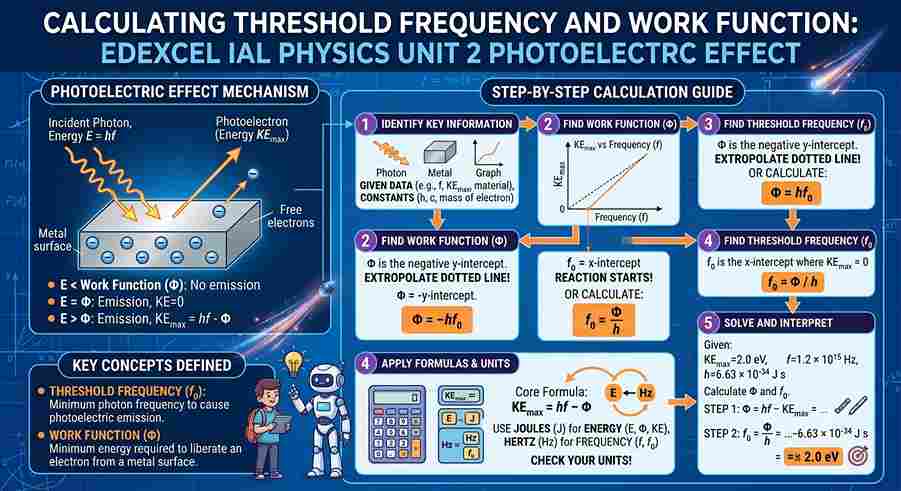
For high school students preparing for the Pearson Edexcel International Advanced Level (IAL) Physics Unit 2 (WPH12: Waves and Electricity) examination, quantum physics and the photoelectric effect represent core topics that routinely appear across multiple-choice items and structured calculations.
Questions testing the photoelectric effect—specifically calculating threshold frequency ($f_0$), work function ($\Phi$), maximum kinetic energy ($KE_{\max}$), and stopping potential ($V_s$)—carry high-tariff marks. Students frequently drop marks not due to conceptual misunderstandings of photon behavior, but because of unit conversion errors between Joules and electronvolts (eV), or misinterpreting the gradient and x-intercept of graphical representations.
This comprehensive masterclass guide breaks down the underlying quantum equations, provides a step-by-step calculation workflow, walks through a fully worked numerical model, exposes top examiner traps, and supplies a 100% copy-paste JSON-LD schema markup.
Part 1: Theoretical Foundations and Einstein's Photoelectric Equation
The photoelectric effect demonstrates the particulate nature of electromagnetic radiation. When light of a sufficiently high frequency is incident on a metal surface, electrons are instantly emitted from the surface.
                  THE PHOTOELECTRIC EFFECT ENERGY BALANCE
                                     |
        $$E_{\text{photon}} = \Phi + KE_{\max}$$

• $E_{\text{photon}} = hf$ ---> Energy of the incident photon ($h$ = Planck's constant, $f$ = frequency).
• $\Phi = hf_0$         ---> Work function (minimum energy required to release an electron).
• $KE_{\max}$          ---> Maximum kinetic energy of the emitted photoelectrons.
Key Definitions:
- Threshold Frequency ($f_0$): The minimum frequency of incident radiation required to eject photoelectrons from a metal surface. Below $f_0$, no electrons are emitted regardless of light intensity.
- Work Function ($\Phi$): The minimum energy bound holding an electron within the metal lattice, expressed in Joules ($\text{J}$) or electronvolts ($\text{eV}$).
Part 2: Step-by-Step Calculation Protocols
When tackling numerical problems in Unit 2, follow this structured 4-step workflow:
                  PRACTICAL CALCULATION WORKFLOW
                                   |
  Step 1: Identify Given Data    ---> Note wavelength ($\lambda$), frequency ($f$), or stopping potential ($V_s$).
  Step 2: Check Unit Consistency ---> Convert nanometers ($\text{nm}$) to meters ($\text{m}$) and eV to Joules if required.
  Step 3: Apply Energy Equation  ---> Use $hf = \Phi + KE_{\max}$ or $hf = \Phi + eV_s$.
  Step 4: Solve and Verify Units ---> Ensure final answers match required significant figures and units.
Part 3: Fully Worked Exam-Style Numerical Model
Exam Question:
Light of wavelength $3.50 \times 10^{-7} \text{ m}$ is shone onto a clean metal surface. The maximum kinetic energy of the emitted photoelectrons is found to be $1.85 \times 10^{-19} \text{ Joules}$.
(Given: Planck's constant $h = 6.63 \times 10^{-34} \text{ J s}$, Speed of light $c = 3.00 \times 10^8 \text{ m s}^{-1}$, Elementary charge $e = 1.60 \times 10^{-19} \text{ C}$)
Tasks:Calculate the energy of an incident photon in Joules.Calculate the work function ($\Phi$) of the metal in Joules.Calculate the threshold frequency ($f_0$) of the metal.Express the work function in electronvolts ($\text{eV}$).
Step 1: Calculate Incident Photon Energy ($E$)
Using the wave equation $c = f\lambda$, substitute into $E = hf$:
$$E = \frac{hc}{\lambda}$$$$E = \frac{(6.63 \times 10^{-34} \text{ J s})(3.00 \times 10^8 \text{ m s}^{-1})}{3.50 \times 10^{-7} \text{ m}}$$$$E = \frac{1.989 \times 10^{-25}}{3.50 \times 10^{-7}} = \mathbf{5.683 \times 10^{-19} \text{ Joules}}$$
Step 2: Calculate Work Function ($\Phi$)
Rearrange Einstein's photoelectric equation ($E = \Phi + KE_{\max}$):
$$\Phi = E - KE_{\max}$$$$\Phi = 5.683 \times 10^{-19} \text{ J} - 1.85 \times 10^{-19} \text{ J}$$$$\Phi = \mathbf{3.833 \times 10^{-19} \text{ Joules}}$$
Step 3: Calculate Threshold Frequency ($f_0$)
Using the definition $\Phi = hf_0$:
$$f_0 = \frac{\Phi}{h}$$$$f_0 = \frac{3.833 \times 10^{-19} \text{ J}}{6.63 \times 10^{-34} \text{ J s}} = \mathbf{5.78 \times 10^{14} \text{ Hz}}$$
Step 4: Convert Work Function to Electronvolts ($\text{eV}$)
Divide the energy in Joules by the elementary charge $e$:
$$\Phi (\text{in eV}) = \frac{3.833 \times 10^{-19} \text{ J}}{1.60 \times 10^{-19} \text{ J/eV}} = \mathbf{2.40 \text{ eV}}$$
Part 4: Top 4 Traps That Cost Students Marks in Unit 2
- Forgetting Unit Conversions for Wavelength: Leaving wavelength in nanometers ($\text{nm}$) instead of converting to meters ($1 \text{ nm} = 10^{-9} \text{ m}$) before calculating photon energy.
- Confusing Threshold Frequency with Incident Frequency: Substituting the incident light frequency into $\Phi = hf$ instead of the specific threshold frequency ($f_0$) when calculating the work function.
- Incorrect Joule-to-eV Conversion: Multiplying by $1.60 \times 10^{-19}$ instead of dividing when converting energy from Joules into electronvolts. Remember: $1 \text{ eV} = 1.60 \times 10^{-19} \text{ J}$.
- Misinterpreting Stopping Potential Equations: Forgetting that maximum kinetic energy can be equated directly to stopping potential ($V_s$) via $KE_{\max} = e V_s$.
Need expert 1-on-1 guidance on EdFlik Physics Unit 2 calculations and past-paper mastery? Book a class on EdFlik.
Frequently Asked Questions (FAQs)
Q1: What happens if the frequency of incident light is below the threshold frequency?
Ans: No photoelectrons are emitted from the metal surface, regardless of how intense or bright the light source is, because individual photons lack sufficient energy to overcome the work function.
Q2: Is the work function constant for a given metal?
Ans: Yes. The work function ($\Phi$) is a characteristic property of a specific metal surface representing the minimum binding energy of its electrons.
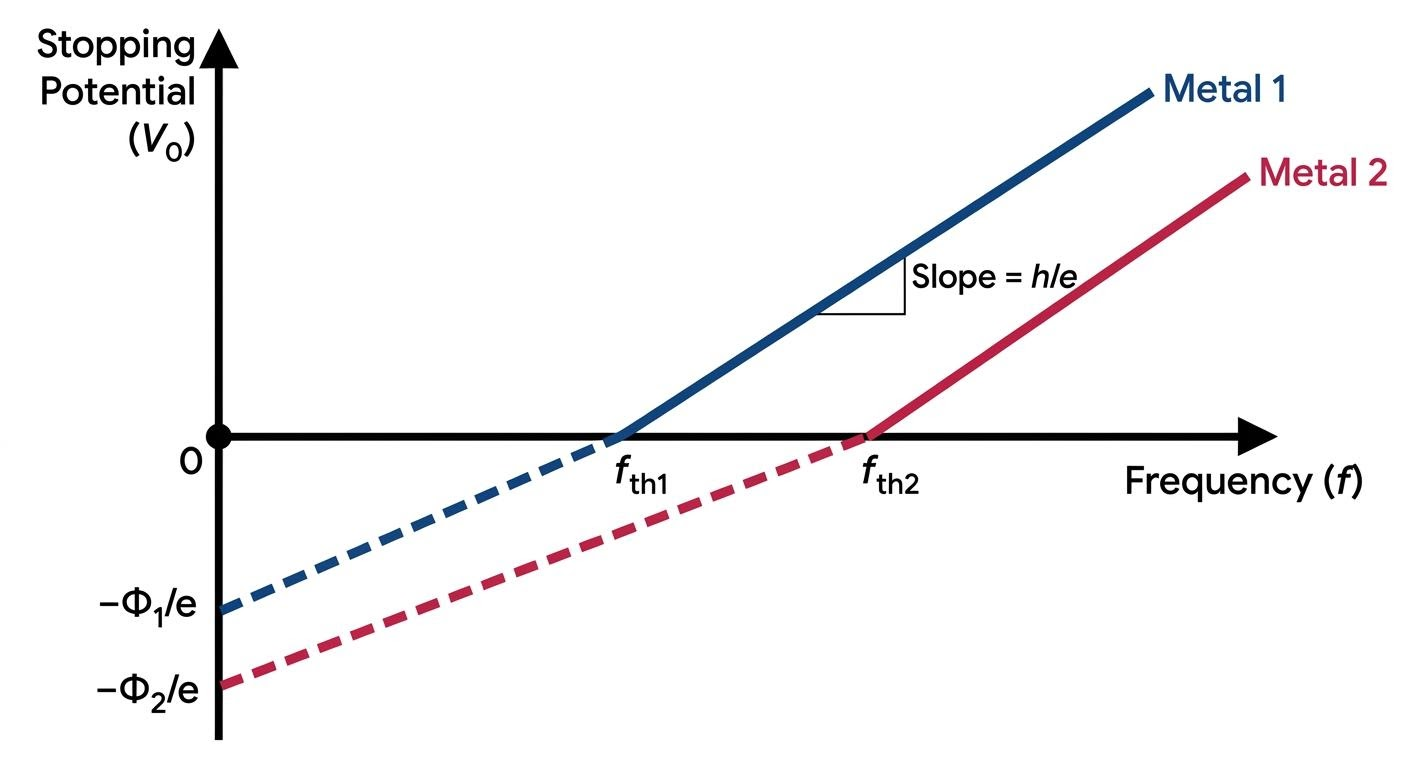
Q3: How do I find the threshold frequency from a graph of stopping potential against frequency?
Ans: On a graph of stopping potential ($V_s$) versus frequency ($f$), the x-intercept represents the threshold frequency ($f_0$), and the gradient multiplied by the elementary charge ($e$) equals Planck's constant ($h$).
More on A-Level
- A-Levels in the UAE: A Complete Guide to Boards, Subjects, Exams and University Entry
- Conquering Momentum in Two Dimensions: Edexcel IAL Physics Unit 4 Problem-Solving Guide
- Understanding Stationary Waves and Diffraction Gratings: Edexcel IAL Physics Unit 2 Revision Masterclass
- How to Evaluate Trading Blocs and Protectionism: Edexcel IAL Economics Unit 4 Essay Structure
- All A-Level articles