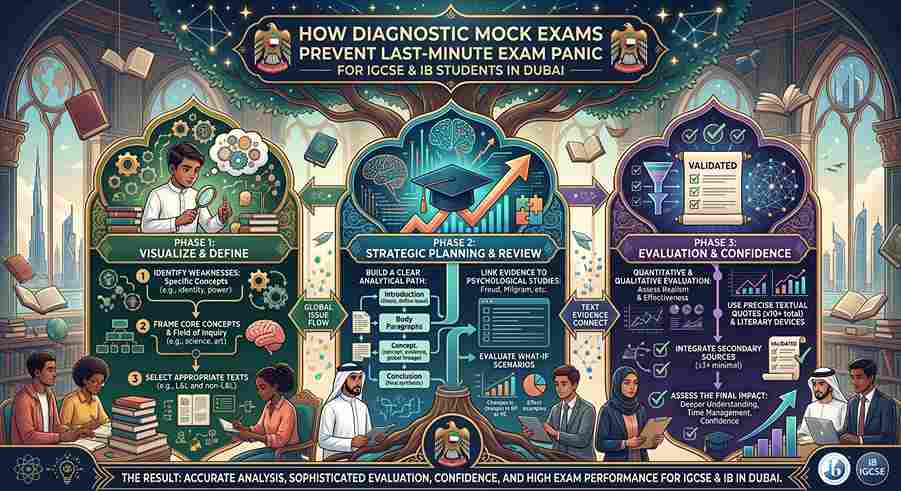
How Diagnostic Mock Exams Prevent Last-Minute Exam Panic for IGCSE and IB Students in Dubai
Last Updated: October 2026 | By EdFlik Education Team
For high school students attending top British and International Baccalaureate (IB) international schools in Dubai—from Knowledge Village and Dubai Silicon Oasis to Jumeirah and Arabian Ranches—the pressure to excel in IGCSE (Cambridge CAIE / Pearson Edexcel) and IB Diploma Programme (DP) examinations is immense.
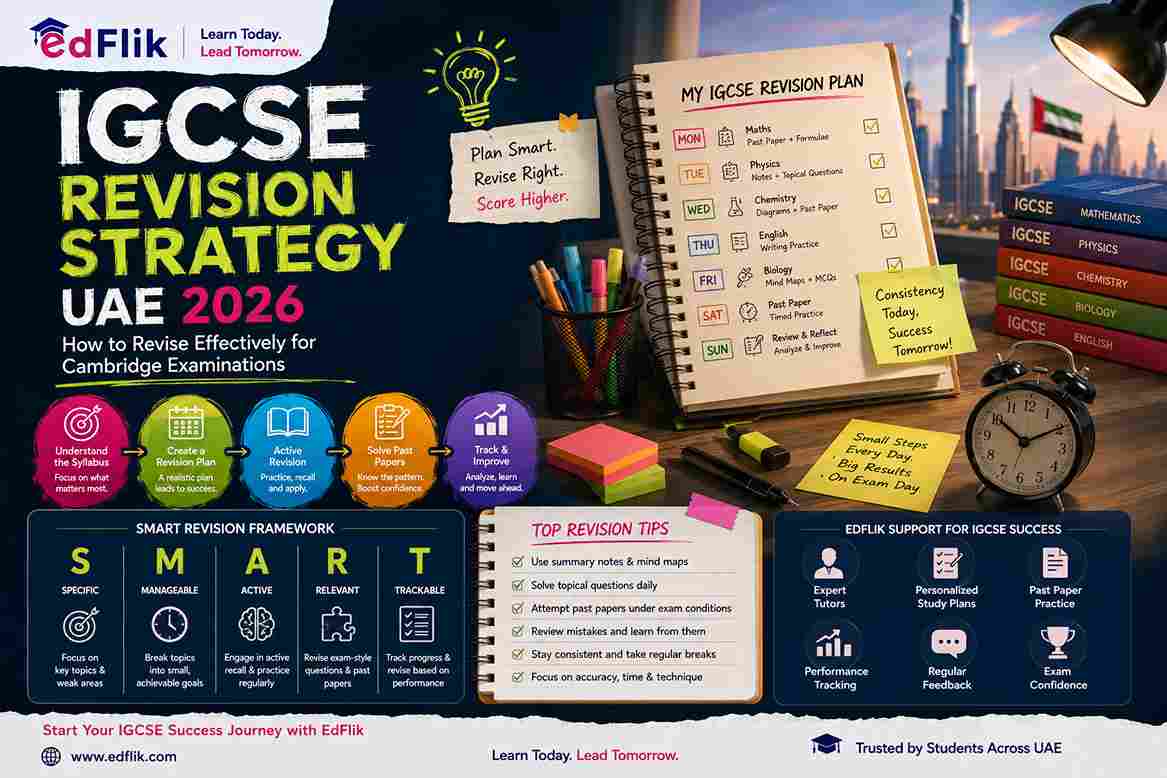
As the spring examination series approaches, students in Dubai often find themselves caught in a high-stakes, high-stress cycle. Endlessly re-reading textbooks, highlighting notes, and frantically cramming past papers during the final weeks before official exams frequently leads to burnout, memory blocks, and severe last-minute exam panic.
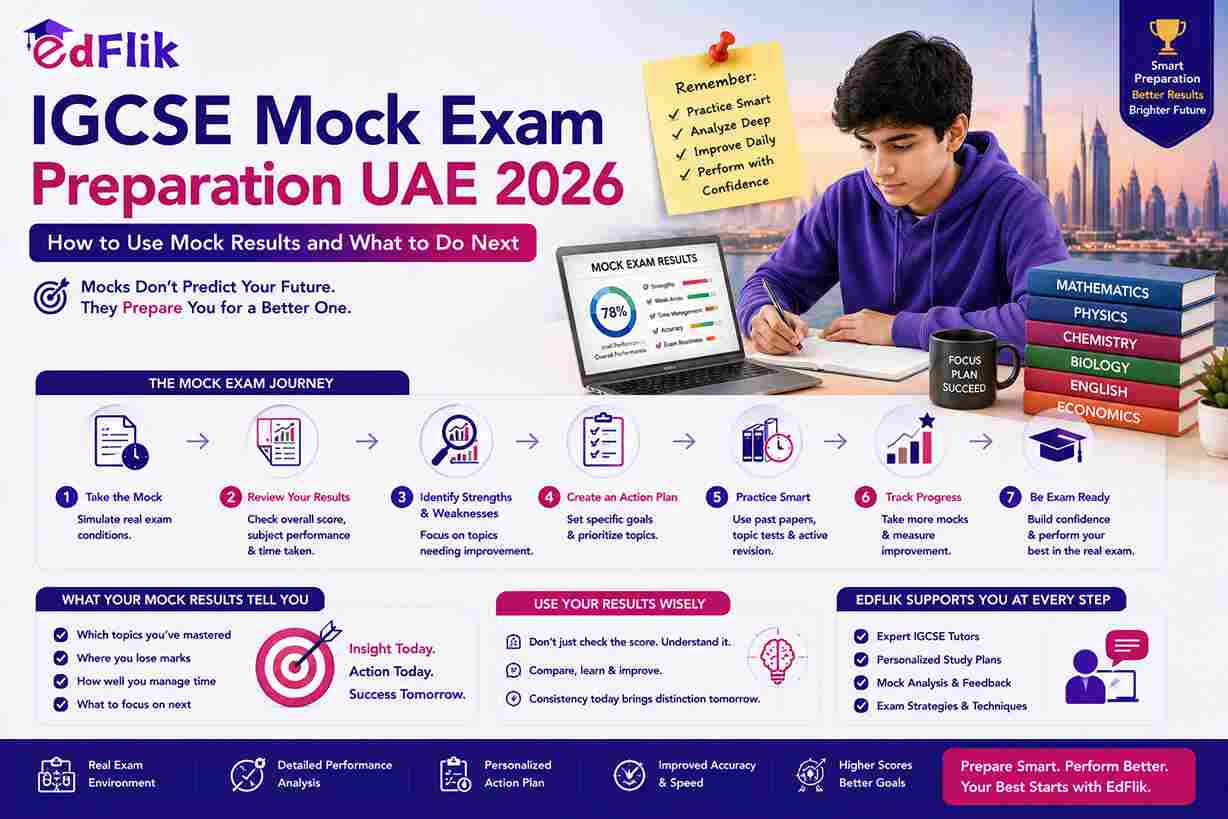
The most effective, proven strategy to eliminate exam-day anxiety and secure top grades ($8/9$ in IGCSEs or $38–45$ points in IB) is the strategic use of Diagnostic Mock Exams.
When taken early and analyzed line-by-line against official mark schemes, diagnostic mocks transform exam preparation from passive, reactive cramming into a structured, proactive system for academic success.
In this comprehensive guide, our expert academic advisors in Dubai break down the psychology of exam anxiety, explain why traditional revision fails, explore the mechanics of diagnostic mock testing, and provide a practical roadmap to help students and parents navigate mock exam seasons with confidence.
Part 1: The Anatomy of Last-Minute Exam Panic
Exam anxiety rarely stems from a lack of intelligence or effort. In high-achieving international school environments like Dubai, students often spend dozens of hours "studying." However, last-minute panic usually arises from three specific causes:
                     THE ROOT CAUSES OF EXAM PANIC
                                   |
      +----------------------------+----------------------------+
      |                            |                            |
 ILLUSION OF COMPETENCE      UNTESTED TIMING & STAMINA    UNKNOWN SYLLABUS GAPS
 Passive reading creates a    Students freeze when facing  Uncovering major topic
 false sense of mastery that  strict exam time limits and  weaknesses 48 hours before
 crumbles under exam conditions. lengthy multi-paper series. the paper creates panic.
- The "Illusion of Competence": Passively re-reading textbook chapters, reviewing pretty summary sheets, or watching revision videos creates a false sense of familiarity. When handed a blank exam script with an unfamiliar command word, the brain struggles to retrieve and construct the answer.
- Untested Exam Stamina & Timing: IB Higher Level (HL) papers and IGCSE multi-component science/math exams require sustained focus over several hours. Without prior practice under strict time constraints, students panic when they notice the clock running out with questions left unanswered.
- Late Discovery of Knowledge Gaps: Discovering that you don't truly understand Parametric Differentiation in IAL Math or Theme-Based Comparative Synthesis in IB History two days before the exam creates overwhelming anxiety that impairs memory retrieval across all subjects.
Part 2: What Is a "Diagnostic" Mock Exam?
A standard school mock exam tests what a student knows at a single point in time, often resulting in a letter grade and little actionable feedback.
In contrast, a Diagnostic Mock Exam treats the test as a precision diagnostic tool—much like a medical scan—designed to identify specific operational weaknesses before official marks are at stake.
                  STANDARD MOCKS vs. DIAGNOSTIC MOCKS
                                   |
        +--------------------------+--------------------------+
        |                                                     |
  STANDARD SCHOOL MOCKS                         DIAGNOSTIC MOCKS
  • Evaluates final score/grade                 • Audits error types (Knowledge vs. Time vs. Technique)
  • Teacher returns paper with a percent         • Line-by-line mark scheme breakdown with a tutor
  • Student files paper away and moves on        • Generates a targeted, topic-specific action plan
The 3 Dimensions Audited by a Diagnostic Mock:
- Content Knowledge Gaps: Exactly which syllabus sub-topics caused mark deductions? (e.g., Stomach enzyme pH curves vs. Villi structure adaptations in IGCSE Biology).
- Command Word & Exam Technique Errors: Did the student lose marks because they wrote a general descriptive summary when the question explicitly demanded Evaluation or Synthesis?
- Time Management & Stress Triggers: At what exact minute mark did performance drop? Which question structure caused the student to get stuck and lose momentum?
Part 3: How Diagnostic Mocks Prevent Last-Minute Exam Panic
Integrating structured diagnostic mocks into your revision schedule months before official examinations alters how your brain handles high-stakes testing:
            HOW DIAGNOSTIC MOCKS ELIMINATE EXAM ANXIETY
                                 |
  Desensitizes Stress Response  ---> Replaces fear of the unknown with familiar exam conditions
  Exposes Blind Spots Early     ---> Converts panic-inducing surprises into solvable revision tasks
  Builds Exam-Hall Stamina     ---> Trains pace and timing so the official exam feels natural
  Drives Targeted Revision     ---> Replaces overwhelmed, passive reading with structured active recall
1. Desensitizing the Brain to Exam Stress (Stress Inoculation)
Psychological research shows that exposure to simulated stressors in a safe environment reduces acute stress responses during real events. Sitting full-length diagnostic mocks under strict exam rules (no phones, timed conditions, silent environment) desensitizes the brain's "fight-or-flight" trigger. By test day, the exam hall feels routine rather than intimidating.
2. Replacing Ambiguity with Actionable Data
Panic thrives on ambiguity ("I don't know if I'm ready"). A diagnostic mock replaces vague fear with clear, actionable data ("I scored 82% overall, but I lost 8 marks on Unit 4 Differential Equations because I forgot to separate variables"). Having a clear list of specific topics to fix restores a sense of control.
3. Mastering the Mark Scheme Code
Exam boards like Cambridge, Pearson Edexcel, and IB use strict, criteria-based mark schemes. A student can have a strong grasp of physics concepts but still lose marks if they omit required keywords or fail to show intermediate calculation steps. Diagnostic mocks train students to write precisely what mark schemes reward.
Part 4: The Ideal Diagnostic Mock Timeline for Dubai Students
To eliminate last-minute cramming, students in Dubai should align their diagnostic mock schedule with the academic calendar:
                  THE OPTIMAL DIAGNOSTIC MOCK TIMELINE
                                   |
        +--------------------------+--------------------------+
        |                                                     |
  OCTOBER / NOVEMBER (Term 1)                   JANUARY / FEBRUARY (Term 2)
  • Baseline Diagnostic Mocks                  • Pre-Board Full-Length Mocks
  • Audits early Year 11/13 content             • Simulates full exam week timetable
  • Establishes baseline study plan             • Fine-tunes time management & technique
        |                                                     |
        +--------------------------+--------------------------+
                                   |
                          MARCH / APRIL (Term 3)
                          • Final Polishing Mocks & Past Papers
                          • Targeted repair of residual weaknesses
                          • Confident entry into May/June exams
Term 1 (October – November): The Baseline Diagnostic
- Goal: Sit full-length paper components covering Year 10/12 and early Year 11/13 content.
- Outcome: Identifies foundational gaps early, allowing months of calm, spaced repetition rather than late-night cramming.
Term 2 (January – February): Pre-Board Simulation
- Goal: Sit full-length mock series under strict school-simulated conditions across all registered subjects.
- Outcome: Tests stamina across back-to-back exam days and refines time allocation strategies for multi-part questions.
Term 3 (March – April): Targeted Revision & Final Polishing
- Goal: Complete timed past-paper papers focusing exclusively on lingering weak spots identified in previous diagnostics.
- Outcome: Consolidates confidence, sharpens mark-scheme keyword usage, and ensures peak performance for May/June exams.
Part 5: Top 4 Traps to Avoid During Mock Preparation
- Treating Mocks as " do-or-die " Final Judgments: Viewing a diagnostic mock score as an unchangeable grade rather than a temporary measurement designed to help you improve.
- Looking at the Score and Ignoring the Mark Scheme: Checking the total percentage score and filing the paper away without conducting a line-by-line post-mortem audit of every lost mark.
- Doing Mocks Open-Book: Completing mock papers with textbook notes open nearby. This preserves the "illusion of competence" and masks crucial knowledge gaps until the real exam.
- Re-studying Topics You Already Know: Spending hours revising comfortable, familiar topics because it feels rewarding, while avoiding challenging topics where diagnostic marks were lost.
Preparing for IGCSE or IB Diploma exams in Dubai and looking to eliminate exam anxiety? EdFlik connects international school students across Dubai, Abu Dhabi, and the GCC with expert, 1-to-1 online tutors specializing in diagnostic mock evaluations, past-paper mark scheme breakdowns, and personalized revision strategies. Book a Free Demo Class Today!
Frequently Asked Questions (FAQs)
Q1: How do diagnostic mocks differ from solving standard past papers at home?
Ans: Solving past papers at home often lacks strict timing, formal exam conditions, and objective marking. A diagnostic mock is conducted under strict exam constraints and is marked line-by-line against official mark schemes by an experienced tutor to produce an actionable diagnostic error report.
Q2: Should I wait until I finish revising the entire syllabus before taking a diagnostic mock?
Ans: No! Waiting until you feel "100% ready" means you may never take a mock paper. Taking diagnostic mocks on completed units early in the academic year uncovers learning gaps while you still have plenty of time to address them.
Q3: How many mock exams should an IGCSE or IB student complete before the official exams?
Ans: Students should aim to complete at least 2 to 3 full diagnostic mock series per subject prior to official exams: an early diagnostic in Term 1, a comprehensive mock in Term 2 (January/February), and timed past-paper practice sessions in the weeks leading up to exams.
Q4: How does EdFlik help IGCSE and IB students in Dubai with diagnostic mocks?
Ans: EdFlik connects students across Dubai and the UAE with expert 1-to-1 online tutors specializing in Cambridge IGCSE, Pearson Edexcel IAL, and IB DP curricula. Our tutors conduct detailed diagnostic mock evaluations, analyze mark-scheme alignment, repair core topic weaknesses, and build exam-hall confidence.