How to Write a Scoring AP History Document-Based Question (DBQ) Essay: Step-by-Step Breakdown
Last Updated: October 2026 | By EdFlik Education Team
For high school students enrolled in Advanced Placement history courses—whether tackling AP European History, AP US History (APUSH), or AP World History: Modern—the Document-Based Question (DBQ) is universally recognized as the ultimate test of historical writing proficiency. Worth a massive 25% of your total exam score, Section II Part A of the AP exam requires you to read, analyze, and synthesize 7 historical documents into a sophisticated, argumentative essay within a grueling 60-minute timeframe.
Many students struggle with the DBQ not because they lack historical knowledge, but because they treat the documents like a reading comprehension quiz rather than building blocks for an airtight historical argument.
In this comprehensive, masterclass guide, our expert AP history educators break down the official College Board rubric, provide a foolproof step-by-step writing framework, and share high-impact strategies to secure all 7 points.
Part 1: Decoding the Official AP History DBQ Rubric (7 Points Total)
Before putting pen to paper (or fingers to keyboard), you must understand exactly how College Board readers grade your essay. The 7-point rubric is structured as follows:
- Thesis / Claim (1 Point): Present a defensible thesis that establishes a nuanced line of reasoning.
- Contexturualization (1 Point): Describe a broader historical context relevant to the prompt (what was happening globally or regionally right before or during the era).
- Evidence from the Documents (3 Points possible):
- 1 Point: Accurately describe the content of at least 3 documents to address the prompt.
- 2 Points: Support an argument in response to the prompt using at least 6 documents.
- Evidence Beyond the Documents (1 Point): Provide an additional piece of specific historical evidence (a name, law, event, or movement) not found in the documents that relates to the prompt.
- Sourcing / Analysis (1 Point): Explain how or why the point of view, purpose, historical situation, or audience of at least 3 documents relevantly connects to your argument.
- Complexity / Nuance (1 Point): Demonstrate a complex understanding of the historical development by qualifying or modifying an argument, explaining multiple perspectives, or connecting disparate themes.
Part 2: The 15-Minute Reading and Planning Blueprint
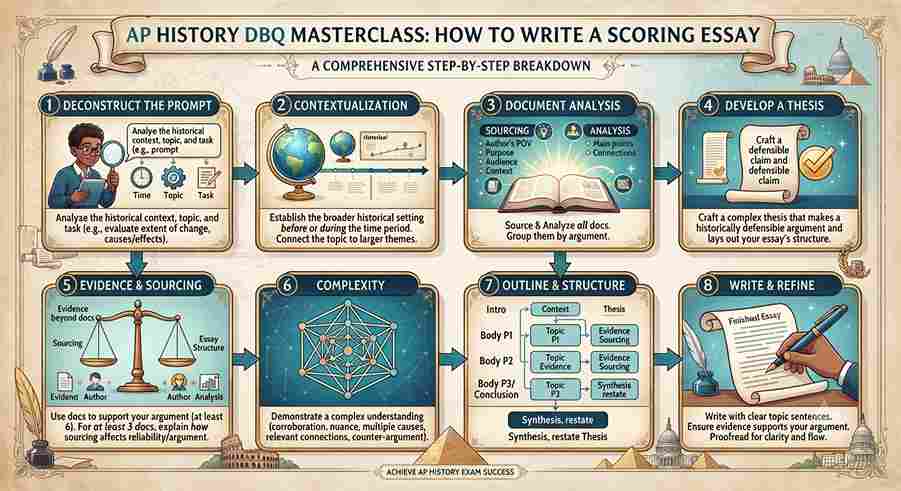
With only 60 minutes total for the DBQ, successful students strictly allocate their first 15 minutes to document analysis and essay outlining before beginning to write.
Step 1: Deconstruct the Prompt
Read the prompt twice. Identify the exact historical thinking skill being tested (e.g., causation, comparison, continuity and change over time) and establish the exact chronological boundaries.
Step 2: Rapid Document Triage (HIPPO Method)
As you read through the 7 documents, do not just summarize them. Annotate each document using the HIPPO acronym to prepare for your analysis point:
- Historical Situation (What was happening when this was created?)
- Intended Audience (Who was this written for?)
- Purpose (Why did the author create this?)
- Point of View (Who is the author, and how does their background bias their perspective?)
- Outside Connection (What outside historical fact does this remind you of?)
Part 3: Step-by-Step Writing Framework (45 Minutes)
Structure your essay into 4 distinct, cohesive paragraphs:
Paragraph 1: Introduction (Contextualization + Thesis)
- Sentence 1–3 (Contextualization): Paint a vivid historical picture of the broader era leading up to your prompt topic. (e.g., Before the outbreak of the French Revolution, the Estates-General operated under centuries of feudal inequality...).
- Sentence 4 (The Thesis): Deliver a clear, multi-pronged thesis statement that answers the prompt and outlines your categories of argument. Avoid generic statements; take a defensible stance.
Paragraph 2 & 3: Body Paragraphs (Evidence + Sourcing)
- Group your 6 to 7 documents logically into thematic buckets (e.g., economic motivations vs. political pressures).
- Integrate Documents Seamlessly: Never quote long blocks of text. Paraphrase or embed short, punchy phrases ("As merchant guild leader Jean Dubois argued in Doc 3...").
- Incorporate Sourcing (HIPPO): Immediately following or preceding document evidence, analyze why the document's perspective matters ("Because this decree was issued by the Committee of Public Safety during the Reign of Terror (Historical Situation), its primary purpose was to enforce ideological conformity rather than reflect general public sentiment...").
Paragraph 4: Conclusion & Complexity
- Restate your thesis in a fresh way (do not just copy-paste your intro).
- Secure Complexity: Throughout your essay, weave in qualifying statements ("While economic factors certainly accelerated industrialization, political stability played an equally decisive role...") or connect your topic to another historical period to lock in the elusive 7th complexity point.
Part 4: Top 4 Exam Traps That Cost Students DBQ Points
- The "Document Laundry List": Writing a summary of Document 1, then Document 2, then Document 3 without an overarching argument. The essay must be driven by your thesis, not by the order of the documents.
- Quoting Without Citing or Analyzing: Copying massive 3-sentence blocks from a source and failing to explain how it proves your argument. Always use parenthetical citations like
(Doc 4). - Forgetting Outside Evidence: Relying 100% on the provided documents. You must explicitly bring in at least one detailed historical fact, person, act, or treaty not mentioned in the texts.
- Weak Contextualization: Writing a single sentence of vague context ("Throughout history, people fought for freedom") instead of a substantive, 3-sentence setup directly relevant to the specific prompt era.
Preparing for AP Euro, APUSH, or AP World History exams? EdFlik connects international school students globally with expert, 1-to-1 online history tutors, helping you master DBQ writing frameworks, historical thinking skills, and past-paper rubrics to secure top score 5s.Book a Free Demo Class Today!
Frequently Asked Questions (FAQs)
Q1: What happens if I only use 5 documents instead of 6?
Ans: If you cite and describe only 5 documents accurately, you will earn the 1-point description score, but you will miss the 2nd evidence point which strictly requires using at least 6 documents to support an argument. Always aim to use all 7!
Q2: Do I need a formal conclusion paragraph on the AP DBQ?
Ans: While College Board does not officially award a standalone point for a conclusion, writing a brief concluding paragraph helps synthesize your argument and often pushes borderline essays into the scoring threshold by reinforcing your thesis and complexity.
Q3: How should I cite documents in my essay?
Ans: Simple parenthetical citations at the end of your sentence, such as (Doc 2), are standard, clean, and universally accepted by AP readers.
Q4: How does EdFlik support AP History students?
Ans: EdFlik connects international school students worldwide with vetted, expert 1-to-1 online tutors specializing in AP European History, AP US History, and AP World History. Our personalized coaching focuses on rubric mastery, document sourcing (HIPPO), timed essay drills, and historical argumentation.