IGCSE Business Studies Tutor UAE 2026 — Cambridge 0450 Evaluation Essays, Case Studies and Data Response
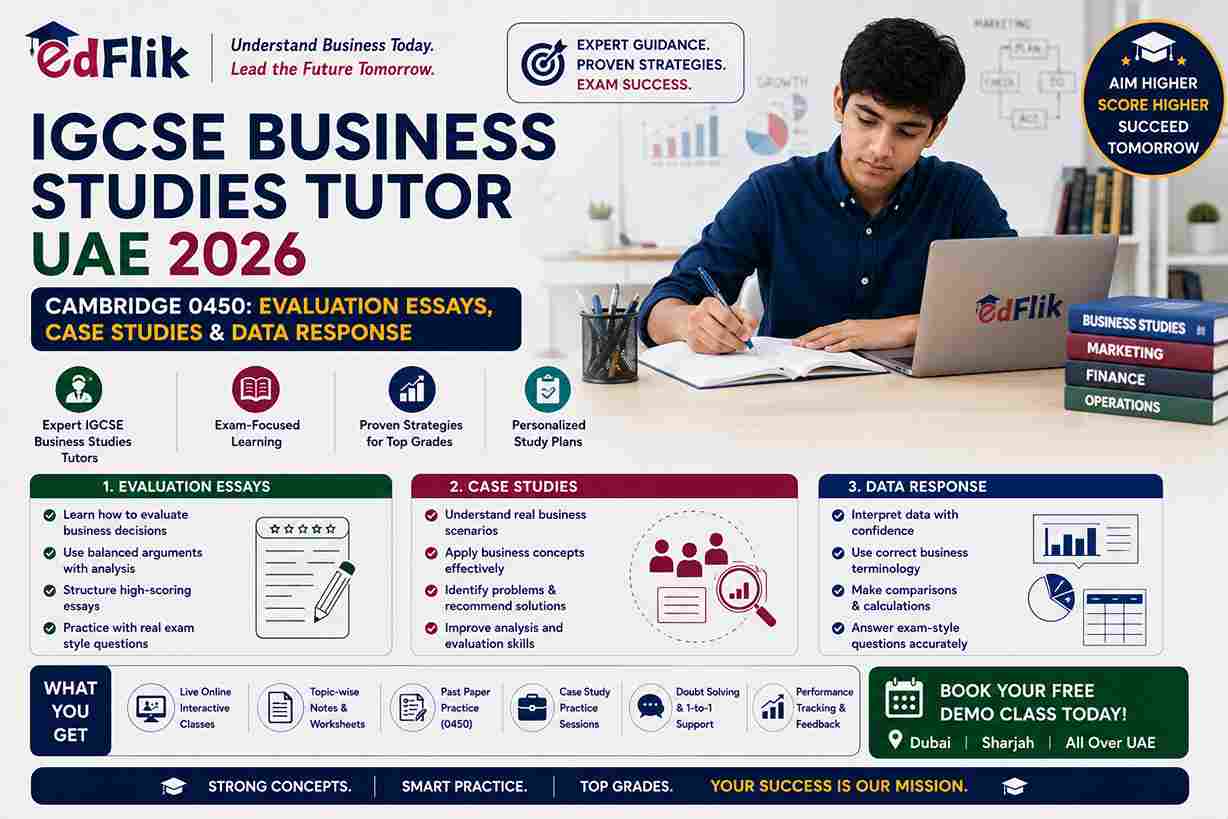
IGCSE Business Studies (Cambridge 0450) is one of the most widely taken optional IGCSE subjects at UAE British curriculum schools — and consistently one of the lowest-graded, because the evaluation essay format is harder than it looks. Most students who score C and D in Business Studies have adequate content knowledge but have not been taught the specific four-part evaluation structure that 12-mark questions require. This guide covers the paper structure, the evaluation essay framework, case study technique, and the financial calculations that are most consistently tested.
IGCSE Business Studies Paper Structure — Cambridge 0450
|
Paper |
Format |
Duration |
% of Grade |
Key Feature |
|
Paper 1 |
Short answer
and structured questions based on a pre-released case study |
1 hour 30
minutes |
50% |
Pre-released
case study can be studied in advance — application to specific business earns
marks |
|
Paper 2 |
Case study
data response with short answer and 12-mark evaluation questions |
1 hour 30
minutes |
50% |
12-mark
evaluation questions determine the grade boundary between A* and A |
|
The
pre-released case study for Paper 1 is released approximately 4-6 weeks
before the examination. Students who know the business thoroughly — its type,
size, market, challenges, and relevant Business Studies concepts —
consistently earn higher application marks than students who treat it as an
unseen text. This is the most frequently missed advantage in IGCSE Business
Studies preparation. |
The 12-Mark Evaluation Essay — The Most Important IGCSE Business Skill
The 12-mark evaluation question in Paper 2 determines grade boundaries more than any other question type. The four-part structure that earns full marks:
|
Part |
What It
Requires |
Typical
Length |
Marks
Available |
|
1. Definition
/ explanation |
Define or
explain the key business concept being asked about in 2-3 accurate sentences |
2-3 sentences |
2-3 marks |
|
2. Application |
Apply the
concept to the specific business in the question — use the case study
context, not generic examples |
2-3 sentences |
2-3 marks |
|
3. Two-sided
analysis |
Present
arguments FOR and arguments AGAINST — advantages and disadvantages; or
benefits and risks; or reasons for and reasons against |
One paragraph
each side, 3-4 sentences each |
4-5 marks |
|
4. Evaluation
/ Conclusion |
State which
side of the argument is stronger FOR THIS SPECIFIC BUSINESS and why — the
conclusion must be justified by the context, not just repeat the analysis |
2-3 sentences |
2-3 marks |
The most common UAE student error: writing only one side of the argument and then writing "In conclusion, this is a good idea." A one-sided answer — no matter how detailed — earns a maximum of 8 marks out of 12. The evaluation marks (the last 2-3 marks) are only accessible when the response demonstrates genuine two-sided reasoning before the conclusion.
The Six IGCSE Business Studies Topic Areas
|
Topic Area |
Key Concepts |
Most
Frequently Examined |
|
Business and
its environment |
Business
objectives, sole trader/partnership/limited company/franchise, stakeholders,
business growth methods |
Business
ownership comparison (12-mark); objectives and stakeholder conflicts |
|
People in
business |
Motivation
theories (Maslow, Herzberg, Taylor), organisational structure, recruitment
and training methods, leadership styles |
Motivation
methods and theories (12-mark comparison); delegation and communication |
|
Marketing |
4Ps (Product,
Price, Place, Promotion), market research methods, pricing strategies,
product life cycle |
Marketing mix
decisions (12-mark); pricing strategy justification |
|
Operations
management |
Production
methods (job, batch, flow, cell), lean production, quality methods, capacity
utilisation |
Production
method comparison (12-mark); quality control vs quality assurance |
|
Finance |
Income
statements, balance sheets, break-even analysis, cash flow, sources of
finance |
Break-even
calculation and interpretation; sources of finance (12-mark) |
|
External
influences |
Economic
environment (recession, growth), government influence, environmental and
ethical issues |
Government
policy effects on business; CSR discussion (12-mark) |
Financial Calculations — Break-Even Analysis
Break-even calculations appear consistently in Paper 2 and must be answered precisely. Key formulae:
• Break-even output = Fixed Costs ÷ Contribution per unit. Where Contribution per unit = Selling price per unit – Variable cost per unit.
• Margin of safety = Actual output – Break-even output. (May be asked as units or as a percentage)
• Total revenue at a given output = Selling price × Output level
• Profit or loss at a given output = Total Revenue – Total Costs. Where Total Costs = Fixed Costs + (Variable cost per unit × Output)
Break-even questions in IGCSE Business frequently also ask for interpretation: what does the margin of safety show, how would a change in fixed costs affect the break-even point, what happens to break-even if the selling price increases. These interpretation marks are separate from the calculation marks and require written explanation in business context.
|
EdFlik IGCSE
Business Studies tutors are Cambridge 0450 specialists. Sessions target
12-mark evaluation essay structure, case study application technique, and
financial calculations. From AED 60 per session. Free diagnostic trial. Book
at www.edflik.com or WhatsApp +91 88788 96600. |
Frequently Asked Questions
Q: Is IGCSE Business Studies a good subject to take in UAE?
Yes — excellent preparation for A-Level Business, Economics, and university programmes in Business and Management. The evaluation essay format develops analytical skills that transfer broadly. Often underestimated in difficulty.
Q: What are the 12-mark evaluation questions in IGCSE Business Studies?
Four parts: (1) define/explain the concept; (2) apply to the specific business; (3) two-sided analysis (advantages and disadvantages or for and against); (4) justified conclusion for this specific business. A one-sided argument earns maximum 8 marks regardless of quality.
Q: What does IGCSE Business Studies cover?
Six topic areas: Business and its environment, People in business, Marketing, Operations management, Finance, and External influences — each providing content for the case study analysis questions in both papers.
Q: How are IGCSE Business Studies papers structured?
Paper 1 (50%): structured questions based on a pre-released case study. Paper 2 (50%): case study data response with short answer and 12-mark evaluation questions. Both papers are 1 hour 30 minutes.
Q: What is the pre-released case study in IGCSE Business Studies Paper 1?
Released 4-6 weeks before the exam — a specific business that Paper 1 questions are based on. Students who study it thoroughly and apply all six topic areas to it earn higher application marks than those who treat it as unseen.