IB Internal Assessment UAE 2026 — Complete Cross-Subject IA Guide for All Six Groups
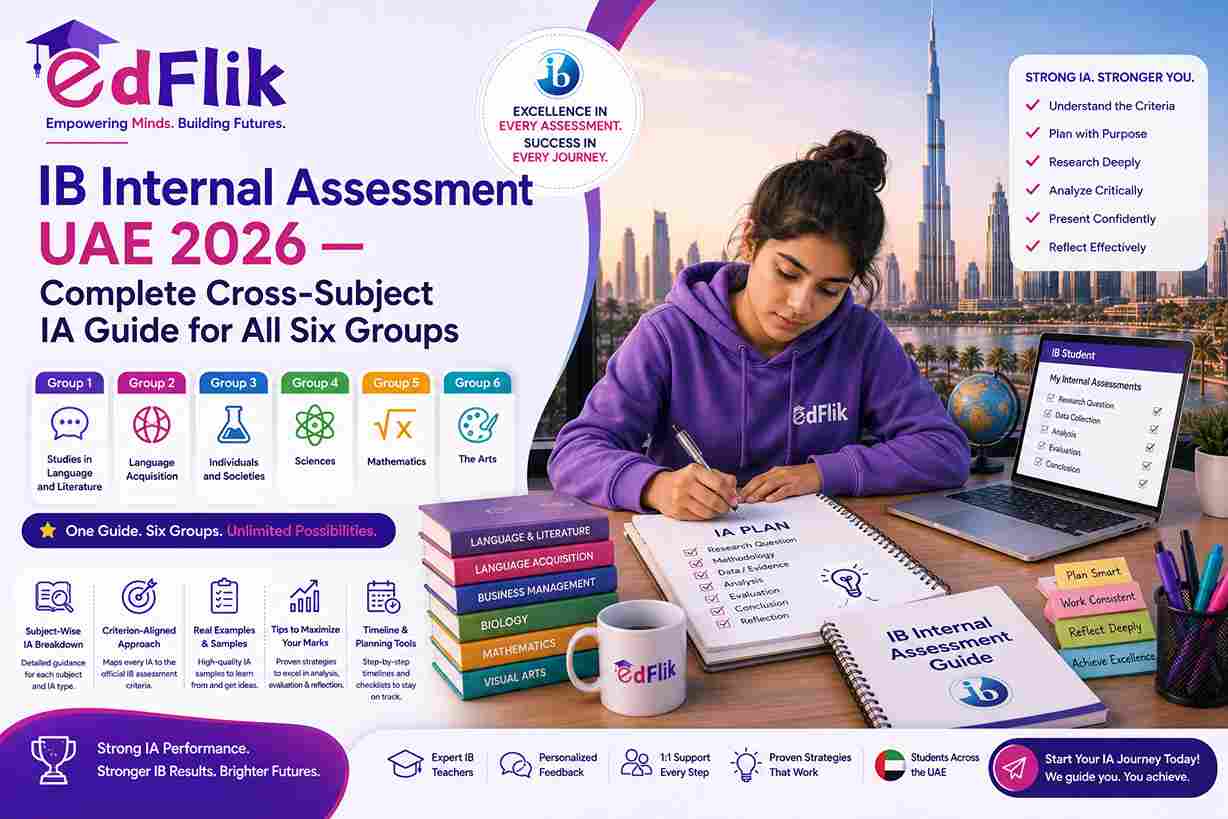
The IB Internal Assessment is the most consequential piece of work IB Diploma students complete outside of the May examinations — and the most commonly underestimated. While most families focus on IA marks as a supplement to examination marks, the reality is different: with IAs counting for 20-25% of each subject grade, a weak IA profile can cost a student 3-5 Diploma points before a single examination paper has been sat. This guide covers every subject group's IA requirements, the most consistently penalised errors, and what permitted tutoring support looks like.
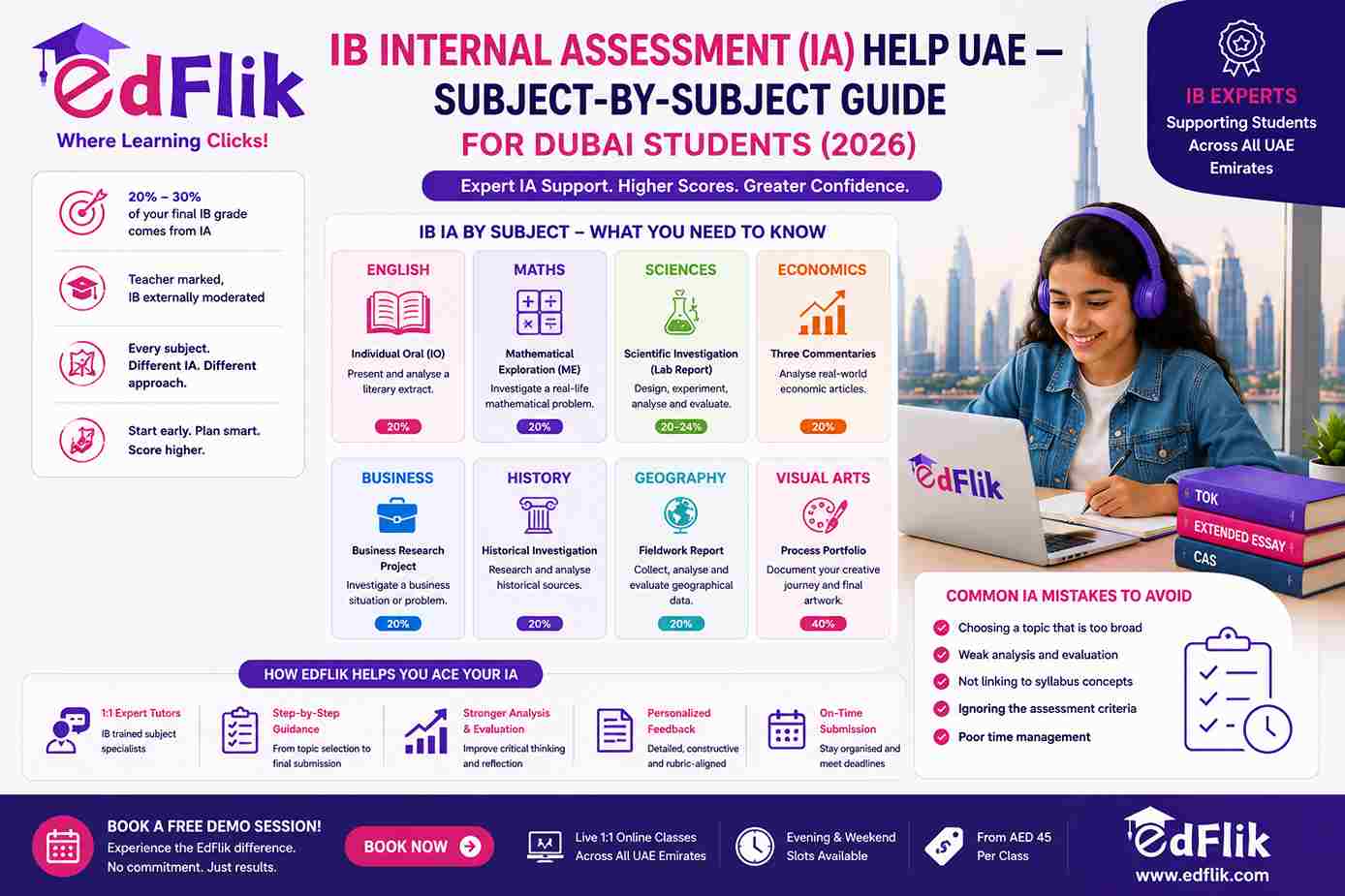
IB IA by Subject Group — What Each Requires
|
Subject Group |
IA Title |
Word Count /
Length |
Weight |
What External
Moderators Look For |
|
Group 1 —
Language A (English Literature, English Language and Literature) |
Individual
Oral (recorded) + Written Assignment |
IO: 10-15 min
recording; WA: 1,200-1,500 words |
30% combined |
IO: ability to
develop an independent, interpretive argument linking a literary and
non-literary text to a global issue; WA: formal academic register, close
textual analysis |
|
Group 2 —
Language B (French, Spanish, Arabic B) |
Individual
Oral |
12-15 minutes
recorded |
25% |
Vocabulary
range and accuracy; ability to discuss the visual stimulus; interactive
communication skills; HL: ability to discuss the literary work convincingly |
|
Group 3 —
History |
Historical
Investigation |
2,000-2,200
words |
25% |
Focused
research question with historical significance; use of at least one primary
source with OPCVL analysis; evidence-based argument; proper citation |
|
Group 3 —
Economics |
Portfolio of
Three Commentaries |
2,250 words
total (750 each) |
20% |
Each
commentary: a real article from the past 3 years, analysis using appropriate
IB Economics concepts, one diagram per commentary, clear link between article
and economic theory |
|
Group 4 —
Biology, Chemistry, Physics |
Individual
Investigation |
6-12 pages
(approximately 3,000 words) |
20% |
Focused
research question; clear independent, dependent, controlled variables;
personal engagement with the investigation design; correct data processing
with uncertainty; meaningful evaluation and reflection |
|
Group 5 —
Mathematics AA or AI |
Mathematical
Exploration |
12-20 pages |
20% |
Personal
mathematical interest evident; mathematical communication and notation
correct; development beyond basic syllabus (extension or application);
reflection on what was learned |
|
Group 6 —
Visual Arts, Theatre, Film, Music, Dance |
Varies by
subject — portfolio or process work |
Varies
significantly by subject |
40% (Visual
Arts) to 30% |
Evidence of
creative and critical thinking; process documentation; technical skill;
personal voice and reflection |
The Sciences IA — The Most Mark-Sensitive Assessment
Research Question: The Foundation of Everything
The IB Sciences IA Research Question (RQ) must be independently designed and specific enough to be falsifiable in a single investigation. The most common RQ error:
• Too broad: "How does pH affect enzyme activity?" (dozens of possible experiments)
• Appropriately specific: "How does pH (3, 5, 7, 9, 11) affect the rate of hydrogen peroxide decomposition by catalase from potato extract, measured by oxygen gas volume produced in 60 seconds?"
The difference is complete specification of: the independent variable (pH, five levels), the dependent variable (oxygen volume in 60 seconds), the enzyme system (catalase from potato extract), and the substrate (hydrogen peroxide). This level of specificity enables the investigation to be assessed against the Criterion A (Personal Engagement) — a moderator must be able to see that the RQ is the student's own, not a standard school practical.
Personal Engagement — The Most Commonly Lost Criterion
IB Sciences IA Criterion A (Personal Engagement) requires evidence that the student has taken personal ownership of the investigation. This does not mean a personal story in the introduction — it means the RQ itself, the experimental design choices, and the exploration demonstrate the student's own curiosity and decision-making. A standard textbook enzyme practical submitted as a student IA will score 0 in Personal Engagement regardless of how well the rest is executed.
The Maths Exploration — What Earns Marks in the Top Band
The most common Maths IA error: presenting a problem, solving it using standard techniques, and concluding that the answer is X. This earns marks in Communication and Mathematical Presentation but not in Personal Engagement or Reflection. Top-band Maths IAs do something beyond what the syllabus requires: model a real-world phenomenon using appropriate mathematics, investigate a conjectured pattern, or extend a known result to a new domain. The best UAE student Maths IAs are investigations with a genuine question that the student pursues — not a known result that the student demonstrates.
|
IB Academic
Integrity Policy — what tutors can and cannot do: Permitted: explaining IA
criteria and what each level requires; reviewing the student's own draft and
providing written feedback; discussing data analysis methods the student then
applies; explaining how the OPCVL framework works for History IA. Not
permitted: writing any section of the IA; providing the research question the
student adopts; editing to the point of changing the student's own voice. All
EdFlik IA support is within these guidelines. |
|
EdFlik
provides IB IA guidance within IB Academic Integrity guidelines — research
question development sessions, criteria explanation, draft feedback, data
analysis method coaching, and Maths Exploration direction. Available for all
six subject groups and all six IB IA types. From AED 70 per session. Free
diagnostic. Book at www.edflik.com or WhatsApp +91 88788 96600. |
Frequently Asked Questions
Q: What is the IB Internal Assessment and how much does it count?
School-assessed work moderated by external IB examiners. Counts 20-25% per subject depending on the subject. Collectively, IAs can influence the total Diploma score by 3-8 points — more than underperforming in a single exam paper. Submitted to IB in April for the May series.
Q: When are IB Internal Assessments due?
Most UAE school IA deadlines fall in October-January of IB Year 2. Sciences typically October-November; Maths, History, and Humanities November-December; Language B IO organised throughout. Many students underestimate how early IAs are due — not at year end, but in Term 1 of Year 2.
Q: What are the IB IA requirements for each subject group?
Group 1: Individual Oral + Written Assignment. Group 2: Individual Oral. Group 3: Historical Investigation (History, 2,200 words) or Portfolio of Three Commentaries (Economics). Group 4: Individual Investigation. Group 5: Mathematical Exploration. Group 6: Portfolio or process work. Weight ranges from 20% to 40% of subject grade.
Q: What are the most common IB IA mistakes UAE students make?
Sciences: RQ too broad (missing variable specification) and no evidence of personal engagement (standard school practicals submitted as student investigations). Maths: no mathematical extension beyond known results. History: no primary source with OPCVL analysis. Economics: article older than 3 years or no diagram.
Q: Can UAE students get tutoring help with IB Internal Assessments?
Yes, within IB Academic Integrity guidelines. Permitted: criteria explanation, draft feedback, content knowledge explanation, data analysis coaching. Not permitted: writing any part, providing the RQ, excessive editing that changes student voice. EdFlik IA support operates within these guidelines.