IGCSE Physics Past Paper Technique UAE 2026 — Cambridge 0625 Cause-Effect Chains, Paper 6 and Scoring A*
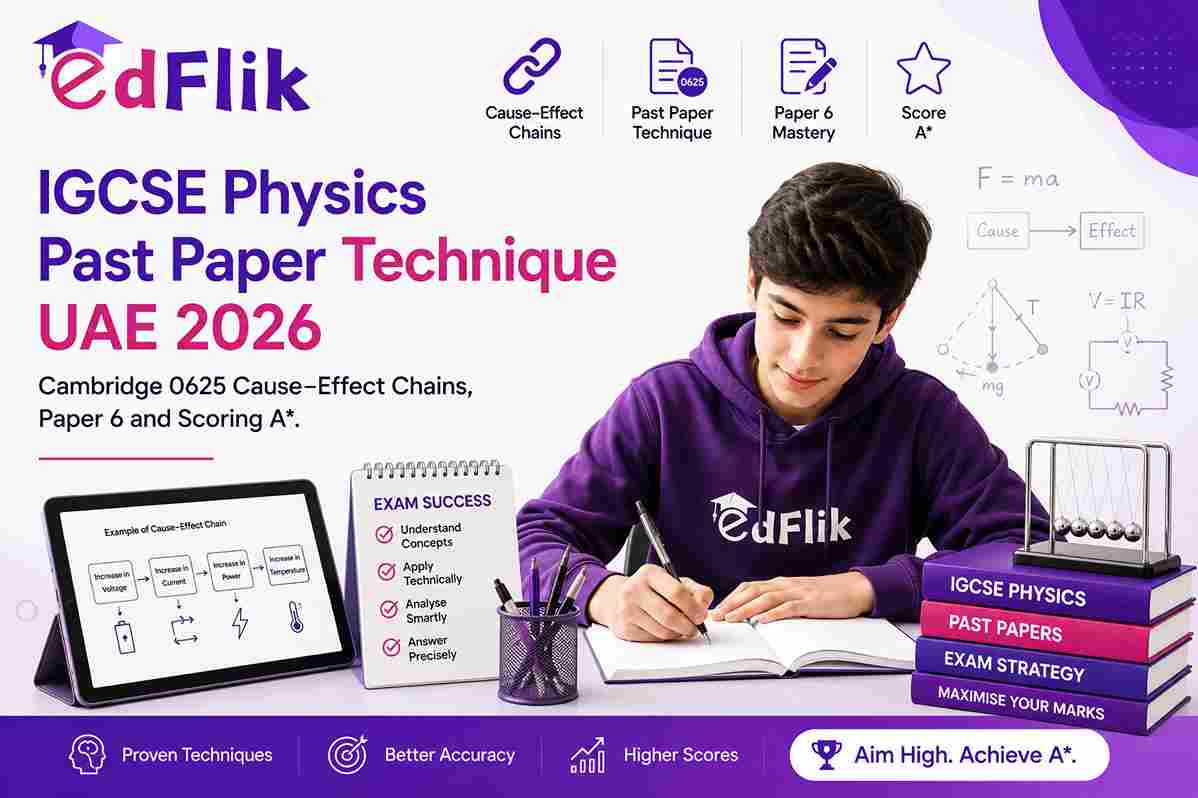
IGCSE Physics (Cambridge 0625) is the second most tutored IGCSE science subject in UAE after Maths. Most students who score B and C in Physics understand the physics conceptually — they fail to earn full marks because of technique errors, not knowledge gaps. The cause-effect chain framework for explain questions, the precise language required for Paper 6 practical descriptions, and the calculator technique for multi-step Physics calculations are all learnable, teachable techniques. This guide covers all three.
Cambridge 0625 Paper Structure
|
Paper |
Format |
Duration |
% of Grade |
Key Focus |
|
Paper 1 |
40 MCQ — Core
and Extended content |
45 minutes |
30% |
Conceptual
knowledge; common misconceptions tested |
|
Paper 2 |
Extended
structured questions — calculation and explanation |
1 hour 15
minutes |
50% |
Cause-effect
chains; formula application; graph interpretation |
|
Paper 6 |
Alternative to
Practical — experimental planning and analysis |
1 hour |
20% |
Planning;
variable identification; graph drawing; evaluation |
The Cause-Effect Chain — The Single Most Important IGCSE Physics Technique
Explain questions in Paper 2 (and some Paper 1 questions) award marks for each correctly linked step in a physical process. The mark scheme lists individual marks for each step in the chain — stopping the explanation before all steps are listed stops the marks.
|
Explain
Question Example |
Incomplete
(loses marks) |
Complete
cause-effect chain (earns all marks) |
|
Explain why a
copper wire has lower resistance than an iron wire of the same dimensions. |
Copper is a
better conductor than iron. |
Copper has
more free electrons per unit volume than iron. These free electrons drift
more easily through the copper lattice under the same potential difference.
More charge flows per unit time, so the current is higher. Since resistance =
V/I, the resistance is lower. |
|
Explain why
the gas pressure increases when a container is heated at constant volume. |
The molecules
move faster, so they hit the walls more often. |
Heating the
gas increases the average kinetic energy of the molecules. The molecules move
faster and collide with the walls of the container more frequently. Each
collision transfers more momentum to the wall. The force exerted per unit
area on the wall increases, so the pressure increases. |
|
Explain why a
solenoid acts as a magnet when current flows through it. |
The current
creates a magnetic field. |
When current
flows through each turn of wire in the solenoid, a circular magnetic field is
created around each wire. These individual fields combine to produce a
uniform magnetic field along the length of the solenoid, with a north pole at
one end and a south pole at the other, behaving like a bar magnet. |
High-Frequency Topics by Paper 2 Appearance
Electricity and Magnetism — Appears in Every Paper
Circuit calculations require: V = IR (Ohm's Law); P = IV, P = I²R, P = V²/R (power); total resistance in series R_T = R₁ + R₂ + R₃; total resistance in parallel 1/R_T = 1/R₁ + 1/R₂ + 1/R₃. Common error: reversing the series and parallel formulae. UAF students frequently lose the 4-5 mark multi-step circuit question by applying the series formula to a parallel section of the circuit. Draw and label the circuit before calculating.
Forces and Motion — Speed-Time Graphs
Speed-time graphs appear in every Paper 2. Required skills: gradient of a line = acceleration (or deceleration); area under a line = distance travelled; horizontal line = constant speed (zero acceleration); line through origin with positive gradient = uniform acceleration from rest. Most UAE students draw and interpret these correctly but lose marks by not using correct SI units or by misidentifying the area as the gradient.
Waves — Frequency, Wavelength, and Wave Speed
Wave equation: v = fλ where v is wave speed (m/s), f is frequency (Hz), λ is wavelength (m). Common UAE error: mixing up frequency and period (T = 1/f — period is the inverse of frequency). Electromagnetic spectrum questions require knowing the order of the spectrum from lowest to highest frequency (radio waves → microwaves → infrared → visible → UV → X-rays → gamma rays) and knowing typical frequencies and wavelengths for each type.
Thermal Physics — Specific Heat Capacity
Specific heat capacity calculation: Q = mcΔθ where Q is heat energy (J), m is mass (kg), c is specific heat capacity (J/kg°C), and Δθ is the temperature change (°C). Common UAE error: using the wrong formula by confusing SHC with specific latent heat (Q = mL for phase changes, where L is the specific latent heat). Knowing WHEN to use each formula (change of temperature vs change of state) is a common Paper 1 discriminator.
Paper 6 — Alternative to Practical Technique
Paper 6 tests experimental reasoning without actual laboratory work. Five question types appear consistently:
• Identifying variables: independent variable (what you change), dependent variable (what you measure), control variables (what you keep the same). Name specific variables — not generic terms like "conditions"
• Describing measurement method: state the specific instrument used with its measurement range and precision; describe how measurements are taken step by step; state how readings are repeated to improve reliability
• Drawing and interpreting graphs: labelled axes with quantity and unit (e.g. "Current, I/A"); best-fit line (straight or curve as appropriate); gradient calculation showing triangle with coordinates used; y-intercept identification
• Identifying anomalous results: an anomalous result is one that does not fit the pattern of other results — state which point is anomalous and what it implies (re-measuring that point reduces uncertainty)
• Evaluating limitations and improvements: state ONE specific limitation of the method (not "human error") and ONE specific improvement — e.g. "The ruler is only accurate to ±1 mm, so measuring a longer distance would reduce the percentage uncertainty. The student could use a longer run distance of 2 m instead of 0.5 m."
|
EdFlik IGCSE
Physics tutors are Cambridge 0625 specialists. Sessions target cause-effect
chain technique, Paper 2 formula application, and Paper 6 experimental
reasoning — using official Cambridge past papers and mark schemes. From AED
60 per session. Free diagnostic trial. Book at www.edflik.com or WhatsApp +91
88788 96600. |
Frequently Asked Questions
Q: What is the most commonly failed IGCSE Physics technique?
Incomplete cause-effect chains in explain questions. The mark scheme awards one mark per correctly linked step — stopping the chain halfway stops the marks, even when the beginning is correct.
Q: What topics appear most frequently in IGCSE Physics 0625 past papers?
Electricity and magnetism (circuits, V=IR, power), waves (reflection, refraction, EM spectrum), forces and motion (speed-time graphs, Newton's laws), thermal physics (SHC calculations), and atomic physics (radioactive decay, half-life).
Q: How does Cambridge IGCSE Physics Paper 6 work?
A 1-hour written paper (20% of grade) testing practical knowledge through planning, variable identification, graph work, anomalous result identification, and experimental limitation evaluation — without actual laboratory work.
Q: What is the difference between IGCSE Physics Core and Extended?
Core (Papers 1, 3, 6) allows grades C-G. Extended (Papers 1, 2, 6) allows A*-E and covers additional content. Most UAE private school students sit Extended.
Q: How should UAE students use IGCSE Physics past papers?
Complete Papers 2 and 6 together, timed, on the same day. Mark using the official Cambridge mark scheme. Categorise every lost mark by type (cause-effect chain, formula, graph, Paper 6 planning) and address each type systematically.