IGCSE Exam Timetable: Planning Revision Across All Subjects
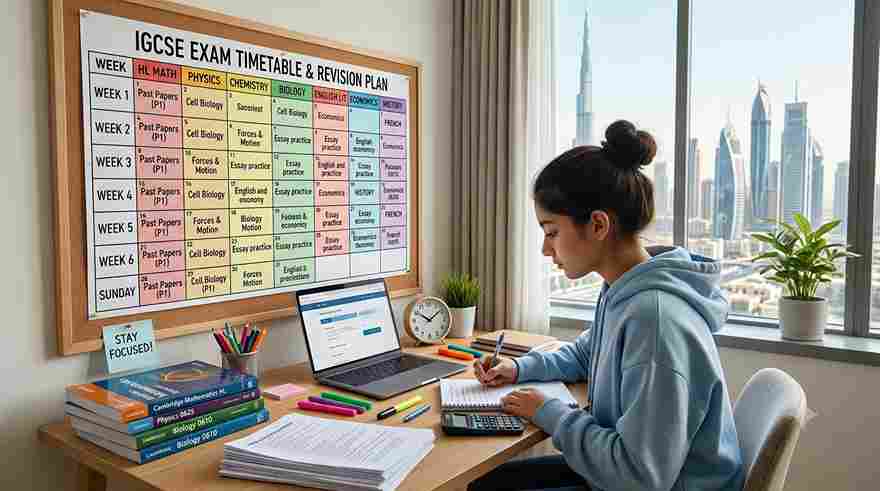
Most IGCSE students sit several subjects in the same exam season. Maths, English, Science, a language and a humanities subject can all be on the calendar within a few weeks. Each one needs attention, and it is easy for one subject to take over while the others slip. A well-planned exam timetable solves this problem. It gives every subject its place, leaves room for past papers and protects time for rest. This guide shows UAE parents and students how to build one step by step.
Why one timetable for all subjects matters
When each subject is planned separately, the total workload is hard to see. A student may spend every evening on maths, then discover with a week to go that their history notes are incomplete. A single timetable lets you see the whole picture at once. You can check how many blocks each subject has, whether the hardest subjects get enough time and where the busy days are.
A shared timetable also helps families. Parents can see when support is needed, siblings can plan around exam days, and the student has one clear reference point rather than a pile of separate lists.
Step one: gather the exam dates and school deadlines
Begin with the facts. Write down each subject, the paper dates and any coursework or internal deadlines that your child's school has set. Exam dates and paper structures can change, so check the official provider's current dates and the current official syllabus or specification for each subject. Your child's school can confirm what applies to them.
Once you have the dates, mark them on a calendar. Look for clusters, where two or three exams fall close together. These weeks need the most careful planning, because there will be less time to revise between papers.
Step two: count the weeks and the blocks
Next, count how many weeks are available before the first exam. Then decide how many study blocks your child can manage each week. A realistic plan for most students is four to six blocks on weekdays, plus one or two longer sessions at the weekend. Each block should last about 45 to 60 minutes, with short breaks in between.
Multiply the blocks by the weeks to find the total available time. Then divide that time across the subjects, giving more blocks to subjects with more papers, lower confidence or heavier content. Keep a small reserve, perhaps one block a week, for catching up when plans change.
Step three: give each subject a clear weekly purpose
Each subject should have a job in the weekly plan. A subject might need new content learned in one block, practice questions in another and a past paper every second week. Writing this purpose down helps a student know what to do in each block, rather than sitting down and wondering where to start.
For example, a student might spend Monday on Biology notes, Tuesday on Maths practice questions, Wednesday on English reading, Thursday on a History source analysis and Saturday on a timed past paper. The exact pattern matters less than the consistency. Students usually find that a regular rhythm reduces stress.
Step four: schedule past papers and review days
Past papers are a core part of IGCSE revision, because they show the style of questions and help with timing. Check the official materials for the years available, and ask teachers which papers they recommend. Schedule past papers at regular intervals. Early in the plan, a student might answer single questions. Later, they should attempt full timed papers, followed by careful marking and review.
Review is where progress happens. After each paper, ask your child to list the questions they lost marks on, and note the reason for each mistake. Did they misread the question, lack a key fact or run out of time? These notes can then guide the next week's blocks.
Step five: build in rest and buffer days
Rest is not wasted time. Students who sleep well, eat regular meals and take breaks tend to focus better. Keep one fully free half-day each week, and avoid heavy revision on the evening before an exam. A buffer day, or a lighter week in the middle of the plan, gives room to catch up if something goes wrong, such as an illness or a school event.
It also helps to talk about how your child feels during revision. Stress is normal, but persistent worry or trouble sleeping may need attention from a teacher, a family doctor or a counsellor at school.
Common problems and how to solve them
Some problems come up in almost every family. The first is a timetable that is too ambitious. If your child misses most of the blocks in the first week, the plan is probably too full. Cut back the number of tasks and rebuild the plan from what is realistic. A smaller plan that gets completed is far better than a large one that gets abandoned.
The second is one subject that keeps slipping. If Maths keeps moving to the next week, look at the reason. Is it too hard, or is it simply placed at the end of the day, when your child is tired? Move it earlier, shorten the task or ask for help with the specific topic.
The third is a student who stays on one subject they enjoy. Gentle reminders help, but so does a visible plan. A printed weekly page on the wall can make the whole picture clear.
A practical checklist for parents and students
- Confirm exam dates and school deadlines with official sources and the school
- List every subject and the number of papers for each
- Count the weeks and the available study blocks before dividing time
- Give each subject a clear purpose in the weekly plan
- Schedule past papers at regular intervals, with time for review
- Keep one free half-day each week and a light evening before each exam
- Review the timetable together each week and adjust it honestly
How EdFlik can help
EdFlik offers live, one-to-one online classes for students aged 3 to 18. Each class lasts about one hour, so a tutor can help your child work through a difficult topic, mark a past paper and set the goals for the week ahead. Classes start from AED 45 per class, and you can book a free trial class to see how the sessions feel.
If your child needs support in one or two subjects, ask whether the tutor teaches that IGCSE course before you book. You can also ask which resources they use for past papers and feedback. Many families start with a trial in the subject that needs the most help, then add others as the plan develops. To book a free trial class, visit www.edflik.com, or email support@edflik.com with your questions.
Conclusion
An IGCSE exam timetable across all subjects gives your child a clear route through a busy season. Start with the dates, count the available time, give each subject a purpose and build in past papers, review and rest. Review the plan together each week, and adjust it when life changes. With a steady plan and encouragement, your child can face the exams feeling organised and prepared.
Frequently Asked Questions
How early should IGCSE revision start?
The right start point depends on the number of subjects, the exam dates and how much revision has already happened. Many students begin a structured plan several weeks before their first paper. Check the official exam dates and talk to your child's teachers about their advice.
How many hours a week should IGCSE students revise?
There is no single figure that suits every student. Many plans use four to six weekday blocks of 45 to 60 minutes, plus one or two weekend sessions. Choose an amount your child can keep up with consistently while still getting enough sleep and rest.
How do you fit several IGCSE subjects into one timetable?
List each subject with its number of papers, then give more blocks to the subjects that need the most work. Give every subject a clear weekly purpose, such as new content, practice questions or a past paper. Keep one buffer block each week for catching up.
Should students revise the hardest subject first?
Not always. Some students find it helpful to tackle the hardest subject while their energy is highest, but others need an early win to build momentum. Try both approaches for a week and see which one leads to more completed blocks.
What should parents check on a revision timetable?
Look at whether the plan is realistic, whether every subject has time, whether past papers are scheduled and whether rest is included. Ask your child which blocks were completed and where they felt stuck. A short weekly review is more useful than a single check at the end.
More on IGCSE & GCSE
- IGCSE in the UAE: A Complete Guide to Boards, Subjects, Exams and Revision
- IGCSE Online Tutoring for All Subjects (2026 Parent Guide)
- IGCSE Revision Timetable UAE 2026 — Free Weekly Template for Cambridge & Edexcel
- IGCSE Tutor UAE 2026 — Cambridge & Edexcel Specialists Across All Seven Emirates
- All IGCSE & GCSE articles