IGCSE Functions: Function Notation, Composite and Inverse Functions
Last updated: November 2026 | By EdFlik Education Team
Function questions look intimidating because of the notation, but each one is a short algebra task. This guide explains what the symbols mean and works through each type.
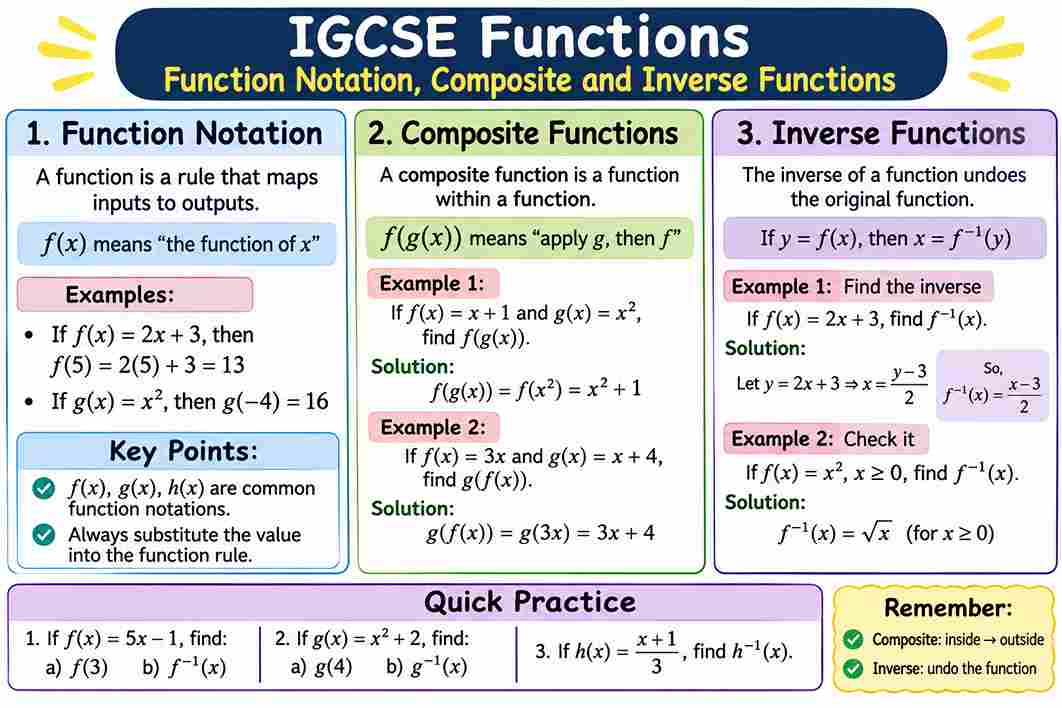
What function notation means
f(x) = 2x + 3 means "the function f takes an input x, doubles it and adds 3". f(4) means replace x with 4.
Worked example 1
f(x) = 2x + 3. Find f(4) and the value of x when f(x) = 11.
- f(4) = 2(4) + 3 =11.
- Solve 2x + 3 = 11: 2x = 8, sox = 4.
Composite functions
fg(x) means "do g first, then f". Work from the inside out. fg(x) and gf(x) are usually different.
Worked example 2
f(x) = 3x − 1 and g(x) = x + 5. Find fg(2) and gf(2).
- g(2) = 7, so fg(2) = f(7) = 3(7) − 1 =20.
- f(2) = 5, so gf(2) = g(5) = 5 + 5 =10.
Worked example 3: composite as an expression
f(x) = 2x + 3 and g(x) = x². Find fg(x) and gf(x).
- fg(x) = f(x²) = 2x² + 3.
- gf(x) = g(2x + 3) = (2x + 3)² = 4x² + 12x + 9.
Inverse functions
The inverse f⁻¹(x) undoes f. To find it: write y = f(x), make x the subject, then swap y for x.
Worked example 4
Find the inverse of f(x) = 2x + 3.
- y = 2x + 3, so y − 3 = 2x and x = (y − 3) ÷ 2.
- f⁻¹(x) = (x − 3) ÷ 2.
- Check: f(f⁻¹(x)) = 2 × (x − 3) ÷ 2 + 3 = x ✓.
Worked example 5: a fraction
Find the inverse of h(x) = (x + 4) ÷ (x − 1), for x not equal to 1.
- y = (x + 4) ÷ (x − 1), so y(x − 1) = x + 4.
- yx − y = x + 4, so yx − x = y + 4.
- x(y − 1) = y + 4, so x = (y + 4) ÷ (y − 1).
- h⁻¹(x) = (x + 4) ÷ (x − 1), the same as h(x). This function is its own inverse.
Solving f(x) = g(x)
Set the two expressions equal and solve. If f(x) = 3x − 1 and g(x) = x + 5, then 3x − 1 = x + 5, so 2x = 6 and x = 3.
Common mistakes
- Reading fg(x) as f times g.
- Doing the functions in the wrong order. fg means g first.
- Forgetting to swap x and y after rearranging an inverse.
- Confusing f⁻¹(x) with 1 ÷ f(x).
- Not simplifying a composite function that the question asks to be simplified.
Practice questions
Question |
Answer |
1. f(x) = 5x − 2. Find f⁻¹(x). |
(x + 2) ÷ 5 |
2. f(x) = x + 3 and g(x) = 2x. Find fg(x). |
2x + 3 |
3. Same functions: find gf(x). |
2x + 6 |
4. f(x) = 2x + 3. Find f⁻¹(7). |
(7 − 3) ÷ 2 = 2 |
Frequently asked questions
Q: What does fg(x) mean?
Apply g first, then f to the result.
Q: How do I find an inverse function?
Write y = f(x), rearrange to make x the subject, then replace y with x.
Q: Is f⁻¹(x) the same as 1/f(x)?
No. f⁻¹ is the inverse function; 1/f(x) is the reciprocal.
Q: Are functions on every tier?
Notation appears widely; composite and inverse functions are usually Extended or Higher.
Try a free trial class with EdFlik. Live 1:1 IGCSE tutoring for Cambridge and Edexcel students in the UAE, matched to your child's board, subject and year group. Book at edflik.com or message us on WhatsApp. |
Related reading
- IGCSE Maths Quadratic Equations: Worked Examples
- IGCSE Straight-Line Graphs: Gradient and Equations
- IGCSE Simultaneous Equations: Worked Examples
Sources
- Cambridge International IGCSE Mathematics 0580 syllabus (algebra and functions)
- Pearson Edexcel International GCSE Mathematics A 4MA1 specification
More on IGCSE & GCSE