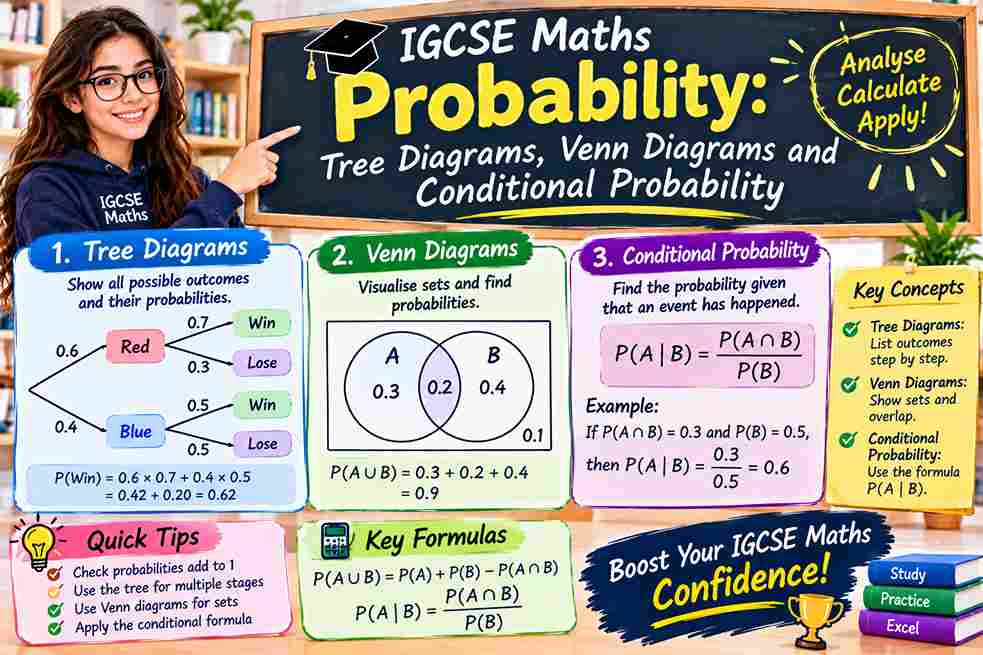
IGCSE Maths Probability: Tree Diagrams, Venn Diagrams and Conditional Probability
Last updated: November 2026 | By EdFlik Education Team
Probability questions reward careful setup. Students who draw the right diagram and label it fully usually find the arithmetic easy. This guide covers the four situations that appear most: basic probability, tree diagrams with and without replacement, Venn diagrams, and conditional probability.
The basics
- Probability = number of favourable outcomes ÷ total number of outcomes, between 0 and 1.
- P(not A) = 1 − P(A).
- Probabilities of all outcomes in a situation add to 1. Use this to check your work.
- Give answers as fractions, decimals or percentages as the question asks. Do not round fractions to decimals unless told.
The two rules for combining events
Words in the question |
Rule |
Example |
"A and B" (independent events) |
Multiply: P(A and B) = P(A) × P(B) |
P(A) = 0.4, P(B) = 0.25, so P(both) = 0.1 |
"A or B" (mutually exclusive) |
Add: P(A or B) = P(A) + P(B) |
Roll a 1 or a 2: 1/6 + 1/6 = 1/3 |
"A or B" (not exclusive) |
P(A) + P(B) − P(A and B) |
0.4 + 0.25 − 0.1 = 0.55 |
Tree diagrams: without replacement
Worked example 1
A bag holds 5 red and 3 blue counters. Two counters are taken at random without replacement. Find the probability that (a) both are red, (b) one of each colour.
- First pick: P(R) = 5/8, P(B) = 3/8.
- After a red is removed: P(R) = 4/7, P(B) = 3/7. After a blue is removed: P(R) = 5/7, P(B) = 2/7.
- (a) P(R, R) = 5/8 × 4/7 = 20/56 =5/14.
- (b) P(R, B) + P(B, R) = 5/8 × 3/7 + 3/8 × 5/7 = 15/56 + 15/56 = 30/56 =15/28.
- Check: P(B, B) = 3/8 × 2/7 = 6/56. The three results 20/56 + 30/56 + 6/56 = 56/56 = 1 ✓.
Multiply along the branches, add between the branches. In "without replacement", the denominator on the second branch is always one smaller. |
Tree diagrams: with replacement and independent events
When the counter is put back, or events do not affect each other, the second set of branches has the same probabilities as the first. A coin tossed twice has P(H, H) = 1/2 × 1/2 = 1/4.
Venn diagrams
Worked example 2
In a class of 30 students, 18 play football, 12 play basketball and 5 play both. Find (a) how many play neither, (b) the probability that a student chosen at random who plays basketball also plays football.
- Fill the overlap first: 5 play both. Football only = 18 − 5 = 13. Basketball only = 12 − 5 = 7.
- Total in at least one sport = 13 + 5 + 7 = 25, soneither = 30 − 25 = 5.
- (b) Given the student plays basketball (12 students), 5 also play football:P = 5/12.
Conditional probability from a tree
Worked example 3
The probability it rains is 0.3. If it rains, the probability Sam is late is 0.4. If it does not rain, the probability Sam is late is 0.1. Find (a) P(late), (b) P(it rained, given Sam was late).
- P(rain and late) = 0.3 × 0.4 = 0.12. P(no rain and late) = 0.7 × 0.1 = 0.07.
- (a) P(late) = 0.12 + 0.07 =0.19.
- (b) P(rain | late) = 0.12 ÷ 0.19 =0.632(3 s.f.), or 12/19.
The pattern: "given that" means the denominator is the probability of the given event.
Expected frequency
Expected number = probability × number of trials. If P(both) = 0.15 and an experiment is repeated 200 times, expect 0.15 × 200 =30occurrences. This is an average, not a guarantee.
Common mistakes
- Using the same denominator on the second branch of a "without replacement" tree.
- Adding along branches or multiplying between branches.
- Fractions on a branch not adding to 1.
- Forgetting that "at least one" is easiest as 1 − P(none).
Practice questions
Question |
Answer |
1. A bag has 4 red and 6 blue counters. Two are taken without replacement. Find P(both blue). |
6/10 × 5/9 = 30/90 = 1/3 |
2. Same bag: find P(two different colours). |
2 × (4/10 × 6/9) = 48/90 = 8/15 |
3. A and B are independent, P(A) = 0.4, P(B) = 0.25. Find P(A and B). |
0.4 × 0.25 = 0.1 |
4. Same events: find P(A or B). |
0.4 + 0.25 − 0.1 = 0.55 |
Frequently asked questions
Q: How do I know whether to add or multiply probabilities?
Multiply for "and" along a tree branch; add for "or" between different outcomes.
Q: What is the difference between with and without replacement?
With replacement, the item is returned so probabilities stay the same. Without it, the numbers on the second branch change.
Q: What does "given that" mean?
It restricts attention to cases where the given event happened. The denominator becomes the probability of that event.
Q: Is conditional probability on every tier?
Formal conditional probability is usually Extended or Higher content. Check your specification.
Try a free trial class with EdFlik. Live 1:1 IGCSE tutoring for Cambridge and Edexcel students in the UAE, matched to your child's board, subject and year group. Book at edflik.com or message us on WhatsApp. |
Related reading
- IGCSE Maths Trigonometry: Worked Examples
- IGCSE Maths 8-Week Mock Revision Plan
- IGCSE Practice Questions Online
Sources
- Cambridge International IGCSE Mathematics 0580 syllabus (probability content)
- Pearson Edexcel International GCSE Mathematics A 4MA1 specification
More on IGCSE & GCSE
- IGCSE in the UAE: A Complete Guide to Boards, Subjects, Exams and Revision
- Best IGCSE Maths Tutors in UAE for Probability | Online One-on-One Tutoring in Dubai, Abu Dhabi, Sharjah
- IGCSE Maths Online Tutoring: A Complete Guide (2026)
- Finding IGCSE Maths Tuition in Abu Dhabi: A Parent's Guide
- All IGCSE & GCSE articles