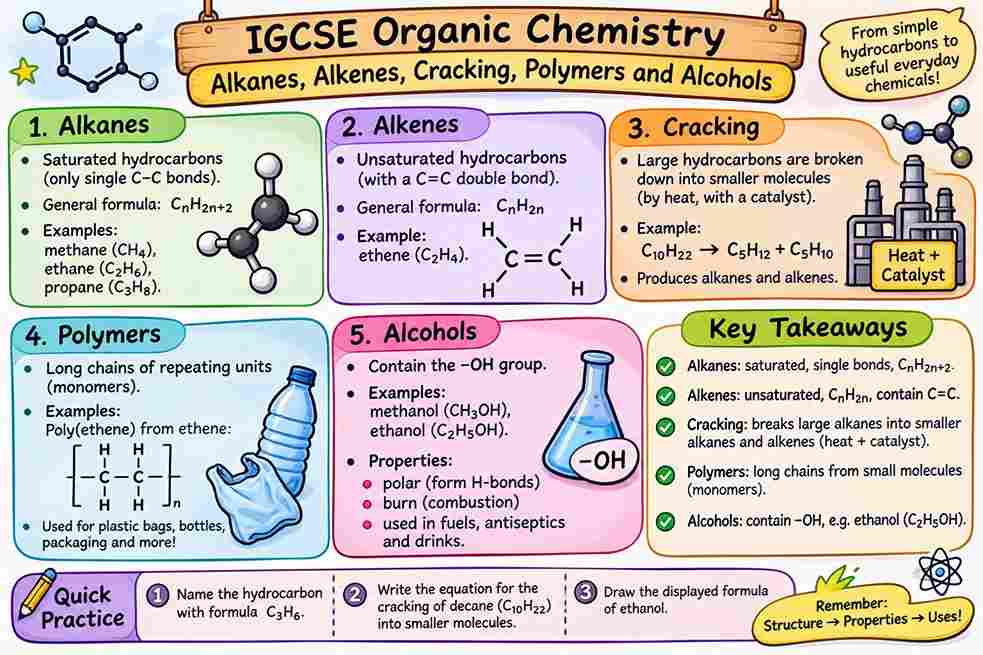
IGCSE Organic Chemistry: Alkanes, Alkenes, Cracking, Polymers and Alcohols
Last updated: November 2026 | By EdFlik Education Team
Organic chemistry at IGCSE is about families of compounds and what they do. If you can write the formulae, name the compounds and recall the key reaction of each family, you can answer most questions. This guide builds that toolkit.
Hydrocarbons
Family |
General formula |
Bonding |
First four members |
Alkanes |
CₙH₂ₙ₊₂ |
Single C–C bonds only (saturated) |
Methane CH₄, ethane C₂H₆, propane C₃H₈, butane C₄H₁₀ |
Alkenes |
CₙH₂ₙ |
At least one C=C double bond (unsaturated) |
Ethene C₂H₄, propene C₃H₆, butene C₄H₈ |
Alcohols |
CₙH₂ₙ₊₁OH |
–OH group |
Methanol CH₃OH, ethanol C₂H₅OH, propanol C₃H₇OH |
Isomers have the same molecular formula but different structures. Butane and methylpropane are both C₄H₁₀.
Alkanes: combustion
- Complete combustion in plenty of oxygen: CH₄ + 2O₂ → CO₂ + 2H₂O.
- Ethane: 2C₂H₆ + 7O₂ → 4CO₂ + 6H₂O.
- Incomplete combustion in limited oxygen gives carbon monoxide or carbon (soot) and water. Carbon monoxide is toxic.
Alkenes: the double bond
The double bond makes alkenes more reactive than alkanes. They undergo addition reactions, where the double bond breaks and atoms add on.
Reaction |
Equation |
Conditions or observation |
With bromine |
C₂H₄ + Br₂ → C₂H₄Br₂ |
Bromine water turns from orange to colourless. This is the test for unsaturation. |
With hydrogen |
C₂H₄ + H₂ → C₂H₆ |
Nickel catalyst, heated |
With steam |
C₂H₄ + H₂O → C₂H₅OH |
Steam with a phosphoric acid catalyst at high temperature and pressure |
Cracking
Cracking breaks long-chain alkanes into shorter, more useful alkanes and alkenes using heat and a catalyst (or steam at high temperature). Example: C₁₀H₂₂ → C₈H₁₈ + C₂H₄. Check that atoms balance: 10 carbons and 22 hydrogens on both sides.
Why crack? Shorter alkanes make better fuels and there is more demand for them than for long chains; alkenes are raw materials for polymers.
Polymers from alkenes
Many ethene molecules join to form poly(ethene) by addition polymerisation. The double bond opens and each monomer joins to the next. Write the repeat unit with the bonds extending outside the brackets, with n showing the number of repeat units.
Making ethanol
Method |
Equation |
Notes |
Fermentation |
C₆H₁₂O₆ → 2C₂H₅OH + 2CO₂ |
Yeast, warm (about 25–35 °C), no oxygen. Renewable, but slow and gives dilute ethanol. |
Hydration of ethene |
C₂H₄ + H₂O → C₂H₅OH |
Fast and gives pure ethanol, but uses ethene from crude oil, which is non-renewable. |
Common mistakes
- Using C₂H₆ as the formula for ethene. Ethene is C₂H₄.
- Saying bromine "decolourises" without naming the colour change from orange to colourless.
- Writing the polymer without the repeat unit brackets and n.
- Forgetting to balance cracking equations.
- Confusing complete and incomplete combustion products.
Practice questions
Question |
Answer |
1. State the general formula of the alkenes. |
CₙH₂ₙ |
2. Name the test for an alkene and the positive result. |
Bromine water changes from orange to colourless |
3. Write the equation for ethene reacting with hydrogen. |
C₂H₄ + H₂ → C₂H₆ |
4. Give one advantage of fermentation over hydration of ethene. |
It uses renewable sugar (or biomass) |
Frequently asked questions
Q: What is the difference between an alkane and an alkene?
Alkanes have only single bonds (saturated); alkenes have a C=C double bond (unsaturated).
Q: What is an addition reaction?
A reaction in which a molecule adds across a double bond and no other product forms.
Q: Why is cracking important?
It turns long, less useful hydrocarbons into shorter alkanes for fuel and alkenes for making polymers.
Q: How do I test for an alkene?
Shake with bromine water; it turns from orange to colourless.
Try a free trial class with EdFlik. Live 1:1 IGCSE tutoring for Cambridge and Edexcel students in the UAE, matched to your child's board, subject and year group. Book at edflik.com or message us on WhatsApp. |
Related reading
- IGCSE Chemistry (0620 / 4CH1) Guide
- IGCSE Chemistry Rates of Reaction
- IGCSE Command Words Explained
Sources
- Cambridge International IGCSE Chemistry 0620 syllabus 2026–2028
- Pearson Edexcel International GCSE Chemistry 4CH1 specification
More on IGCSE & GCSE