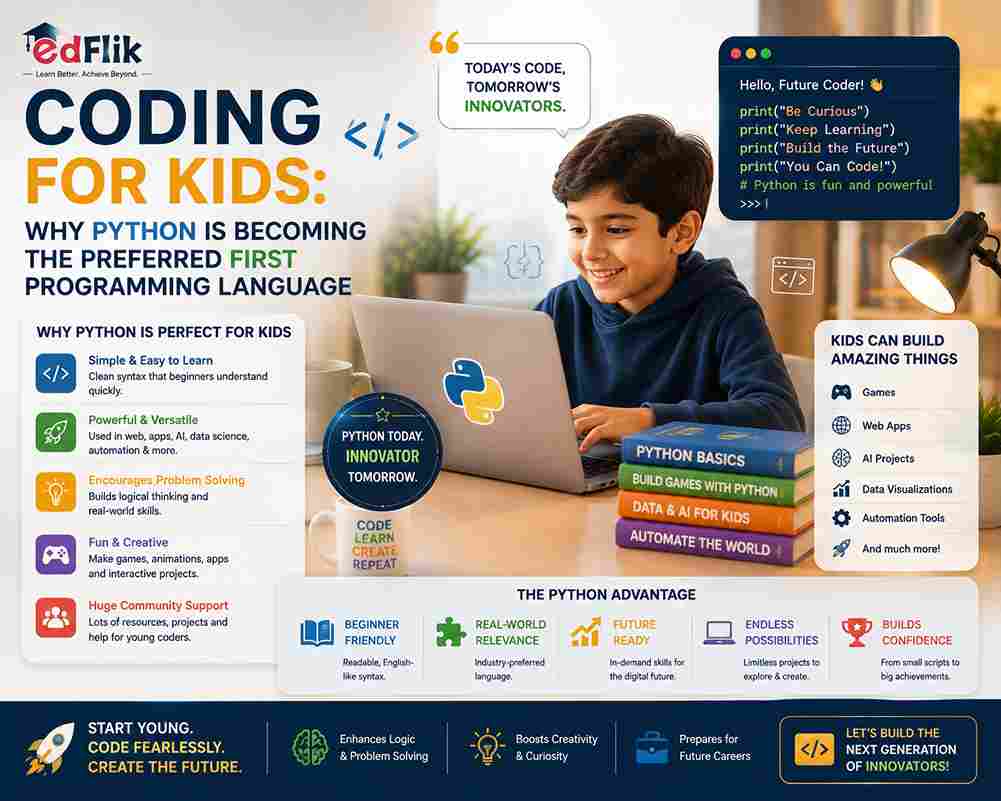
Coding for Kids: Why Python is Becoming the Preferred First Programming Language
Last Updated: August 2026 | By: EdFlik Education Team
Quick Contact: Need an online coding tutor in Dubai & UAE 2026 right now? WhatsApp us at +91 88788 96600 | Sessions starting from AED 55–70/hour | Book a Free Trial Class today viawww.edflik.com.
Introduction: The Shift from Block Coding to Real-World Syntax
For years, introducing children to computer science meant starting with colorful, drag-and-drop visual blocks like Scratch or Blockly. While these block-based environments are fantastic for igniting initial curiosity in young children (ages 6 to 9), a major educational transition occurs as students enter upper primary and middle school. Parents and educators increasingly ask: What comes next? How do we bridge the gap between playing with digital puzzle pieces and writing actual, professional software?
The undisputed answer in modern education is Python.
Across progressive schools and online learning platforms worldwide—from London and Singapore to Dubai and Abu Dhabi—Python has rapidly overtaken older introductory languages like Java or C++ as the premier first text-based programming language for kids and teens. Its clean syntax, immense versatility, and readability make it the ultimate gateway into the world of professional computer science.
Section 1: Why Python is the Ideal First Text-Based Language
Traditional programming languages often overwhelm beginners with complex syntax rules, heavy punctuation, and rigid structural requirements. A single missing semicolon or misplaced bracket can cause a beginner's code to fail completely, leading to immediate frustration and burnout. Python was deliberately designed to eliminate this friction.
- Human-Readable Syntax: Python code reads almost like standard English. For example, checking a condition in Python looks like
if score > 50: print("Winner!"), whereas older languages require extensive boilerplate syntax. This allows students to focus entirely on logic rather than memorizing punctuation rules. - Immediate Gratification: Because Python requires fewer lines of code to achieve complex results, young learners can see their programs execute and produce results instantly. This rapid feedback loop keeps motivation high.
- The Bridge Between Play and Power: Python bridges the gap between educational toy languages and industry-standard tools. It is the exact same language used by software engineers at tech giants like Google, NASA, and Netflix, giving students real-world confidence from day one.
Section 2: Cognitive Benefits of Early Python Education
Learning Python is much more than a vocational skill for future software developers; it is a profound cognitive exercise that reshapes how young minds process information:
1. Mastering Algorithmic Decomposition
Python forces students to break massive, complex problems down into smaller, sequential steps (decomposition). Whether writing a script to calculate student grades or automating a simple math puzzle, students learn how to structure their thoughts logically.
2. Reinforcing Mathematical Intuition
Many children struggle with abstract math concepts on a whiteboard. When they write a Python script to calculate coordinates, plot geometric patterns, or manipulate numbers dynamically, math transforms from a sterile textbook exercise into an interactive, visual reality.
3. Cultivating Resilient Problem-Solving (Debugging)
In programming, code rarely works perfectly on the first try. When an error or bug occurs, Python provides clear error messages. Students learn to read these messages calmly, test hypotheses, and "debug" their logic—building immense intellectual resilience.
Section 3: Real-World Applications That Excite Kids
Children learn best when they create projects that genuinely interest them. Python’s incredible versatility allows young programmers to build exciting, customized projects early in their learning journey:
- Text-Based Adventure Games: Students code interactive story games where the user's choices dictate the plot, combining creative writing with conditional programming logic.
- Automated Productivity Tools: Teens build practical utilities, such as automated file organizers, currency converters, or custom weather-checking scripts.
- Introduction to AI and Data Science: Because Python is the foundational language of modern Artificial Intelligence and Machine Learning, advanced students can explore basic data visualization and interactive chat bots early on.
Section 4: Common Pitfalls Parents and Tutors Make
When introducing children to programming, well-meaning parents often make a few common missteps:
- Rushing into Advanced Object-Oriented Concepts: Forcing beginners to learn complex class structures and inheritance before they have mastered basic loops, variables, and functions.
- Treating Coding Like a Memory Test: Making children memorize code syntax rather than teaching them how to reference documentation and solve logic puzzles independently.
- Isolating Code from Creativity: Teaching Python in a dry vacuum rather than letting students apply their coding skills to art, game design, or science projects.
Section 5: The EdFlik Advantage for Young Programmers
At EdFlik Education, we recognize that mastering text-based coding requires patient, structured guidance. Our 1-on-1 online tutoring model makes learning Python an exciting and rewarding experience:
- Engaging 1-on-1 Mentorship: Our expert coding tutors break down complex syntax into bite-sized, digestible steps tailored to your child's age and learning speed.
- Interactive Virtual Coding Environments: Using live collaborative code editors and digital whiteboards, tutors write code alongside students in real time.
- Exceptional Affordability: Premium tech mentorship starting at an accessible AED 55–70/hour, delivering future-ready education without exorbitant agency markups.
Success Stories & Testimonials
"My 12-year-old son wanted to learn how to code video games but got overwhelmed trying to learn C++ on his own. His EdFlik tutor introduced him to Python in a fun, project-based way. Within months, he was building his own interactive text games with total confidence!"
— Parent in Dubai Silicon Oasis
"Finding a coding tutor who could explain complex loops and functions to a middle schooler online was difficult. EdFlik's interactive approach made Python feel intuitive and fun."
— Parent in Abu Dhabi
Frequently Asked Questions (FAQ)
Why is Python recommended as the best first programming language for kids?
Python features a clean, human-readable syntax that mimics plain English, allowing beginners to focus on problem-solving logic rather than getting bogged down by complex punctuation rules.
What age can children start learning Python?
While younger children (ages 6–8) benefit from visual block coding like Scratch, most children are ready to transition to text-based Python programming around ages 10 to 12 once they have foundational reading and math skills.
How much do online Python tutoring sessions cost with EdFlik?
EdFlik offers expert 1-on-1 Python and STEM tutoring starting at an accessible AED 55–70/hour, making future-ready tech education affordable for families across the UAE.
Ready to Give Your Child a Head Start in Coding?
Equip your child with the digital literacy of tomorrow through expert 1-on-1 Python mentorship. Experience the EdFlik difference today.
- WhatsApp Us:+91 88788 96600
- Visit Us:www.edflik.com
- Special Offer: Book your Free Trial Class now!