Python for Beginners: Essential Coding Concepts for IGCSE and A-Level Computer Science Students
Last Updated: September 2026 | By EdFlik Education Team
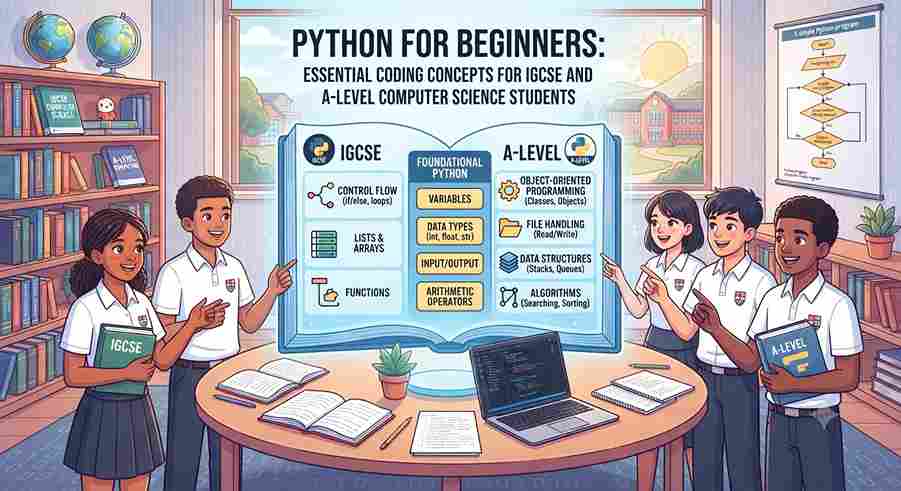
For students stepping into IGCSE or International A-Level Computer Science—whether following Cambridge (CAIE), Pearson Edexcel, or AQA syllabi—learning to program is no longer just an extracurricular hobby; it is a core academic requirement. Among all programming languages, Python has become the gold standard for introductory computer science education. Its clean syntax, readability, and versatility make it the ideal language for mastering computational thinking.
However, moving from writing basic scripts to solving complex algorithmic problems in an exam hall can be daunting. Examiners don't just want your code to "work"—they want to see robust, efficient, and well-structured code that follows computer science principles.
In this comprehensive guide, our expert Computer Science tutors break down the essential Python coding concepts every IGCSE and A-Level student must master to ace their programming papers and practical assessments.
Part 1: The Three Core Programming Constructs
Every algorithm you will ever write—regardless of complexity—is built on top of three fundamental control structures. Mastering these is non-negotiable.
1. Sequence
Sequence is the execution of statements line by line, in the exact order they are written.
- Example: Asking a user for their name, greeting them, and calculating their age happens sequentially.
2. Selection (Decision Making)
Selection allows your program to make choices based on certain conditions using if, elif, and else statements.
- Key Concept: Boolean logic (
and,or,not). Examiners frequently test your ability to evaluate complex Boolean expressions.
Python
# Example of Selection
score = 85
if score >= 90:
    print("Grade: A*")
elif score >= 80:
    print("Grade: A")
else:
    print("Keep practicing!")
3. Iteration (Loops)
Iteration allows code to repeat automatically. Python provides two primary types of loops, and exam boards love asking about the difference between them:
forloops (Count-controlled iteration): Used when you know in advance how many times the loop should run (e.g., iterating through a list or running a loop 10 times).whileloops (Condition-controlled iteration): Used when you don't know how many times the loop will run beforehand, and it continues while a specific condition remains true (e.g., asking a user for a password until they enter the correct one).
Part 2: Data Types and Data Structures
Computers process data, but how that data is stored and organized dictates the efficiency of your program.
1. Primitive Data Types
You must instantly recognize and declare fundamental data types:
int(Integers: whole numbers like42)float(Floating-point numbers: decimals like3.14)str(Strings: text characters enclosed in quotes like"Hello EdFlik")bool(Booleans: logical valuesTrueorFalse)
2. Data Structures: Lists, Tuples, and Dictionaries
At IGCSE and A-Level, handling collections of data is heavily examined.
- Lists: Mutable (changeable) ordered collections defined with square brackets
my_list = [1, 2, 3, "Apple"]. You must know how to append, remove, and slice lists. - Tuples: Immutable (unchangeable) ordered collections defined with parentheses
my_tuple = (10, 20, 30). Once created, their values cannot be altered. - Dictionaries: Key-value pairs (
student = {"name": "Ali", "grade": 11}). Dictionaries are essential for efficient data lookups by key rather than index.
Part 3: Subprograms (Functions and Procedures)
As programs grow larger, writing everything in one block of code becomes messy and inefficient. Modular programming involves breaking code down into reusable subprograms.
- Procedures: Subroutines that perform a task but do not return a specific value. In Python, these are defined using
def. - Functions: Subroutines that perform a task and return a value back to the main program using the
returnkeyword. - Scope (Local vs. Global Variables): A classic exam trap involves variable scope. Local variables only exist inside the function where they are declared, while global variables can be accessed throughout the entire program. Examiners frequently ask what happens if you try to call a local variable outside its function!
Part 4: File Handling (Reading and Writing Data)
At A-Level and advanced IGCSE modules, programs must be able to interact with external storage, such as text files (.txt) or CSV files.
- Opening Files: Python uses the
open()function. Using thewithstatement is best practice because it automatically closes the file when your code block finishes execution:
Python
# Writing to a text file
with open("student_data.txt", "w") as file:
    file.write("Ali scored 95% in Computer Science.")

# Reading from a text file
with open("student_data.txt", "r") as file:
    content = file.read()
    print(content)
Part 5: Top 4 Coding Habits to Secure an A* in Exams
- Meaningful Variable Names: Never name variables
x,y, oraunless they are loop counters. Use descriptive names liketotal_score,user_input, oris_valid_email. Examiners look for code readability. - Robust Input Validation: Real-world users enter unexpected data (like typing letters when asked for an age). Use
try-exceptblocks orwhileloops to ensure your programs don't crash when invalid data is entered. - Comment Your Code: Use
#to explain complex logic, especially in algorithms like bubble sorts, linear searches, or recursive functions. - Trace Tables Practice: In written exam papers, you will be given Python code and asked to fill out a trace table showing how variables change step-by-step. Practice tracing loops manually on paper so you don't make careless counting errors.
Struggling with Python syntax, algorithms, or preparing for your IGCSE/A-Level Computer Science coding exams? EdFlik offers expert, 1-to-1 online tutoring customized specifically for your school curriculum.Book a Free Demo Class Today!
Frequently Asked Questions (FAQs)
Q1: Is Python the only programming language allowed in IGCSE/A-Level Computer Science?
Ans: No. While Python is the most popular, exam boards like Cambridge (CAIE) and Edexcel also accept pseudocode or other high-level languages. However, Python's clean syntax makes it the most widely taught language globally.
Q2: What is the difference between a syntax error and a logic error?
Ans: A syntax error violates the grammatical rules of Python (e.g., forgetting a colon : or misspelling a command), preventing the program from running at all. A logic error occurs when the program runs successfully without crashing, but produces an incorrect output due to flawed algorithm design.
Q3: How important is pseudocode in computer science exams?
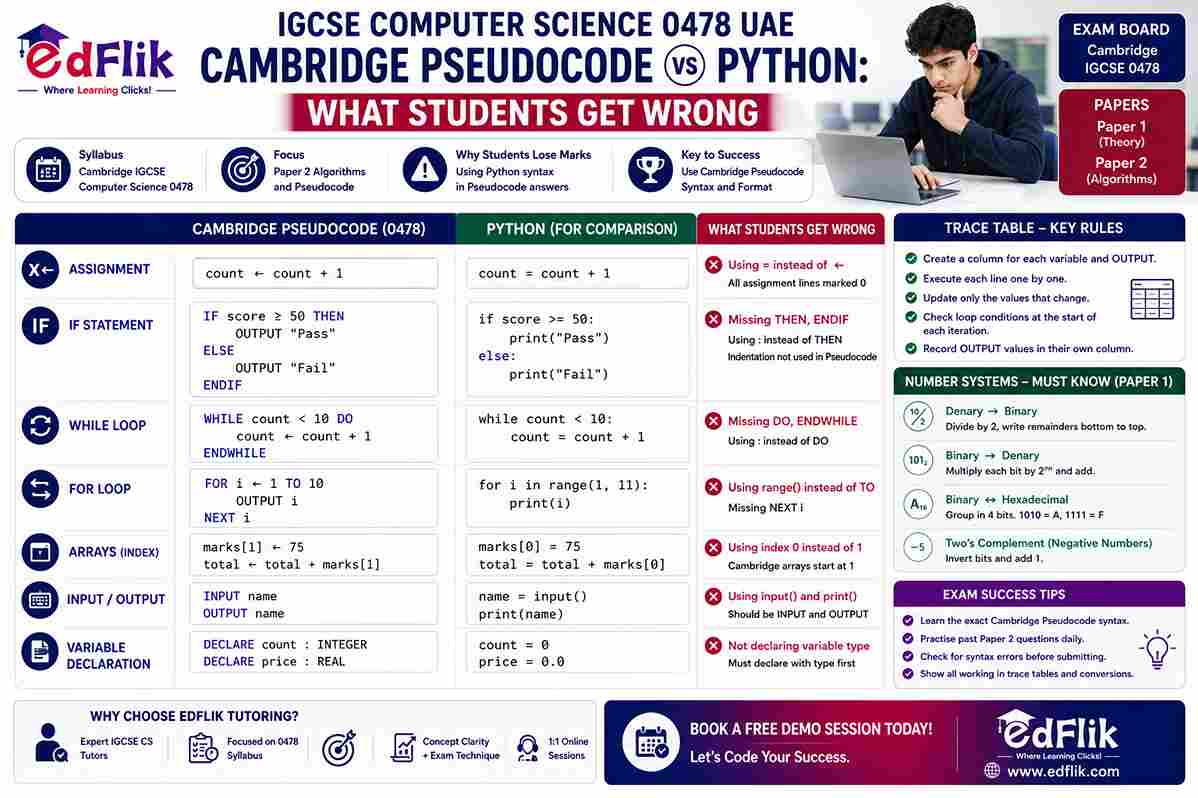
Ans: Extremely important. Even if you code fluently in Python, exam papers frequently require you to answer algorithm questions using standard exam-board pseudocode. Mastering both Python and pseudocode is essential.
Q4: How can EdFlik help my child master Computer Science programming?
Ans: EdFlik connects students with experienced, certified 1-to-1 online tutors who specialize in IGCSE and International A-Level Computer Science. Our tutors guide students through practical coding projects, trace table drills, and past paper problem-solving.