Mastering Halogenoalkane Reaction Mechanisms: Nucleophilic Substitution in Edexcel IAL Chemistry Unit 2
Last Updated: October 2026 | By EdFlik Education Team
For high school students completing the Pearson Edexcel International Advanced Level (IAL) Chemistry qualification, Unit 2 (Application of Core Principles of Chemistry - Energetics, Group 7, and Halogenoalkanes) marks a critical transition into mechanistic organic chemistry. While Unit 1 establishes atomic structure and basic bonding, Unit 2 requires students to visualize three-dimensional electron movements, understand reaction kinetics, and master curly arrow mechanisms.
Among all organic reaction pathways tested on Unit 2 papers—including alkene electrophilic addition and alcohol oxidation—Nucleophilic Substitution in Halogenoalkanes ($S_N1$ and $S_N2$) stands out as a core foundation. It appears consistently across multiple-choice questions, mechanism drawing tasks, and multi-step synthetic route problems.
Every exam season, students lose marks not because they don't know the reagents, but because of common mechanistic errors: drawing curly arrows starting from atoms instead of bonds, omitting lone pairs or partial charges, or confusing the stereochemical outcomes of $S_N1$ versus $S_N2$ pathways.
In this comprehensive, exam-focused masterclass guide, our expert Edexcel IAL chemistry educators break down the chemistry of halogenoalkanes, demystify $S_N1$ and $S_N2$ mechanisms, explore carbon-halogen bond enthalpy trends, and provide a structured problem-solving framework to help you score full marks on Unit 2.
Part 1: The Structure and Reactivity of Halogenoalkanes
A halogenoalkane (or haloalkane) is an alkane where one or more hydrogen atoms have been replaced by halogen atoms (fluorine, chlorine, bromine, or iodine).
1. Polarity of the Carbon-Halogen Bond
Halogens are significantly more electronegative than carbon. For example, in chloromethane ($\text{CH}_3\text{Cl}$), chlorine pulls electron density toward itself via inductive effect, creating a permanent dipole:
$$\text{}^{\delta+} \text{C} - \text{Cl}^{\delta-}$$
- The Electrophilic Carbon: Because the carbon atom is electron-deficient ($\delta+$), it acts as an electrophile (electron-pair acceptor) and is immediately targeted by electron-rich reagents called nucleophiles (electron-pair donors).
2. Carbon-Halogen Bond Enthalpy vs. Bond Polarity (The Classic Exam Trap!)
A frequent multiple-choice question on Edexcel Unit 2 asks: "Which halogenoalkane undergoes nucleophilic substitution the fastest?"
Students often assume that because fluoroalkanes are the most polar, they react the fastest. This is completely incorrect!
                HALOGENOALKANE REACTIVITY TRENDS
                                 |
      +--------------------------+--------------------------+
      |                                                     |
TREND IN BOND POLARITY                                TREND IN BOND ENTHALPY
C–F > C–Cl > C–Br > C–I                               C–F > C–Cl > C–Br > C–I
(Fluorine is most electronegative)                    (Iodine bond is weakest to break)
                                                             |
                                                             v
                                            OVERALL REACTIVITY RATE:
                                            Iodoalkanes react FASTEST
                                            Fluoroalkanes react SLOWEST
- The Deciding Factor: During nucleophilic substitution, the carbon-halogen bond must be broken.
- Bond enthalpy decreases down Group 7 as atomic radius increases and overlap worsens ($\text{C–F} = 467 \text{ kJ mol}^{-1}$ down to $\text{C–I} = 238 \text{ kJ mol}^{-1}$).
- Because the $\text{C–I}$ bond requires the least energy to break, iodoalkanes react the fastest, while fluoroalkanes react extremely slowly (often requiring harsh conditions to react at all).
Part 2: Nucleophilic Substitution Reactions
A nucleophile is an electron-pair donor (e.g., $\text{OH}^-, \text{CN}^-, \text{NH}_3$). In a nucleophilic substitution reaction, the halogen atom is displaced by the incoming nucleophile.
Here are the three primary nucleophilic substitution reactions tested in Unit 2:
                         NUCLEOPHILIC SUBSTITUTION PATHWAYS
                                         |
        +--------------------------------+--------------------------------+
        |                                |                                |
 1. HYDROLYSIS (Formation of Alcohols)    2. NITRILE FORMATION             3. AMINE FORMATION
 Reagent: Aqueous $\text{NaOH}$ or $\text{KOH}$ Reagent: Aqueous/Ethanolic $\text{KCN}$ Reagent: Excess Ethanolic $\text{NH}_3$
 Condition: Reflux with water/ethanol   Condition: Reflux under heat     Condition: Sealed tube, excess ammonia
 Equation: $\text{R–X} + \text{OH}^- \rightarrow \text{R–OH} + \text{X}^-$ Equation: $\text{R–X} + \text{CN}^- \rightarrow \text{R–CN} + \text{X}^-$ Equation: $\text{R–X} + 2\text{NH}_3 \rightarrow \text{R–NH}_2 + \text{NH}_4\text{X}$
Part 3: Mechanism Mechanisms — $S_N2$ vs. $S_N1$
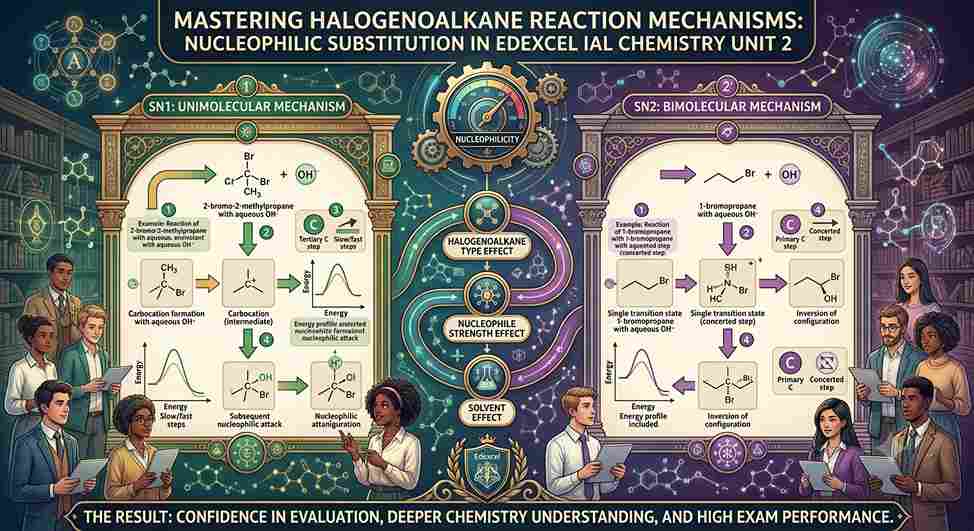
Edexcel Unit 2 requires students to distinguish between two distinct mechanisms for nucleophilic substitution: $S_N2$ (Substitution Nucleophilic Bimolecular) and $S_N1$ (Substitution Nucleophilic Unimolecular).
                      $S_N2$ vs. $S_N1$ MECHANISTIC PATHWAYS
                                         |
        +--------------------------------+--------------------------------+
        |                                |                                |
  $S_N2$ MECHANISM (Primary)               $S_N1$ MECHANISM (Tertiary)
  • One concerted step                   • Two distinct steps
  • Bimolecular rate-determining step    • Unimolecular rate-determining step
  • Inversion of stereochemical configuration • Racemic mixture (equal enantiomers)
1. The $S_N2$ Mechanism (Primary Halogenoalkanes)
Primary halogenoalkanes (e.g., 1-bromobutane) react via a concerted, single-step mechanism called $S_N2$.
Step-by-Step Mechanism Rules for Exams:
- Curly Arrow 1: Must start from the lone pair on the oxygen of the hydroxide ion ($\text{:OH}^-$) and point directly to the electron-deficient carbon ($\delta+$).
- Transition State: The incoming nucleophile attacks from the backside (opposite the halogen), forming an unstable transition state where both the $\text{OH}$ and the halogen are partially bonded to the central carbon.
- Curly Arrow 2: Simultaneously, the bond between carbon and the halogen breaks, with the electron pair moving entirely onto the halogen atom, forming a halide ion ($\text{X}^-$).
- Stereochemical Inversion: The spatial arrangement of the carbon skeleton inverts (like an umbrella turning inside out in the wind).
2. The $S_N1$ Mechanism (Tertiary Halogenoalkanes)
Tertiary halogenoalkanes (e.g., 2-bromo-2-methylpropane) react via a two-step mechanism called $S_N1$ because steric hindrance prevents backside attack by the nucleophile.
Step-by-Step Mechanism Rules for Exams:
- Step 1 (Slow / Rate-Determining Step): The carbon-halogen bond heterolytically cleaves spontaneously without the nucleophile, forming a stable carbocation intermediate ($\text{R}_3\text{C}^+$) and a halide ion ($\text{X}^-$).
- Step 2 (Fast Step): The nucleophile ($\text{OH}^-$) rapidly attacks the planar carbocation intermediate from either above or below, producing a racemic mixture (equal amounts of optical enantiomers).
Part 4: Step-by-Step Framework for Drawing Curly Arrow Mechanisms
When an exam question instructs you to "Draw the mechanism for the reaction between 1-bromopropane and aqueous sodium hydroxide," execute this 4-step drawing protocol:
                  THE 4-STEP MECHANISM DRAWING PROTOCOL
                                   |
  Step 1: Draw Structures    ---> Include partial charges (δ+ C and δ- Br)
  Step 2: Add Nucleophile    ---> Draw hydroxide ion with a visible lone pair
  Step 3: Draw Curly Arrow 1 ---> Start on nucleophile lone pair, point to δ+ C
  Step 4: Draw Curly Arrow 2 ---> Start on C–Br bond, point entirely to Br atom
Part 5: Top 4 Traps That Cost Students Marks in Edexcel Unit 2
- Starting Curly Arrows on Atoms Instead of Bonds / Lone Pairs: Drawing a curly arrow that starts floating in empty space or originates from the center of an atom. Every curly arrow must start either on a lone pair of electrons or on a covalent bond!
- Confusing Hydrolysis Conditions (Aqueous vs. Ethanolic): Using ethanolic $\text{NaOH}$ when you want to form an alcohol via substitution.
- Aqueous $\text{NaOH}$ under reflux $\rightarrow$ Substitution (Forms Alcohol).
- Ethanolic $\text{NaOH}$ under reflux $\rightarrow$ Elimination (Forms Alkene).
- Forgetting Intermediate Carbocation Structures in $S_N1$: Omitting the planar carbocation intermediate when explaining tertiary halogenoalkane substitution.
- Misidentifying Primary vs. Tertiary Halogenoalkanes: Mistaking a secondary or tertiary halogenoalkane for a primary one, leading to incorrect assumptions about whether the reaction proceeds via $S_N1$ or $S_N2$.
Preparing for Pearson Edexcel IAL Chemistry Unit 2 exams and aiming for an $A^$ grade? EdFlik connects international school students globally with expert, 1-to-1 online A-Level chemistry tutors, helping you master reaction mechanisms, curly arrow notation, energetics, organic synthesis routes, and past-paper exam techniques. *Book a Free Demo Class Today!
Frequently Asked Questions (FAQs):-
Q1: Why do tertiary halogenoalkanes undergo $S_N1$ instead of $S_N2$?
Ans: Tertiary halogenoalkanes have three bulky alkyl groups surrounding the central carbon atom. This creates severe steric hindrance, blocking the backside attack required for an $S_N2$ mechanism. Instead, the molecule forms a stable tertiary carbocation intermediate via an $S_N1$ pathway.
Q2: How can you chemically test for the presence of different halogenoalkanes?
Ans: React the halogenoalkane with aqueous silver nitrate ($\text{AgNO}_3$) in the presence of ethanol solvent under warm conditions.
- A white precipitate of silver chloride ($\text{AgCl}$) forms slowly (fastest for iodo, slowest for chloro).
- A cream precipitate of silver bromide ($\text{AgBr}$) forms at a moderate rate.
- A yellow precipitate of silver iodide ($\text{AgI}$) forms the fastest.
Q3: What is the difference between a nucleophile and a base?
Ans: A nucleophile donates an electron pair to an electron-deficient carbon atom (forming a new covalent bond with carbon). A base accepts a proton ($\text{H}^+$ ion). Many species (like $\text{OH}^-$) can act as both nucleophiles (substitution) and bases (elimination) depending on reaction conditions (aqueous vs. ethanolic).
Q4: How does EdFlik support Edexcel IAL Chemistry students?
Ans: EdFlik connects international school students worldwide with vetted, expert 1-to-1 online tutors specializing in Pearson Edexcel IAL Chemistry (Units 1–6). Our personalized coaching focuses on clarifying complex organic reaction mechanisms, practicing curly arrow notations, mastering mathematical calculations, and building exam confidence.