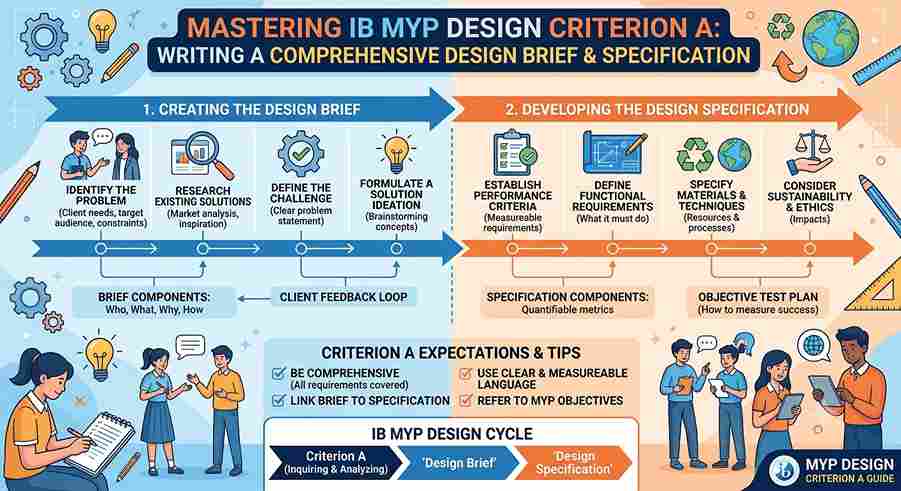
Mastering IB MYP Design Criterion A: Writing a Comprehensive Design Brief and Specification
Last Updated: October 2026 | By EdFlik Education Team
For students navigating the International Baccalaureate (IB) Middle Years Programme (MYP), the Design Cycle serves as the foundational framework for creative problem-solving, engineering, digital design, and product creation. Across all five years of the MYP (MYP 1–5), student assessment is structured around four distinct criteria:
- Criterion A: Inquiring and Analysing
- Criterion B: Developing Ideas
- Criterion C: Creating the Solution
- Criterion D: Evaluating
Among these, Criterion A (Inquiring and Analysing) sets the entire trajectory of a design project. If your inquiry is shallow, your user research incomplete, or your design specification vague, the entire remaining project—no matter how well-crafted the final product—will struggle to score in the top Level 7–8 band.
In this comprehensive, exam-focused masterclass guide, our expert IB Design educators break down the official Criterion A rubric, explore the four essential strands, provide step-by-step frameworks for crafting a rock-solid Design Brief and Design Specification, expose common student traps, and supply a 100% copy-paste JSON-LD schema markup for your portfolio resources.
Part 1: Deconstructing IB MYP Design Criterion A Rubric
To achieve a top score in Criterion A, your design ePortfolio or project folder must address four distinct strands with depth, analytical rigor, and primary/secondary evidence.
                  THE 4 STRANDS OF CRITERION A (INQUIRING & ANALYSING)
                                           |
      +------------------------------------+------------------------------------+
      |                                                                         |
STRAND A.i: EXPLAINING THE NEED                                     STRAND A.ii: ACTION PLAN & RESEARCH
• Identify the problem, target audience/client,                      • Formulate a structured research plan.
  and real-world context of the challenge.                          • Conduct primary (surveys/interviews) &
                                                                      secondary (market research) inquiry.
      |                                                                         |
      +------------------------------------+------------------------------------+
                                           |
      +------------------------------------+------------------------------------+
      |                                                                         |
STRAND A.iii: ANALYSING EXISTING PRODUCTS                            STRAND A.iv: DESIGN BRIEF & SPECIFICATION
• Evaluate commercial/existing solutions using                      • Write a clear Design Brief.
  frameworks like **ACCESS FM**.                                    • Establish testable, measurable, and prioritized
                                                                      Design Specifications.
Part 2: Strand-by-Strand Blueprint for a Level 7–8 Portfolio
Strand A.i: Explaining and Justifying the Need for a Solution
You must establish a compelling, authentic reason why a design solution is required.
- Identify the Client/Target User: Who is experiencing this problem? Define their demographics, preferences, physical capabilities, or technical constraints.
- The Problem Statement: Clearly state what the problem is, where it occurs, and why existing solutions fail to solve it adequately.
- Primary Evidence: Include direct quotes, observation notes, or photos of the problem in its natural environment to validate that the need is real rather than assumed.
Strand A.ii: Developing a Research Plan and Conducting Inquiry
Top-tier portfolios do not simply dump random Google search results into their documentation. You must structure a formal Research Matrix:
| Research Question | Primary or Secondary? | Research Source / Method | Why is this information necessary? |
| What are the ergonomics of a teenager's study desk? | Secondary | Anthropometric data tables | Ensures the product meets human dimensional standards. |
| What features does my client prioritize? | Primary | 1-on-1 Client Interview | Guarantees the solution meets specific user preferences. |
| Which materials are eco-friendly and locally sourced? | Secondary | Material safety data sheets | Establishes sustainability compliance. |
Strand A.iii: Analysing Existing Products
To design something better, you must critically evaluate what already exists on the market. In IB Design, the gold-standard framework for analyzing existing solutions is ACCESS FM:
                       THE ACCESS FM ANALYSIS FRAMEWORK
                                      |
      +-------------------------------+-------------------------------+
      |                                                               |
• **A**esthetic: Colors, textures, forms    • **E**nvironment: Sustainability, life cycle
• **C**ost: Price point vs manufacturing    • **S**ize: Dimensions, weight, portability
• **C**ustomer: Target market appeal        • **S**afety: Ergonomic hazards, material toxicity
• **F**unction: How well does it work?      • **M**aterial: Composition, durability
Part 3: Writing a Scoring Design Brief and Specification (Strand A.iv)
The culmination of Criterion A is synthesizing all your research into two critical instruments: the Design Brief and the Design Specification.
1. The Design Brief
A Design Brief is a concise summary (typically 1–2 paragraphs) outlining the overall goal of your project. It acts as your project's mission statement.
Formula for an Outstanding Design Brief:
$$\text{Design Brief} = \text{[Target Client]} + \text{[Identified Problem]} + \text{[Proposed Solution]} + \text{[Key Constraints]} + \text{[Primary Goal]}$$
Example Design Brief:
"I will design and manufacture a space-efficient, ergonomic desktop organizer for high school students in Dubai who struggle with cluttered study spaces. The solution must utilize sustainably sourced plywood, fit within a $30\text{ cm} \times 20\text{ cm}$ desk footprint, and safely store stationery, digital devices, and textbooks while maintaining a minimalist aesthetic."
2. The Design Specification (Design Requirements)
While the brief is general, the Design Specification is a detailed, bulleted checklist of criteria that your final product must satisfy.
To achieve Level 7–8, every single specification point must be measurable, testable, and justified by research from Strands A.i–A.iii.
                THE STRUCTURE OF A SCORING SPECIFICATION POINT
                                       |
  [Requirement Category] ---> State the specific design rule
  [Measurable Metric]    ---> Provide precise numerical values or pass/fail conditions
  [Research Justification]--> Cite the specific research finding from Strand A.i-A.iii
Example Specification Table:
| Category | Specific Requirement (Measurable Criteria) | Research Justification (Source) | How It Will Be Tested (Criterion D) |
| Function | Must hold a minimum load of $2.5\text{ kg}$ without structural flexing exceeding $2\text{ mm}$. | Client survey (Q3) confirmed standard laptop + 2 books weigh $2.1\text{ kg}$. | Apply $2.5\text{ kg}$ calibration weights and measure deflection with a ruler. |
| Size | Overall dimensions must not exceed $300\text{ mm (L)} \times 200\text{ mm (W)} \times 150\text{ mm (H)}$. | Secondary anthropometric desk measurements taken from school study pods. | Measure final product using a digital caliper and tape measure. |
| Safety | All exposed external edges must feature a minimum radius curve of $3\text{ mm}$ (no sharp $90^\circ$ corners). | Safety analysis (Strand A.iii) identified sharp acrylic corners as a pinch hazard. | Visual inspection and tactile edge gauge test. |
| Aesthetics | Must use a Scandinavian minimalist color palette (natural timber + matte neutral finish). | Client mood board analysis showed $85\%$ preference for natural wood textures. | Client feedback questionnaire rating scale (1–5). |
Part 4: Top 4 Traps That Cost Students Marks in IB MYP Design
- Writing Unmeasurable Specifications: Using vague statements like "The product should look nice" or "It must be lightweight." Instead, quantify every requirement: "The product must receive an average rating of at least 4/5 on the client aesthetic survey" or "The overall weight must not exceed $750\text{ g}$."
- Disconnect Between Research and Specifications: Listing specifications that appear out of nowhere without any supporting evidence in Strands A.i, A.ii, or A.iii. Every requirement must directly cite a research finding.
- Superficial Existing Product Analysis: Including photos of existing products with one-sentence captions like "This product is blue and costs $10." You must apply the full ACCESS FM framework to extract actionable design insights.
- Neglecting Primary User Research: Relying exclusively on internet searches without directly interviewing or surveying actual human clients or target users.
Preparing for IB MYP Design ePortfolios or Personal Projects and aiming for a Level 7? EdFlik connects international school students globally with expert, 1-to-1 online IB tutors, helping you master design criteria, research synthesis, engineering documentation, and ePortfolio optimization. Book a Free Demo Class Today!
Frequently Asked Questions (FAQs)
Q1: What is the main difference between Criterion A and Criterion B in IB MYP Design?
Ans: Criterion A (Inquiring & Analysing) is about understanding the problem, researching user needs, and defining the rules/specifications. Criterion B (Developing Ideas) uses those specifications to brainstorm, sketch, model, and select final design concepts.
Q2: How many specification points should I include in my design table?
Ans: Aim for 8 to 12 detailed, measurable specification points spanning multiple categories (e.g., Function, Aesthetics, Size/Scope, Safety, Materials, Sustainability, Cost).
Q3: Can I change my Design Specification later in the project?
Ans: Yes! In the IB MYP Design Cycle, design is iterative. If prototyping in Criterion C reveals that a specification was unrealistic, you can update it—provided you document and justify the modification in your evaluation (Criterion D).
Q4: How does EdFlik support IB MYP Design students?
Ans: EdFlik connects international school students worldwide with vetted, expert 1-to-1 online tutors specializing in IB MYP and DP subjects. Our personalized coaching covers design ePortfolio structuring, Criterion A–D documentation, personal projects, and academic mentorship.