Mastering Pedigree Charts and Sex-Linked Inheritance Ratios in Edexcel IGCSE Human Biology (4HB1)
By EdFlik Team | November 19, 2026
For Key Stage 4 students across Dubai, Abu Dhabi, Sharjah, and the Northern Emirates studying Pearson Edexcel International GCSE Human Biology (4HB1), genetics and inheritance form one of the most conceptually rewarding—and exam-critical—parts of the syllabus. Unlike standard biology courses that look broadly at plants, ecology, and general organisms, Edexcel IGCSE Human Biology (4HB1) centers directly on human physiology, cell division (mitosis and meiosis), alleles, chromosomes, and human genetic conditions.
Two high-yield question types regularly appear in 4HB1 Paper 1 and Paper 2: family pedigree (family tree) analysis and sex-linked inheritance ratios (such as red-green color blindness or hemophilia). When an exam question displays a multi-generation chart of squares and circles and asks you to deduce whether a condition is dominant or recessive, identify a specific individual's genotype, or calculate the probability of an affected child, students often lose marks through rushed assumptions or unclear genetic notation.
Securing a Grade 8 or 9 ($A^*$) in Edexcel 4HB1—a strong foundation for A-Level Biology, IB Diploma Biology, or health-science pathways—requires a disciplined, step-by-step approach to reading pedigree charts, writing sex-chromosome alleles cleanly, and distinguishing offspring probabilities from whole-family ratios.
This masterclass guide breaks down how to read pedigree charts in Edexcel 4HB1, explains sex-linked inheritance notation and ratios, walks through full worked exam examples, highlights frequent mark-scheme traps, and includes 100% copy-paste JSON-LD schema markup.
Key Takeaways
- Standard Pedigree Symbols: Squares represent males, circles represent females, horizontal connecting lines represent mating/parents, vertical lines drop to offspring, and shaded/filled shapes indicate individuals expressing the trait/condition being studied.
- Look for "Two Unaffected Parents, Affected Child": Whenever two unaffected parents have an affected child, the trait must be recessive, and both parents must be heterozygous carriers ($Aa \times Aa$ or $X^H X^h \times X^H Y$).
- Always Attach Alleles to the $X$ Chromosome: For sex-linked traits in human genetics, write alleles as superscripts on the $X$ chromosome (such as $X^B$ and $X^b$), while the $Y$ chromosome carries no corresponding allele for the trait ($X^B Y$ or $X^b Y$).
- Separate "All Children" vs. "Boys Only" Ratios: Read probability wording with extreme care. The chance of a child being an affected boy is often half the chance of a son being affected.
Part 1: Reading Pedigree Charts and Deductive Clues in 4HB1
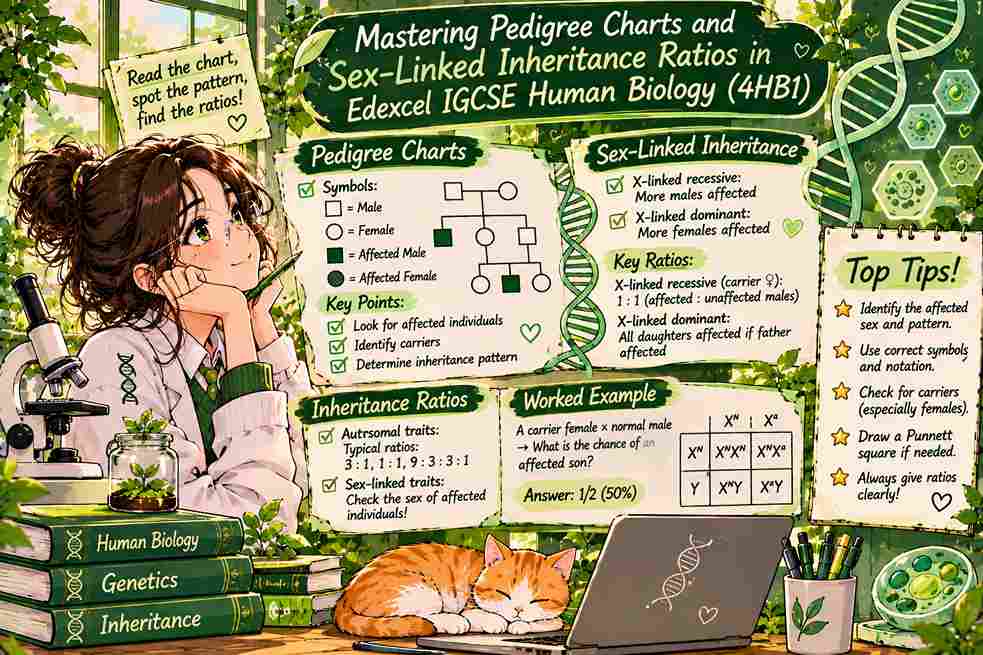
A pedigree chart maps phenotypes across generations so examiners can test your ability to apply Mendelian inheritance rules to real family histories.
In a typical pedigree diagram like the one above, squares represent males, circles represent females, and shaded shapes represent individuals showing the trait being tracked. Tracing relationships from parents down to children lets you test inheritance hypotheses logically rather than guessing.
High-Value Clues to Spot First on Any Pedigree Chart:
                 PEDIGREE DEDUCTION QUICK-CHECK
                                   |
  +--------------------------------+--------------------------------+
  |                                                                 |
1. RECESSIVE CLUE                                            2. DOMINANT CLUE
  • Two UNAFFECTED parents have an                              • Affected individuals appear across
    AFFECTED child.                                               consecutive generations without skipping.
  • Both parents must carry at least one                        • Two AFFECTED parents have an
    recessive allele (heterozygous / carrier).                    UNAFFECTED child (both parents are heterozygous).
Step-by-Step Method for Solving Any Pedigree Question:
- Identify the Trait Being Shaded: Check the key or question stem to confirm whether shaded shapes mean affected (e.g., having a genetic disorder) or expressing a dominant allele.
- Test Recessive vs. Dominant First: Look for two unaffected parents with an affected child (proves recessive) or two affected parents with an unaffected child (proves dominant).
- Assign Known Genotypes Immediately: Any individual showing a recessive phenotype has two recessive alleles (e.g., $dd$ or $X^d Y$ / $X^d X^d$). Work backward to deduce parents and forward to deduce children.
- Use "?" for Uncertain Second Alleles: If an individual has the dominant phenotype and could be either homozygous dominant ($DD$) or heterozygous ($Dd$), write $D\_$ until offspring or parental evidence resolves the second allele.
Part 2: Sex-Linked Inheritance Notation and Ratios in Edexcel 4HB1
In human biology, sex chromosomes are designated $X$ and $Y$. Females typically have $XX$ chromosomes, and males typically have $XY$ chromosomes. Because the $X$ chromosome is much larger than the $Y$ chromosome, it carries many genes that have no matching locus on the $Y$ chromosome.
Why Males Are More Frequently Affected by X-Linked Recessive Conditions:
- A female needs two recessive alleles ($X^r X^r$) to show an X-linked recessive condition (such as red-green color blindness or hemophilia). A female with one dominant and one recessive allele ($X^R X^r$) is an unaffected carrier.
- A male has only one $X$ chromosome ($X^R Y$ or $X^r Y$). If he inherits a single recessive allele ($X^r$) from his mother on his $X$ chromosome, there is no second $X$ chromosome to mask it—so he expresses the condition.
              SEX-LINKED GENOTYPE REFERENCE (X-LINKED RECESSIVE)
                                    |
  +---------------------------------+---------------------------------+
  |                                                                   |
FEMALE GENOTYPES (XX)                                          MALE GENOTYPES (XY)
  • X^R X^R  ---> Unaffected (homozygous dominant)               • X^R Y    ---> Unaffected male
  • X^R X^r  ---> Unaffected carrier (heterozygous)              • X^r Y    ---> Affected male
  • X^r X^r  ---> Affected female (homozygous recessive)         • Note: Y chromosome has no allele for this gene
Crucial Ratio Distinctions in Exam Questions:
When crossing an unaffected carrier mother ($X^R X^r$) with an unaffected father ($X^R Y$):
- Possible offspring genotypes are: $X^R X^R$, $X^R X^r$, $X^R Y$, and $X^r Y$ (equal $1 : 1 : 1 : 1$ outcomes).
- Probability a child is an affected boy: $\frac{1}{4}$ (or $25\%$, or $1\text{ in }4$).
- Probability a child is a boy: $\frac{1}{2}$ (or $50\%$).
- Probability a son (given the child is a boy) is affected: $\frac{1}{2}$ (or $50\%$, or $1\text{ in }2$).
- Probability a daughter is affected: $0$ (or $0\%$), because every daughter receives $X^R$ from her unaffected father.
Part 3: Full Exam-Style Worked Examples
Worked Example 1: Pedigree Analysis and Autosomal vs. Sex-Linked Reasoning
Question: A family pedigree shows a genetic condition caused by a recessive allele. Both parents in Generation 1 are unaffected, and they have four children in Generation 2: two unaffected daughters, one unaffected son, and one affected son.
(a) Explain how the pedigree shows that the condition is caused by a recessive allele. [2 marks]
(b) Using the letters $A$ (dominant allele) and $a$ (recessive allele), state the genotypes of both parents and the affected son if the condition is autosomal. [3 marks]
(c) Explain why an unaffected father cannot pass an X-linked recessive allele directly to his son. [2 marks]
Step-by-Step Solution:
(a) Evidence for a recessive allele: Two unaffected parents produce an affected child. If the allele were dominant, at least one parent would carry the dominant allele and express the condition. Therefore, both unaffected parents must carry a hidden recessive allele that came together in the affected child.
(b) Genotypes (autosomal inheritance):
- Affected son: $aa$ (must be homozygous recessive to show the recessive condition).
- Mother: $Aa$ (unaffected, so has at least one $A$, and must carry $a$ to pass to the affected son).
- Father: $Aa$ (unaffected, so has at least one $A$, and must carry $a$ to pass to the affected son).
(c) Why an unaffected father cannot pass an X-linked recessive allele to his son: A father passes his $Y$ chromosome (not his $X$ chromosome) to a son. An X-linked condition is carried on the $X$ chromosome, and an unaffected male has genotype $X^A Y$, so he does not carry the recessive allele $X^a$ at all.
Worked Example 2: Punnett Square and Inheritance Ratio for an X-Linked Trait
Question: Red-green color blindness is an X-linked recessive condition. Let $X^N$ represent the normal allele and $X^n$ represent the color-blindness allele. A woman who is a carrier for color blindness has children with a man who has normal color vision.
(a) State the genotypes of the mother and father. [2 marks]
(b) Construct a genetic cross (Punnett square) to determine the possible offspring genotypes and phenotypes. [3 marks]
(c) State the probability that their first child will be a color-blind boy, and the probability that a daughter will be a carrier. [2 marks]
Step-by-Step Solution:
(a) Parental genotypes:
- Mother (carrier): $X^N X^n$
- Father (normal vision): $X^N Y$
(b) Genetic cross / Punnett square:
| Gametes | XN (Father) | Y (Father) |
| $X^N$ (Mother) | $X^N X^N$ (Normal girl) | $X^N Y$ (Normal boy) |
| $X^n$ (Mother) | $X^N X^n$ (Carrier girl) | $X^n Y$ (Color-blind boy) |
Possible offspring genotypes: $X^N X^N$, $X^N X^n$, $X^N Y$, and $X^n Y$ in a $1 : 1 : 1 : 1$ ratio.
Possible offspring phenotypes: 1 normal girl, 1 carrier girl, 1 normal boy, and 1 color-blind boy.
(c) Probabilities:
- Probability that the first child is a color-blind boy: $\frac{1}{4}$ (or $25\%$, or $0.25$).
- Probability that a daughter is a carrier: $\frac{1}{2}$ (or $50\%$, or $0.5$), since half of the daughters ($X^N X^n$ out of $X^N X^N$ and $X^N X^n$) are carriers.
Part 4: Top 4 Exam Traps That Cost Edexcel 4HB1 Students Marks
- Writing Bare Letters Like $X^n$ Without Showing the $X$ Chromosome: Always write the full sex-chromosome notation ($X^N X^n$ and $X^n Y$). Dropping the $X$ or putting alleles on the $Y$ chromosome loses accuracy marks in sex-linkage questions.
- Confusing "Chance of an Affected Child" with "Chance of an Affected Boy": In a cross between $X^N X^n$ and $X^N Y$, the chance of any child being an affected boy is $\frac{1}{4}$ ($25\%$), whereas the chance of a boy being affected is $\frac{1}{2}$ ($50\%$). Always re-read the exact wording of the question.
- Treating Each Conception as Dependent on Previous Children: If a couple already has two color-blind boys, the probability that their next child is a color-blind boy is still $\frac{1}{4}$ ($25\%$)—fertilization in each pregnancy is an independent event.
- Assuming "Carrier" Means Mildly Affected: In standard IGCSE Human Biology questions on recessive conditions, a heterozygous carrier ($X^N X^n$ or $Aa$) has the unaffected phenotype unless codominance or incomplete dominance is explicitly stated.
For expert 1-on-1 online tutoring support to master Pearson Edexcel IGCSE Human Biology (4HB1), genetics problem solving, and past-paper exam technique across the UAE, book a class on EdFlik.
Frequently Asked Questions (FAQs)
Q1: Why are X-linked recessive conditions more common in males than in females?
Ans: Males have only one $X$ chromosome ($XY$), whereas females have two ($XX$). A male needs only one copy of a recessive allele on his single $X$ chromosome to express the condition, while a female needs two copies—one from each parent—and is often a carrier if she has only one copy.
Q2: How can I quickly tell from a pedigree chart whether a trait is dominant or recessive?
Ans: Look for a pair of unaffected parents who have an affected child; if that occurs, the trait cannot be dominant and must be recessive. Conversely, if two affected parents have an unaffected child, the trait cannot be purely recessive-only in an obvious way—both parents must be heterozygous for a dominant trait.
Q3: Should I write probabilities as fractions, decimals, or percentages in Edexcel IGCSE Human Biology?
Ans: Fractions (such as $\frac{1}{4}$ or $\frac{1}{2}$), decimals (such as $0.25$ or $0.5$), or percentages (such as $25\%$ or $50\%$) are all acceptable when mathematically equivalent, provided you state the exact value clearly and match the format requested by the question.