O-Level Physics Tutor Online for UAE Students

Physics can be one of the most rewarding subjects a secondary student studies. It explains how things move, how energy is transferred and why the world behaves the way it does. For students who follow the Singapore O-Level route, the subject also brings a clear set of exam papers and practical skills to prepare for. Many UAE families are looking for an online tutor to help with this, and it is worth knowing what to look for before you book.
Qualifications and syllabuses change over time. Before you plan, please check the current official syllabus from the examining body, and confirm the requirements with your child's school.
What O-Level Physics covers
The O-Level Physics syllabus is organised into topics that build on each other. Students study forces and motion, energy, waves, electricity and magnetism, and the particle nature of matter. Each topic includes concepts to understand, calculations to practise and ideas to explain in words. The best way to see the scope is to read the official syllabus document, which sets out what students must know and how they should be able to apply it.
Physics often asks students to link ideas together. A question about a moving car may involve forces, energy and measurements all at once. A tutor can help your child see those links, so they can approach a question with a clear plan rather than guessing which formula to use.
Understanding the exam papers
Most students sit written papers that test knowledge and application, and the examining body sets out the exact structure of each paper. These papers can include a mix of short questions, longer structured questions and calculations. Students should be familiar with the instructions, the mark allocation and the command words used in questions.
A practical step is to gather a set of past papers and mark schemes. Your child can attempt a paper under timed conditions, then mark it with the scheme and note where they lost marks. Look for patterns. Did they forget units? Did they misread a graph? Did they explain a process too briefly? Those patterns show what to practise next.
Check the current guidance for the papers, including any changes to format, because these can be updated. Use the official sources rather than relying on older materials alone.
Practical work and experiments
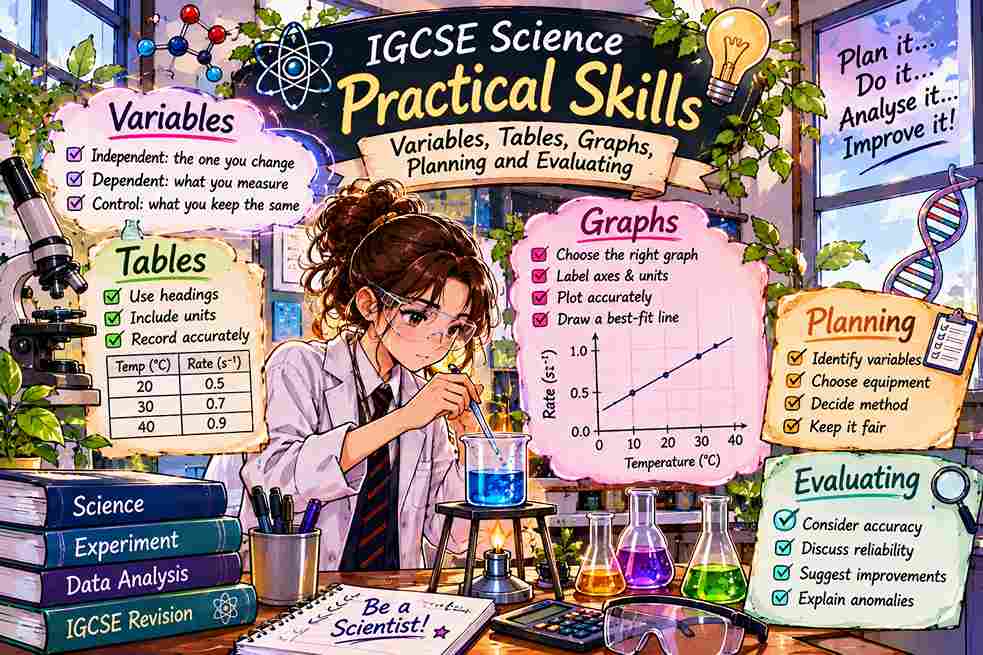
Practical skills are an important part of physics. Students are expected to plan experiments, record measurements, handle data and evaluate results. Some of this is assessed through a practical component, and the details are set out in the current syllabus. Your child will benefit from understanding why a method is chosen, how to record readings clearly and how to spot an anomaly in the data.
Online tutoring can support practical thinking through discussion. A tutor can ask your child to describe an experiment step by step, to explain what each piece of equipment is for and to suggest how the results could be made more reliable. Real equipment at home is helpful where available, but a clear explanation of the method is valuable even without it.
Working with command words
Exam questions use command words such as describe, explain, state, calculate and suggest. Each one asks for a different kind of answer. A question that says state needs a short, precise fact, while one that says explain needs a reason linked to a physical idea. Many students lose marks not because they lack knowledge, but because they answer a different question from the one asked.
Practise this by highlighting the command word in each question before your child starts writing. Ask them to say, in one sentence, what kind of answer that word requires. Over time this becomes automatic. A tutor can help by checking answers against the official guidance on command words and pointing out where a response went beyond what was asked.
A realistic weekly routine
Most students make steady progress with regular, focused practice. A simple routine could include:
- One session to work through a topic and its key ideas
- One session to practise calculations and check units carefully
- One session each few weeks to attempt a past paper and review it
- Short revision of formulas and definitions between sessions
Sessions do not need to be long to be effective. A focused hour, repeated across the week, usually does more than an occasional long cramming session. Keep a notebook of mistakes and revisit them every week until they stop repeating.
Rest matters too. Students who study in long, tired sessions often make careless errors, and those errors can look like gaps in knowledge. Build in days off, and keep the last few days before an exam calm and focused on review rather than new material.
Keeping track of progress
Progress in physics is easier to see when it is recorded. Ask your child to keep a simple log with three columns: the topic, the mistake made and the correction. Review the log before each session and check whether the same mistakes keep returning. If units cause repeated trouble, spend a session on unit conversions alone. Small, targeted changes often produce faster gains than general revision.
Ask the tutor to share a short summary after each session, covering what was covered, what went well and what to practise next. This gives you a clear picture of progress without needing to follow every detail of the physics yourself.
Questions to ask before booking a tutor
Choosing a tutor is easier when you know what to ask. Consider these points:
1. Ask whether the tutor teaches O-Level Physics, and which parts of the current syllabus they are most familiar with.
2. Ask how they help with calculations, including units and rearranging formulas.
3. Ask how they practise exam technique, such as answering structured questions and using command words.
4. Ask how they explain practical work, and whether they include discussion of experiments.
5. Ask which past papers and resources they use, and how they check that materials match the current syllabus.
6. Book a free trial class, and see whether your child feels able to ask questions freely.
Ask also how the tutor reports progress. Clear, specific feedback after each session helps you see what your child is working on.
How EdFlik can help
EdFlik runs live, one-to-one online classes for children and teens aged 3 to 18. Classes last about one hour, and pricing starts from AED 45 per class. In each session, your child can ask questions, work through problems together and get real-time feedback on their working.
We confirm whether a tutor teaches a particular course before we promise it, so please ask us whether a tutor teaches O-Level Physics before you commit. If the answer is yes, the next step is a free trial class. You can start at www.edflik.com, or write to support@edflik.com with your child's age, current level and exam timeline. A free trial gives your child a chance to see how the lessons feel and whether the approach suits them.
Conclusion
O-Level Physics rewards careful reasoning, good habits and steady practice. Students who understand the syllabus, practise past papers and learn from their mistakes often build real confidence over time. Start by reading the current official syllabus, then ask your child which topics they enjoy and which feel unclear. A free trial class is a useful way to find out whether the teaching style is right for them.
Frequently Asked Questions
What does O-Level Physics cover?
O-Level Physics covers topics such as forces and motion, energy, waves, electricity and magnetism, and the particle nature of matter. Students learn concepts, carry out calculations and explain ideas clearly. The official syllabus sets out the full list, so check the current version before you plan.
Which exam papers do students sit?
Students sit written papers that test knowledge and application, and a practical assessment is also part of the course. The exact structure, timing and mark allocation are set by the examining body. Check the current official guidance for the papers your child will sit.
Is O-Level Physics the same as IGCSE Physics?
They are different qualifications set by different examining bodies, so their syllabuses and assessments are not identical. Some topics overlap. Check the current syllabus for each qualification to see how they differ and which one your child's school follows.
How many hours of practice does a student need?
The right amount depends on the student's starting point, their school timetable and their goals. Many students benefit from regular weekly practice, with extra time before exams. Ask a tutor to suggest a plan after an initial session, and adjust as your child progresses.
Can a tutor help with practical skills?
A tutor can help your child plan experiments, record results, handle data and evaluate method. Discussion of practical work is valuable even without equipment at home. Ask whether the tutor includes practical topics in their lessons and how they explain them.
More on IGCSE & GCSE