Structuring an IB MYP Humanities Source Evaluation: How to Analyse Origin, Purpose, and Value
Last Updated: October 2026 | By EdFlik Education Team
For students navigating the International Baccalaureate (IB) Middle Years Programme (MYP) Individuals and Societies (Humanities) curriculum—whether in Years 4 and 5 leading into eAssessments or across international schools in Dubai and globally—source evaluation is one of the most rigorously tested assessment criteria.
Across MYP Criteria A (Knowing and understanding), B (Investigating), C (Communicating), and D (Thinking critically), students are consistently required to interrogate historical, economic, geographical, and political sources. When faced with an unfamiliar photograph from the 1920s, an excerpt from a politician's memoir, or a statistical infographic from an international agency, many students freeze. They either summarize what the source says or make vague assertions without analytical depth.
In this comprehensive, exam-focused masterclass guide, our expert MYP Humanities educators break down the foolproof OPVL (Origin, Purpose, Value, Limitation) or OPV (Origin, Purpose, Value) evaluation frameworks, providing step-by-step structural templates to help you secure top achievement levels.
Part 1: Why Source Evaluation Matters in MYP Humanities
Humanities is not about memorizing dates and reciting historical facts; it is about acting as a historian, geographer, economist, or political scientist. In the real world, information is biased, incomplete, or politically motivated.
When you evaluate a source in an MYP assessment, examiners are testing your ability to:
- Recognize who created a piece of evidence and under what historical circumstances.
- Determine why the source was created (its intended audience and objective).
- Assess how useful (valuable) the source is for a specific inquiry while acknowledging its inevitable blind spots (limitations).
Part 2: The Core Framework — Breaking Down O, P, and V
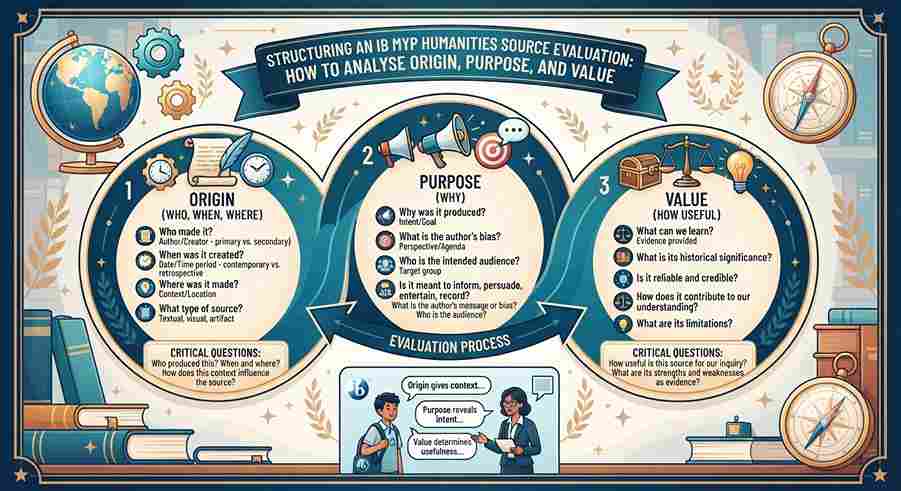
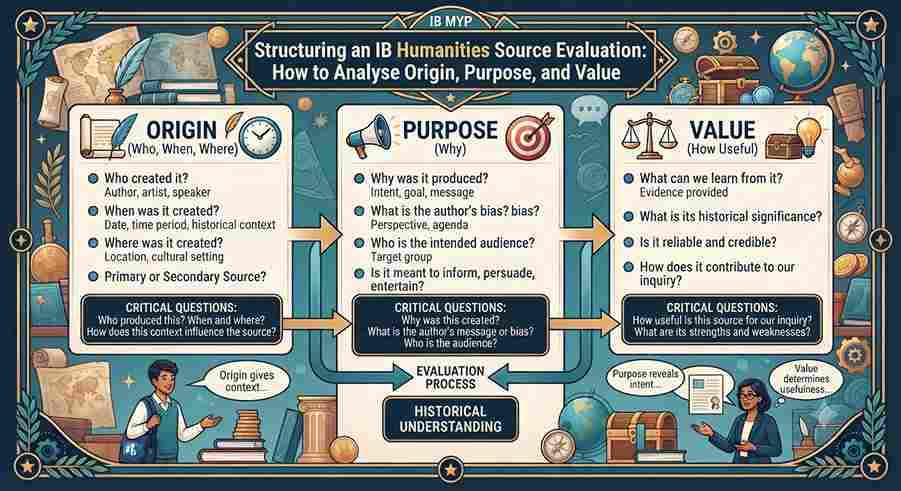
To construct a high-scoring paragraph or multi-paragraph source evaluation, you must systematically address three pillars: Origin, Purpose, and Value (and optionally, Limitations).
1. Origin (Who, When, Where)
The origin refers to the metadata surrounding the source. To analyze origin effectively, you must ask:
- Who created the source? (An eyewitness, a government official, a journalist, an anonymous pamphleteer?)
- When was it created? (Contemporaneous with the event, or years later in hindsight/memoir?)
- Where was it published? (In a democratic nation with free press, or under a strict authoritarian regime with censorship?)
Example Analysis Frame:
"The source is a diary entry written by a British frontline soldier during the Battle of the Somme in July 1916. Because it was recorded contemporaneously by an eyewitness directly participating in the events, its origin provides immediate, first-hand qualitative insight into trench conditions..."
2. Purpose (Why and For Whom)
Purpose examines the author's underlying motive. Why did they sit down to write, photograph, or paint this?
- Is it meant to persuade, inform, entertain, propagandize, justify an action, or record private reflections?
- Who is the intended audience? (A private diary meant for nobody else, a public newspaper read by voters, or a secret government cable?)
Example Analysis Frame:
"The purpose of this speech, delivered by a political leader to parliament in 1938, was to persuade legislators to support increased military defense spending in response to rising geopolitical tensions..."
3. Value (Utility to the Historian / Investigator)
Value is where students often lose marks by writing generic statements like "This source is valuable because it gives information." You must explicitly link value back to what specific aspect of the inquiry the source illuminates.
- Does its origin give it first-hand eyewitness reliability?
- Does its purpose reveal contemporary political attitudes, propaganda strategies, or emotional responses of the era?
Example Analysis Frame:
"The source is of high value to an historian studying public morale during wartime because, as a widely circulated propaganda poster, it directly reveals the emotional appeals and patriotic messaging that governments utilized to influence civilian behavior..."
Part 3: The Step-by-Step Writing Structure (The PEEL Method)
When writing an MYP source evaluation response, structure your analysis using a modified PEEL (Point, Evidence, Explanation, Link) paragraph framework:
- Sentence 1 (Point & Origin): Identify the source and analyze the implications of its origin (author, date, context).
- Sentence 2 (Purpose): Explain the author's intent and target audience.
- Sentence 3 (Value): Evaluate specific strengths regarding what we can learn from the source.
- Sentence 4 (Limitation - Optional/Bonus): Acknowledge bias, gaps, or agenda that restricts its reliability.
Part 4: Top 4 Traps That Cost MYP Humanities Marks
- Describing Instead of Analyzing: Spending 90% of your answer summarizing what is written in the source rather than evaluating who wrote it and why. Examiners already know what the source says; they want to know your critical critique of its reliability.
- Generic "Value" Statements: Writing phrases like "It is very useful for history." You must specify what it helps us understand (e.g., economic hardships, tactical military failures, social attitudes toward gender).
- Ignoring Temporal Proximity: Forgetting to consider whether the source was created during the event (primary) or decades later in a biased memoir when memories faded or reputations were being protected.
- Confusing Bias with Worthlessness: Assuming that because a source is heavily biased (e.g., Nazi propaganda or a political campaign ad), it has zero value. In humanities, biased sources are often of immense value because they reveal the exact propaganda techniques and psychological tactics used by leaders at the time!
Preparing for MYP eAssessments or seeking targeted humanities support? EdFlik connects international school students globally with expert, 1-to-1 online humanities tutors, helping you master source evaluation, critical thinking, and exam writing techniques to secure top grade 7 outcomes.Book a Free Demo Class Today!
Frequently Asked Questions (FAQs)
Q1: What is the difference between primary and secondary sources in MYP Humanities?
Ans: Primary sources are created during the time period being studied (eyewitness accounts, photographs, government documents, artifacts). Secondary sources are interpretations created later by historians or analysts examining primary evidence (textbooks, historical documentaries, scholarly journals).
Q2: Do I always have to evaluate limitations in an MYP source question?
Ans: It depends on the specific command term and mark scheme of the assessment task. If the prompt asks you to evaluate "origin, purpose, and value," focus heavily on those three. If it asks for "limitations," you must discuss what the source leaves out or how bias distorts the truth.
Q3: How can I identify the hidden purpose behind a historical photograph?
Ans: Look at framing, composition, and what is excluded from the camera frame. Photographs are rarely entirely neutral; photographers choose what to capture, and government photojournalists during wartime often staged or curated images to boost morale.
Q4: How does EdFlik support IB MYP students?
Ans: EdFlik connects international school students worldwide with vetted, expert 1-to-1 online tutors specializing in IB MYP Individuals and Societies, Language & Literature, and Sciences. Our personalized sessions focus on developing critical analytical skills, structuring high-scoring essays, and preparing for eAssessments.