Synthesizing Phenylamine and Diazonium Salts: Cambridge AS & A-Level Chemistry Organic Pathways
Last Updated: October 28, 2026 | By EdFlik Team
In the Cambridge International AS & A Level Chemistry (9701) specification, nitrogen compounds—specifically phenylamine (aniline) and benzenediazonium salts—form one of the most vital synthetic pathways in organic chemistry.
Appearing prominently across Paper 1 (Multiple Choice), Paper 2 (AS Level Structured Questions), and Paper 4 (A Level Structured Questions), questions on aromatic substitution, reduction mechanisms, diazotization conditions, and azo-dye coupling reactions carry high-tariff marks. Capable chemistry students often lose marks due to precise mark-scheme requirements: omitting specific reagents (e.g., specifying $\text{Tin/HCl}$ vs $\text{LiAlH}_4$), forgetting temperature constraints ($< 10^\circ\text{C}$), or misdrawing structural formulas for azo linkage ($-\text{N}=\text{N}-$).
This comprehensive, exam-focused masterclass guide breaks down the multi-stage synthesis of phenylamine from benzene, diazotization conditions, coupling reactions, and key examiner mark-scheme traps.
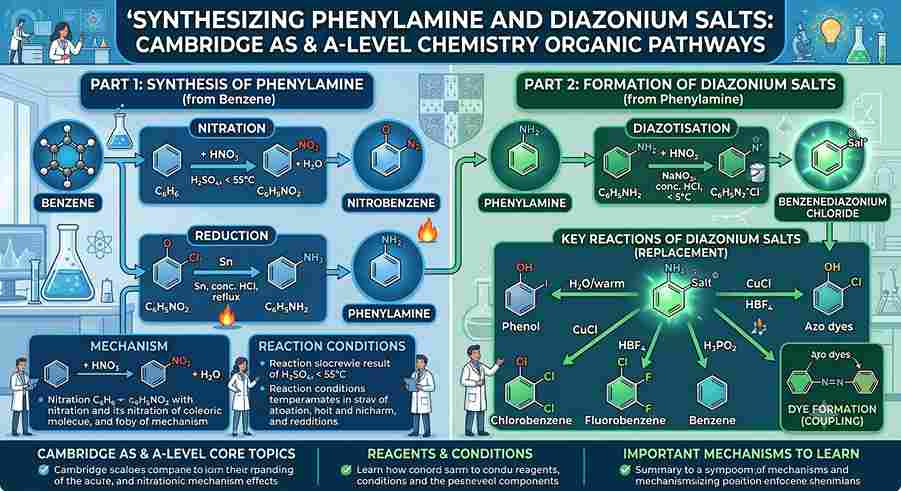
Part 1: Synthetic Roadmap Overview
The transformation of benzene into functionalized aromatic compounds like phenol or azo dyes follows a precise multi-step synthetic sequence:
$$\text{Benzene} \xrightarrow[\text{Electrophilic Substitution}]{\text{Nitration}} \text{Nitrobenzene} \xrightarrow[\text{Reduction}]{\text{Tin / Concentrated HCl}} \text{Phenylamine} \xrightarrow[\text{Diazotization}]{\text{HNO}_2 + \text{HCl}, < 10^\circ\text{C}} \text{Benzenediazonium Chloride}$$
                   AROMATIC NITROGEN SYNTHETIC PATHWAY
                                    |
  1. BENZENE NITRATION            ---> Conc. $\text{HNO}_3$ + Conc. $\text{H}_2\text{SO}_4$ at $50^\circ\text{C} - 55^\circ\text{C}$
  2. NITROBENZENE REDUCTION       ---> Tin (Sn) + Conc. $\text{HCl}$, heat under reflux, then add $\text{NaOH(aq)}$
  3. DIAZOTIZATION OF PHENYLAMINE ---> $\text{NaNO}_2$ + Conc. $\text{HCl}$ below $10^\circ\text{C}$ ($0^\circ\text{C} - 5^\circ\text{C}$)
  4. AZO COUPLING REACTION         ---> Alkaline phenol / naphthalen-2-ol to form brightly colored Azo Dyes
Part 2: Step 1 — Nitration of Benzene to Nitrobenzene
Before synthesizing phenylamine, benzene must undergo electrophilic aromatic substitution to introduce a nitro group ($-\text{NO}_2$).
Reaction Conditions and Reagents:
- Reagents: Concentrated Nitric Acid ($\text{HNO}_3$) and Concentrated Sulfuric Acid ($\text{H}_2\text{SO}_4$).
- Electrophile Generation: Sulfuric acid acts as a catalyst and protonates nitric acid to generate the nitronium ion ($\text{NO}_2^+$):$$\text{HNO}_3 + 2\text{H}_2\text{SO}_4 \rightleftharpoons \text{NO}_2^+ + \text{H}_3\text{O}^+ + 2\text{HSO}_4^-$$
- Temperature Control: Maintained strictly at $50^\circ\text{C} - 55^\circ\text{C}$. If the temperature exceeds $60^\circ\text{C}$, further substitution occurs to form 1,3-dinitrobenzene.
Part 3: Step 2 — Reduction of Nitrobenzene to Phenylamine
Reducing the nitro group ($-\text{NO}_2$) to a primary aromatic amine ($-\text{NH}_2$) requires specific reducing agents. $\text{LiAlH}_4$ is not used for aromatic nitro reduction as it yields complex side products.
                      NITROBENZENE REDUCTION MECHANICS
                                      |
        +-----------------------------+-----------------------------+
        |                                                           |
STAGE 1: ACIDIC REDUCTION                                  STAGE 2: BASE NEUTRALIZATION
• Heat nitrobenzene under reflux with                      • The phenylammonium ion ($\text{C}_6\text{H}_5\text{NH}_3^+$)
  **Tin (Sn)** and **Concentrated $\text{HCl}$**.             is liberated to free phenylamine ($\text{C}_6\text{H}_5\text{NH}_2$)
• Form: Phenylammonium chloride.                             by adding excess aqueous sodium hydroxide ($\text{NaOH}$).
Chemical Equation:
$$\text{C}_6\text{H}_5\text{NO}_2 + 6[\text{H}] \xrightarrow[\text{heat under reflux}]{\text{Sn / conc. HCl}} \text{C}_6\text{H}_5\text{NH}_2 + 2\text{H}_2\text{O}$$
Part 4: Step 3 — Diazotization of Phenylamine
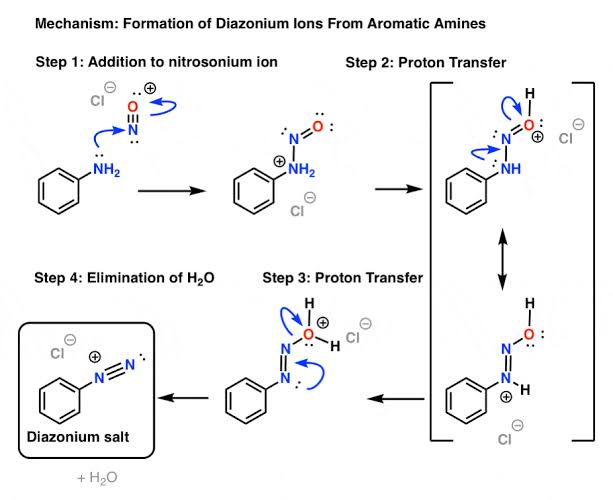
Phenylamine reacts with nitrous acid ($\text{HNO}_2$) to form a benzenediazonium salt. Because nitrous acid is unstable at room temperature, it must be generated in situ.
1. Reagents and Temperature Control:
- Generating $\text{HNO}_2$: Sodium nitrite ($\text{NaNO}_2$) + Concentrated Hydrochloric Acid ($\text{HCl}$):$$\text{NaNO}_2 + \text{HCl} \rightarrow \text{HNO}_2 + \text{NaCl}$$
- Temperature Constraint: Maintained strictly between $0^\circ\text{C}$ and $10^\circ\text{C}$ (ideally an ice bath at $5^\circ\text{C}$).
2. Temperature Sensitivity Trap:
- If $T > 10^\circ\text{C}$: Benzenediazonium chloride decomposes rapidly in water via hydrolysis to produce phenol and nitrogen gas:$$\text{C}_6\text{H}_5\text{N}_2^+\text{Cl}^- + \text{H}_2\text{O} \xrightarrow{> 10^\circ\text{C}} \text{C}_6\text{H}_5\text{OH} + \text{N}_2\text{(g)} + \text{HCl}\text{(aq)}$$
Part 5: Step 4 — Coupling Reactions and Azo Dye Synthesis
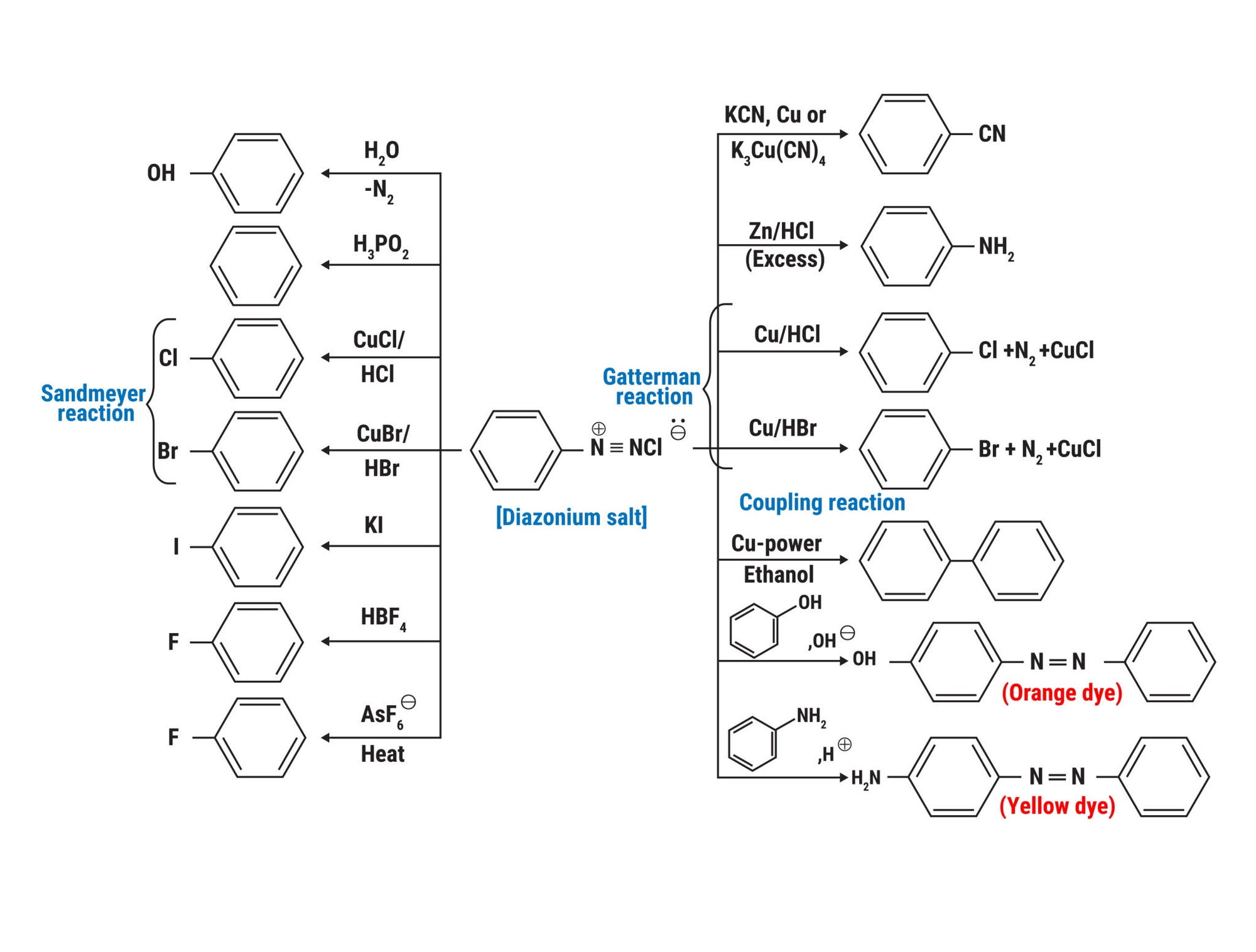
Benzenediazonium ions ($\text{C}_6\text{H}_5\text{N}_2^+$) act as weak electrophiles. They undergo electrophilic substitution reactions with highly activated aromatic rings, such as phenol or naphthalen-2-ol, to form stable azo dyes.
Reaction Conditions for Phenol Coupling:
- Phenol is dissolved in alkaline solution (sodium hydroxide, $\text{NaOH}$) to form the phenoxide ion ($\text{C}_6\text{H}_5\text{O}^-$), which is much more reactive toward electrophiles than neutral phenol.
- The cold benzenediazonium chloride solution is added.
- A yellow/orange precipitate of 4-hydroxyazobenzene forms immediately.
Chemical Equation for Coupling:
$$\text{C}_6\text{H}_5\text{N}_2^+\text{Cl}^- + \text{C}_6\text{H}_5\text{O}^- + \text{OH}^- \rightarrow \text{C}_6\text{H}_5-\text{N}=\text{N}-\text{C}_6\text{H}_4\text{OH} + \text{Cl}^- + \text{H}_2\text{O}$$
                THE STRUCTURE OF AN AZO DYE LINKAGE
                                   |
                  $$\text{Ar}_1 - \text{N}=\text{N} - \text{Ar}_2$$

• **Azo Group:** $-\text{N}=\text{N}-$ connects two aromatic rings.
• **Delocalization:** Extended conjugated $\pi$-system across both benzene rings
  absorbs visible light, imparting intense yellow, orange, or red color.
Part 6: Top 4 Traps That Cost Students Marks in Cambridge 9701
- Specifying the Wrong Reducing Agent: Writing $\text{LiAlH}_4$ or $\text{NaBH}_4$ for reducing nitrobenzene to phenylamine. Cambridge mark schemes strictly require Tin (Sn) + Concentrated $\text{HCl}$ followed by $\text{NaOH}$.
- Forgetting Temperature Limits: Writing "room temperature" for diazotization. You must state below $10^\circ\text{C}$ or $0^\circ\text{C} - 5^\circ\text{C}$ to earn the mark.
- Mishandling Neutralization Steps: Omitting the addition of $\text{NaOH}$ after reduction with $\text{Sn/HCl}$. Without $\text{NaOH}$, the product remains as the salt phenylammonium chloride ($\text{C}_6\text{H}_5\text{NH}_3^+\text{Cl}^-$) rather than free phenylamine.
- Drawing Nitrogen Triple Bonds in Azo Linkages: Writing $-\text{N}\equiv\text{N}-$ inside the final azo dye structure instead of the correct double bond $-\text{N}=\text{N}-$.
Looking for 1-on-1 tutoring support to master A-Level organic pathways? Book a class on EdFlik.
Frequently Asked Questions (FAQs)
Q1: Why are diazonium salts stored below 10°C?
Ans: Benzenediazonium salts are thermally unstable. Above $10^\circ\text{C}$, the diazonium group ($-\text{N}_2^+$) breaks down rapidly into nitrogen gas ($\text{N}_2$) and a phenyl cation, reacting with water to form phenol.
Q2: What is the purpose of adding NaOH in the coupling reaction with phenol?
Ans: Adding $\text{NaOH}$ deprotonates phenol to form the phenoxide ion ($\text{C}_6\text{H}_5\text{O}^-$). The negative charge increases electron density on the benzene ring, making it sufficiently reactive to attack the weak $\text{C}_6\text{H}_5\text{N}_2^+$ electrophile.
Q3: Why are azo dyes colored?
Ans: The azo group ($-\text{N}=\text{N}-$) links two aromatic $\pi$-electron clouds into a single, highly delocalized conjugated system. This lowers the energy gap ($\Delta E$) for electron transitions, allowing the molecule to absorb light in the visible spectrum.
More on A-Level
- A-Levels in the UAE: A Complete Guide to Boards, Subjects, Exams and University Entry
- A-Level Chemistry Tutor: How to Master Organic Chemistry and Mechanisms (2026 Guide)
- A-Level Physics Tutor in the UAE: Mastering Cambridge 9702 from AS to A2
- A-Level Chemistry 9701 UAE 2026 — Organic Mechanisms, Electrochemistry and Paper 5 Guide
- All A-Level articles