
How to Correct Errors Not Affecting the Trial Balance in IGCSE Accounting
Last Updated: October 29, 2026 | By EdFlik Team
In Cambridge IGCSE Accounting (0452) and Pearson Edexcel IGCSE Accounting (4AC1), mastering book-keeping corrections is critical for scoring top grades on Paper 1 (Multiple Choice) and Paper 2 (Structured Written Paper).
A central principle of double-entry book-keeping states that for every debit entry, there must be an equal and opposite credit entry. Consequently, if total debit balances equal total credit balances, the Trial Balance balances.
However, a balanced trial balance does not guarantee that the accounting records are error-free. Certain fundamental mistakes maintain equal debit and credit figures, allowing the trial balance to balance perfectly while hiding underlying errors.
This masterclass guide breaks down the six errors that do not affect the trial balance, provides a step-by-step correcting journal protocol, walks through worked exam examples, highlights common pitfalls, and supplies a 100% copy-paste JSON-LD schema markup script.
Part 1: The 6 Errors Not Affecting the Trial Balance
When correcting errors in IGCSE Accounting, the first diagnostic test is determining whether a Suspense Account is required. Errors that do not affect the trial balance never involve a Suspense Account because total debits already equal total credits.
              ERRORS NOT AFFECTING THE TRIAL BALANCE (C-O-M-P-I-C)
                                       |
  • Error of OMISSION         ---> Transaction is completely left out of all books of prime entry.
  • Error of COMMISSION       ---> Correct amount entered in the WRONG account of the CORRECT class.
  • Error of PRINCIPLE        ---> Correct amount entered in the WRONG account of a DIFFERENT class.
  • Error of ORIGINAL ENTRY   ---> Incorrect figure entered in the book of prime entry and posted to ledger.
  • Error of REVERSAL         ---> Correct accounts used, but debits and credits are completely swapped.
  • COMPENSATING Errors       ---> Two or more independent errors cancel each other out arithmetically.
Part 2: Detailed Breakdown of Each Error Type
1. Error of Omission
- Definition: A transaction is completely omitted from the accounting records. Neither a debit nor a credit entry was made.
- Example: Cash sales of $\$250$ were not recorded anywhere in the books.
- Correction Rule: Record the missing transaction in full.
- Debit: Cash / Bank ($\$250$)
- Credit: Sales Account ($\$250$)
2. Error of Commission
- Definition: A transaction is posted to the wrong account, but the account is in the correct class (e.g., posting to the wrong trade receivable or trade payable personal account).
- Example: A payment of $\$180$ received from credit customer John Smith was credited to John Smyth.
- Correction Rule: Transfer the entry from the incorrect personal account to the correct personal account.
- Debit: John Smyth ($\$180$)
- Credit: John Smith ($\$180$)
3. Error of Principle
- Definition: A transaction is posted to the wrong account of a different class, breaking fundamental accounting principles (e.g., confusing capital expenditure with revenue expenditure).
- Example: Purchase of a new motor vehicle for $\$8,500$ was debited to the Motor Expenses Account instead of the Motor Vehicles Account.
- Correction Rule: Remove the figure from the expense account and debit the non-current asset account.
- Debit: Motor Vehicles Account ($\$8,500$)
- Credit: Motor Expenses Account ($\$8,500$)
4. Error of Original Entry
- Definition: An incorrect figure is entered in the book of prime entry and then posted to both ledger accounts using that same wrong figure.
- Example: Credit purchases from supplier A. Khan of $\$740$ were entered in the Purchases Journal as $\$470$ and posted to both accounts as $\$470$.
- Correction Rule: Record a journal entry for the difference ($\$740 - \$470 = \$270$).
- Debit: Purchases Account ($\$270$)
- Credit: A. Khan Account ($\$270$)
5. Complete Reversal of Entries
- Definition: The correct amounts and accounts are used, but the account that should have been debited was credited, and vice versa.
- Example: Payment of office rent of $\$300$ by cheque was debited to the Bank Account and credited to the Rent Account.
- Correction Rule: Multiply the original transaction amount by 2 to cancel the reversed entry and record the correct entry.
- Debit: Rent Account ($\$600$)
- Credit: Bank Account ($\$600$)
6. Compensating Errors
- Definition: Two or more independent errors on opposite sides of the ledger cancel each other out by coincidence.
- Example: The Sales Account was overstated by $\$100$, and the Rent Account was simultaneously overstated by $\$100$.
- Correction Rule: Adjust both accounts individually to reverse the overstatement/understatement.
- Debit: Sales Account ($\$100$)
- Credit: Rent Account ($\$100$)
Part 3: Step-by-Step Journal Entry Correction Protocol
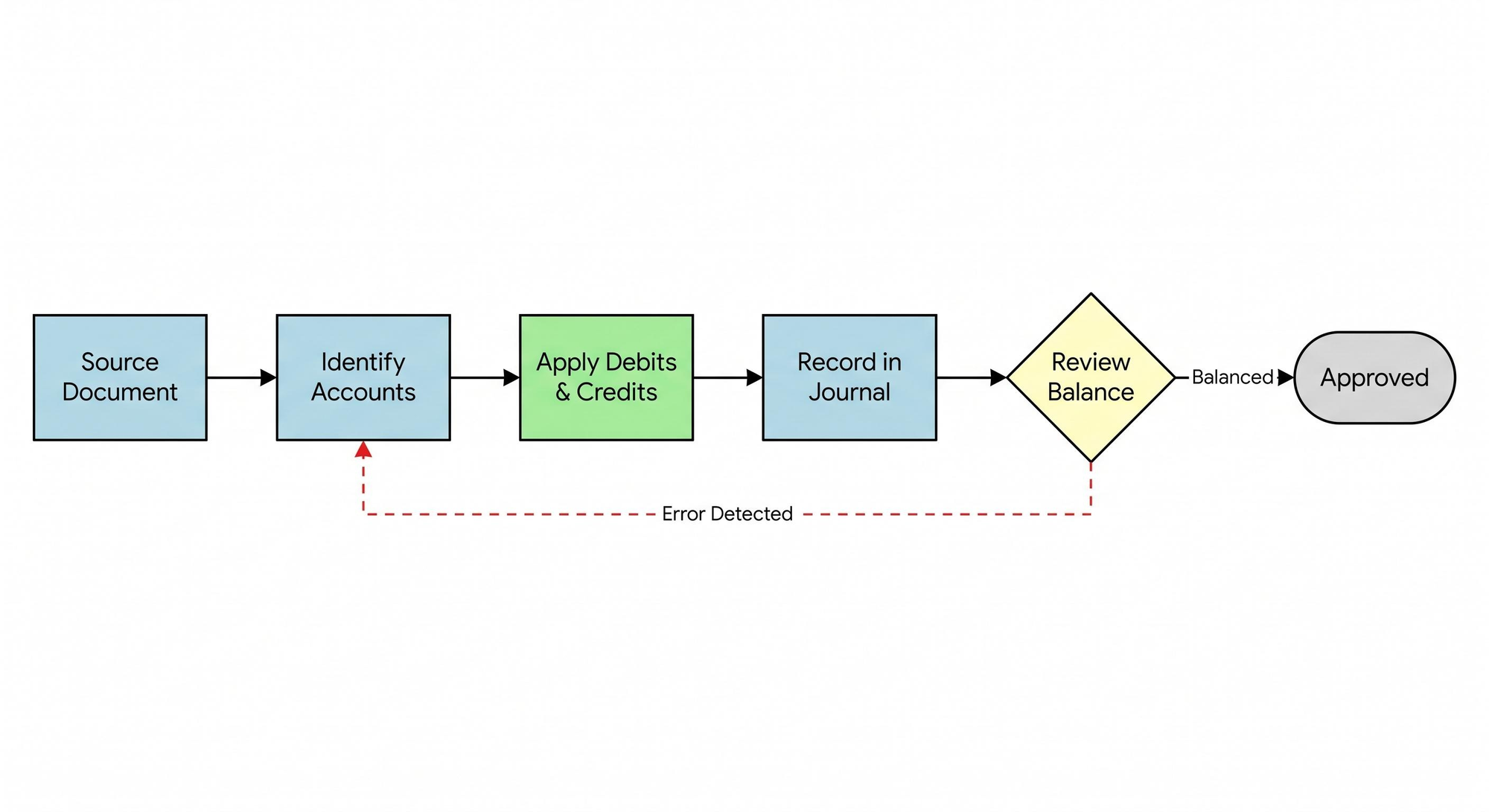
In IGCSE Accounting exams, candidates are required to present corrections using The Journal complete with clear narrative explanations.
                    THE 3-STEP JOURNAL CORRECTION PROTOCOL
                                      |
  Step 1: Identify What WAS Done    ---> Write down the incorrect debit and credit entries made.
  Step 2: Identify What SHOULD Be   ---> Write down the correct debit and credit entries required.
  Step 3: Construct Correcting Entry---> Determine what debits/credits adjust the ledger to the correct state.
Part 4: Fully Worked Exam-Style Scenario
Exam Question:
The trial balance of a sole trader balanced on 31 December 2026. However, the following errors were later discovered:A cheque of $\$420$ paid for machinery repairs was debited to the Machinery Account.Goods sold on credit to Sarah Adams for $\$150$ were recorded in both accounts as $\$510$.Cash drawn by the proprietor for personal use ($\$200$) was debited to the General Expenses Account and credited to Cash.
Task: Prepare the General Journal entries to correct each of the errors above. Narratives are required.
Solution in General Journal Format:
| Date | Details / Account Titles | Debit ($)∣Credit($) |
| 2026 | ||
| Dec 31 | Machinery Repairs Account | 420 |
| Machinery Account | ||
| (Correction of error of principle: machinery repair expense incorrectly debited to non-current asset account) | ||
| Dec 31 | Sales Account | 360 |
| Sarah Adams Account | ||
| (Correction of error of original entry: credit sale overstated by $\$360$ in prime entry books) | ||
| Dec 31 | Drawings Account | 200 |
| General Expenses Account | ||
| (Correction of error of commission/principle: personal drawings debited to general expenses) |
Part 5: Top 4 Traps That Cost Students Marks in IGCSE Accounting
- Unnecessarily Using a Suspense Account: Opening a Suspense Account to correct errors that do not affect the trial balance. If the trial balance balances, never use a Suspense Account.
- Forgetting to Double the Amount on Reversal Errors: Correcting a complete reversal with a single transaction value instead of doubling it. A single amount only zeros out the mistake; doubling it applies the correct balance.
- Confusing Error of Commission with Error of Principle: Classifying an entry made in the wrong class of account (e.g., capital expenditure posted as revenue expenditure) as Commission instead of Principle.
- Omitting Journal Narratives: Forfeiting narrative marks on Paper 2. Always write a brief, clear explanation below each journal entry explaining the error being corrected.
For expert 1-on-1 tutoring support in mastering IGCSE accounting ledger adjustments, trial balances, and financial statement preparation, book a class on EdFlik.
Frequently Asked Questions (FAQs)
Q1: What is the main difference between an Error of Commission and an Error of Principle?
Ans: An Error of Commission occurs when a correct figure is posted to the wrong account within the same class (e.g., debiting A. Smith instead of B. Smith). An Error of Principle occurs when an entry is made in an account of a different class, breaking basic accounting rules (e.g., debiting an expense account instead of an asset account).
Q2: Does an Error of Original Entry affect the Trial Balance?
Ans: No. Because the incorrect figure was entered into the book of prime entry first, that same incorrect figure was debited and credited into the ledger. Since debits still equal credits, the trial balance balances.
Q3: When should a Suspense Account be used in correcting errors?
Ans: A Suspense Account is opened only when the trial balance fails to agree (i.e., total debits do not equal total credits due to one-sided errors, casting errors, or partial omissions).
More on IGCSE & GCSE
- IGCSE in the UAE: A Complete Guide to Boards, Subjects, Exams and Revision
- IGCSE Accounting Tutor UAE 2026 — Cambridge 0452 Double Entry, Financial Statements and Trial Balance Guide
- IGCSE - Accounting
- IGCSE Chemistry Tutor Online: How to Stop Making Calculation Errors (2026 Guide)
- All IGCSE & GCSE articles