How to Improve IGCSE English First Language Essay Writing
By EdFlik Team | November 2, 2026
Mastering essay writing for Cambridge IGCSE First Language English (Syllabus 0500 and 0990) is essential for achieving Grade 8/9 ($A^*$) marks.
Unlike general English exams, the Cambridge IGCSE tests precise skill sets across two main papers: Paper 1 (Reading) and Paper 2 (Directed Writing and Composition). To score in the top bands, candidates must satisfy both Content/Reading (R1–R5) and Writing (W1–W5) Assessment Objectives.
This guide breaks down the core writing tasks, provides structural frameworks for every text type, exposes common examiner traps, and includes 100% copy-paste JSON-LD schema markup.
Part 1: Decoding the IGCSE Essay Tasks
Cambridge evaluates candidates on three distinct essay categories across Paper 1 and Paper 2:
                      IGCSE ENGLISH WRITING TASKS
                                   |
  +--------------------------------+--------------------------------+
  |                                |                                |
1. EXTENDED RESPONSE /          2. DIRECTED WRITING             3. COMPOSITION
   DIRECTED WRITING (P1/P2)        (Paper 2, Section A)            (Paper 2, Section B)
  • Text Types: Speech, Letter,   • Evaluate ideas from two       • Choice of **Descriptive**
    Article, Report, Journal.       source texts.                   or **Narrative** writing.
  • Requires extracting &         • Synthesize, evaluate, and     • Assessed on Content/Structure
    developing text details.        argue a position.               (16 marks) & Style/Accuracy (24).
Assessment Objectives (AOs) Breakdown:
- Reading (AO1): Demonstrate understanding of explicit meanings (R1), implicit meanings (R2), and evaluate/develop facts and opinions (R3).
- Writing (AO2): Articulate experience clearly (W1), organize ideas for deliberate effect (W2), use varied vocabulary and sentence structures (W3), and adapt register to audience and purpose (W4).
Part 2: Directed Writing & Extended Response Masterclass
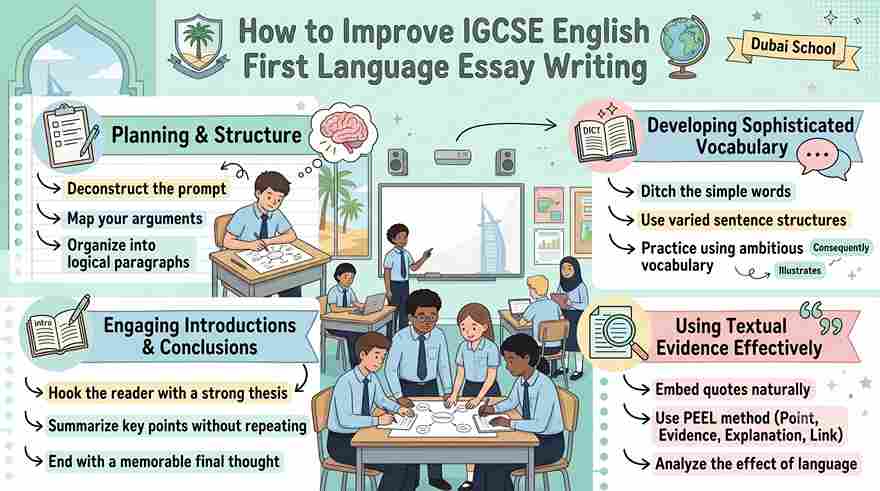
Whether writing a formal letter, speech, article, report, or journal entry, your success depends on adopting the correct Voice, Audience, Register, Purpose, and Format (VARPF).
The 3-Step Evaluation Protocol:
- Extract explicit points: Identify 3–4 core arguments from each reading text.
- Infer implicit meanings: Ask "Why does the writer say this?" or "What are the broader consequences?"
- Evaluate and Develop: Do not merely summarize. Comment on the validity of the arguments, weigh pros and cons, and draw a reasoned conclusion.
                DIRECTED WRITING ESSAY STRUCTURE
                                   |
  Paragraph 1: Introduction  ---> Adopt role/voice, state purpose, establish audience rapport.
  Paragraph 2: Point 1       ---> Evaluate first argument from Source A + offer personal development.
  Paragraph 3: Point 2       ---> Evaluate second argument from Source B + offer counter-perspective.
  Paragraph 4: Point 3       ---> Synthesize opposing views + address implicit implications.
  Paragraph 5: Conclusion    ---> Final persuasive synthesis & call to action suited to text format.
Part 3: Descriptive Writing Masterclass (Paper 2, Section B)
Descriptive writing tests your ability to paint a vivid picture using sensory language, atmospheric mood, and varied spatial structures.
Golden Rule of Descriptive Writing: Avoid narrative features like plot, conflict, dialogue, or action sequences. Focus purely on imagery and impressions.
The "Camera Lens" 5-Paragraph Structure:
                   THE CAMERA LENS DESCRIPTIVE FRAMEWORK
                                     |
  1. LONG SHOT (Wide View)    ---> Establish overall setting, atmosphere, time of day, and weather.
  2. MEDIUM SHOT (Zoom In)   ---> Focus on a specific group, object, or movement within the scene.
  3. CLOSE-UP (Micro Detail)  ---> Describe texture, light reflections, small sounds, or sensory nuances.
  4. PIVOT (Shift in State)   ---> Introduce a change in light, weather, time, or emotional mood.
  5. PANORAMIC (Wide View)   ---> Step back to complete the visual cycle, ending on a resonant image.
High-Band Descriptive Techniques:
- Sensory Engagement: Include sight, sound, smell, touch, and kinetic motion.
- Varied Sentence Openers: Use participle phrases ("Glistening in the morning heat..."), prepositional phrases ("Beneath the fractured pavement..."), and adverbial openers ("Relentlessly, the tide...").
- Controlled Figurative Language: Use original metaphors and personification rather than tired cliches (avoid "dark as night" or "crying like a baby").
Part 4: Narrative Writing Masterclass (Paper 2, Section B)
Narrative tasks evaluate your ability to craft a controlled, engaging story with effective characterization, structural pacing, and a satisfying climax.
                     NARRATIVE ARCHITECTURE (FREYTAG'S PYRAMID)
                                        |
  Phase 1: Exposition      ---> Establish character, setting, and mood quickly (in medias res).
  Phase 2: Inciting Incident---> Introduce a catalyst or disruption.
  Phase 3: Rising Action   ---> Build tension through obstacles; control pacing.
  Phase 4: Climax          ---> The emotional or structural turning point.
  Phase 5: Resolution      ---> Reflective ending; avoid lazy "it was all a dream" tropes.
Top Rules for Narrative Success:
- Limit Characters and Timeframe: Focus on 1 or 2 characters over a short timeframe (e.g., 30 minutes). Expansive epic stories spanning years lose structural control.
- Control Dialogue: Use dialogue sparingly to reveal character traits or advance tension, not for mundane greetings. Format every new speaker on a new line.
- Show, Don't Tell: Instead of writing "He was terrified," write "His fingers trembled against the cold brass handle as his breathing turned shallow."
Part 5: Top 4 Traps That Cost Students Marks
- Lifting Text Chunks in Directed Writing: Copying full sentences directly from the reading texts. Always paraphrase ideas using your own words to secure high Reading and Writing marks.
- Turning Descriptions into Stories: Adding a dramatic plot or character fight into a Descriptive Writing prompt. Keep descriptions focused purely on atmosphere and spatial movement.
- Ignoring Format Conventions: Writing a standard school essay when the prompt asks for a speech, letter, report, or article. Always adopt the required genre features (e.g., formal salutations for letters, headline/subheadings for articles).
- Poor Time Management: Spending too long on Paper 1 comprehension questions and rushing the higher-tariff extended writing tasks.
For expert 1-on-1 tutoring support to master Cambridge IGCSE English First Language essays, refine text-type formats, and achieve top grade bands, book a class on EdFlik.
Frequently Asked Questions (FAQs)
Q1: What is the word count for IGCSE English First Language essays?
Ans: Directed Writing / Extended Response tasks typically require 250 to 350 words (or 250–300 words depending on the specific paper component). Composition tasks (Descriptive/Narrative) require 350 to 450 words. Writing significantly below the recommended length limits your ability to develop ideas fully.
Q2: Should I choose Descriptive or Narrative writing on Paper 2?
Ans: Choose Descriptive Writing if you excel at vocabulary, imagery, and spatial organization. Choose Narrative Writing if you are skilled at building tension, characterization, and pacing a plot effectively.
Q3: How are marks split on Paper 2 Composition?
Ans: Composition tasks are marked out of 40: 16 marks for Content and Structure, and 24 marks for Style and Accuracy. Spelling, punctuation, grammar, and sentence variety account for the majority of the available marks.
More on IGCSE & GCSE