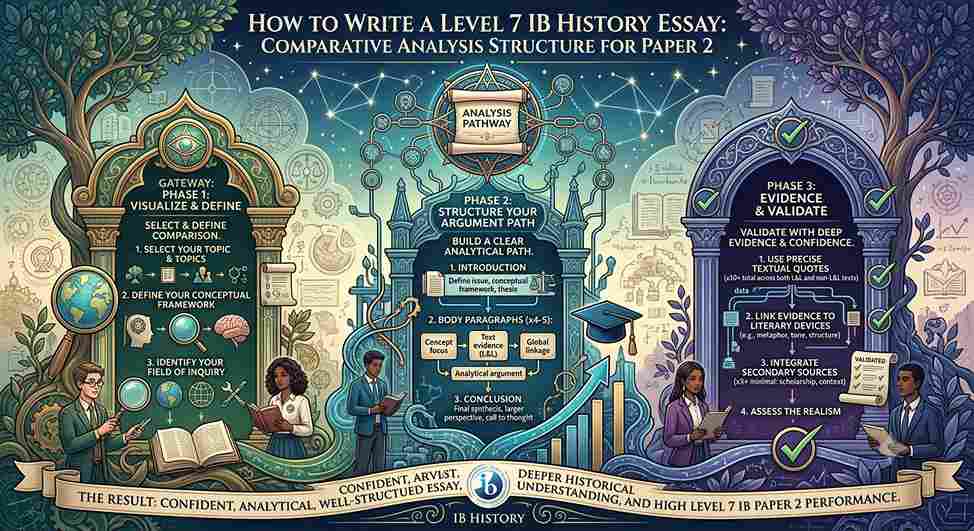
How to Write a Level 7 IB History Essay: Comparative Analysis Structure for Paper 2
Last Updated: October 2026 | By EdFlik Education Team
For high school students enrolled in the International Baccalaureate (IB) Diploma Programme (DP), History Higher Level (HL) and Standard Level (SL) is widely recognized as one of the most intellectually demanding subjects in the curriculum. Among the external assessments, Paper 2 (World History Topics) stands out as the ultimate test of historical synthesis, conceptual understanding, and structural discipline.
Every exam session, thousands of students lose valuable marks not because they lack historical knowledge of twentieth-century authoritarian states, independence movements, or the Cold War, but because their essays are structured as consecutive single-state descriptions rather than a true thematic comparative analysis.
To achieve a coveted Level 7 (22–25/25), your essay must transcend storytelling. It must evaluate multiple historical examples in tandem, weigh contrasting interpretations, and maintain a rigorous thematic thread throughout.
In this comprehensive, exam-focused masterclass guide, our expert IB history educators break down the Paper 2 assessment criteria, introduce our foolproof Thematic Comparative Paragraph Structure, and provide a complete model blueprint to help you secure a Level 7.
Part 1: Deconstructing the IB History Paper 2 Assessment Criteria
Before drafting an essay, you must understand how IB examiners allocate marks across the four assessment criteria for Paper 2 (each worth 5 marks, totaling 20 marks per essay, scaled across two essays):
                   IB HISTORY PAPER 2 ASSESSMENT CRITERIA
                                     |
        +----------------------------+----------------------------+
        |                            |                            |
  CRITERIA A: KNOWLEDGE        CRITERIA B: FOCUS            CRITERIA C: CRITICAL     CRITERIA D: SYNTHESIS
  • Accurate historical        • Addressing the prompt      • Historical reasoning,   • Structuring a cohesive,
    facts, dates, and terms      directly and maintaining     argumentation, and      comparative, and well-
    from two regions             relevance                     historiographical debate supported argument
1. Criterion A: Knowledge and Understanding (5 Marks)
- What it tests: The depth, accuracy, and relevance of your factual knowledge. For Paper 2 world history topics (e.g., Authoritarian States or Cold War), IB regulations require you to integrate examples from at least two different regions of the world (e.g., Latin America and Europe, or Asia and the Middle East).
- Level 7 Secret: Avoid relying on broad generalizations. Integrate precise dates, specific policy names (e.g., Stalin’s First Five-Year Plan or Mao’s Great Leap Forward), and historical terminology.
2. Criterion B: Focus and Understanding of the Question (5 Marks)
- What it tests: How effectively you target the exact demands of the prompt without wandering into irrelevant narrative summaries.
- Level 7 Secret: Deconstruct every command word (Compare, To what extent, Evaluate, Discuss). Your introduction must establish a clear analytical stance that is sustained right through to your conclusion.
3. Criterion C: Critical Thinking (5 Marks)
- What it tests: Your ability to analyze, evaluate, and engage in historiographical debate.
- Level 7 Secret: Do not just state what happened; explain why and how it happened. Integrate alternative historical interpretations (e.g., intentionalist vs. structuralist views) to demonstrate genuine critical maturity.
4. Criterion D: Structure and Synthesis (5 Marks)
- What it tests: The formal organization, clarity, and integrative synthesis of your comparative analysis.
- Level 7 Secret: Never write a blocked essay! A blocked essay is where you write two pages on State A, followed by two pages on State B, with a single concluding paragraph trying to force a comparison. Level 7 essays integrate both states within every single body paragraph.
Part 2: The Blocked Essay vs. The Thematic Comparative Structure
The single most common structural trap in IB History is the blocked format. Here is why it fails, and how the thematic comparative structure achieves Level 7:
                BLOCKED ESSAY (AVOID THIS!)               THEMATIC COMPARATIVE (DO THIS!)
      +------------------------------------------+    +------------------------------------------+
      | Paragraph 1: Introduction                |    | Paragraph 1: Introduction                |
      | Paragraph 2: All about State A (Hitler)  |    | Paragraph 2: Theme 1 (Economic Policy)   |
      | Paragraph 3: All about State B (Castro)  | vs |              - Examines Hitler AND Castro|
      | Paragraph 4: Conclusion (Forced linkage) |    | Paragraph 3: Theme 2 (Use of Force)      |
      |                                          |    |              - Examines Hitler AND Castro|
      | *Result: Caps score at Level 3/4*        |    | Paragraph 4: Theme 3 (Social Control)    |
      |                                          |    | Paragraph 5: Conclusion                  |
      +------------------------------------------+    +------------------------------------------+
Part 3: The Step-by-Step Level 7 Essay Blueprint
When the timer starts in the exam hall, allocate your 45 minutes per essay using this proven time-management and structural blueprint:
Step 1: Planning (5 Minutes)
- Deconstruct the prompt. Identify the core theme and the two required regions.
- Select 3 distinct comparative themes (e.g., Ideological indoctrination, Economic restructuring, Coercive terror).
- Jot down 3-4 precise historical examples, dates, and historians' names for each theme.
Step 2: The Introduction (5 Minutes)
A Level 7 introduction is compact (roughly 4–6 sentences) and contains four essential components:
- Contextual Hook: Briefly anchor the topic in historical time and space.
- Definition of Key Terms: Define ambiguous terms in the prompt (e.g., "authoritarian control" or "successful economic policy").
- Introduction of Case Studies: Clearly name your two states and regions (e.g., Nazi Germany in Europe and Fidel Castro’s Cuba in Latin America).
- Thematic Thesis Statement: Directly answer the prompt by outlining the three comparative themes you will evaluate.
Step 3: Body Paragraphs 1, 2, and 3 (The Thematic Core)
Every body paragraph must be structured around a single comparative theme using our advanced PEEL-C Framework:
                  THE PEEL-C BODY PARAGRAPH STRUCTURE
                                   |
      +----------------------------+----------------------------+
      |                                                         |
  P — Point (Thematic Focus)       E — Evidence (State A)       E — Explanation & Historiography
  State the specific sub-theme     Deploy precise facts and     Analyze how and why this occurred;
  governing this paragraph.        dates for your first state.  integrate a historian's perspective.
      |                                                         |
      +----------------------------+----------------------------+
                                   |
                          C — Comparative Synthesis (State B)
                          Immediately pivot to your second state, comparing
                          similarities, differences, or degrees of success.
Example of a Level 7 Thematic Body Paragraph (Authoritarian States):
"A primary method utilized by both Adolf Hitler and Fidel Castro to consolidate authoritarian control was the systematic restructuring of the national economy to eliminate independent power bases. In Nazi Germany, Hitler achieved this through the implementation of Schacht’s New Plan in 1934 and subsequent Four-Year Plans, which prioritized rearmament and autarky while co-opting major industrial conglomerates like Krupp and IG Farben into state-directed production quotas. Marxist historian Tim Mason argues that economic pressures generated by rearmament forced Hitler into premature aggressive foreign expansion. Similarly, following the revolutionary overthrow of the Batista regime in 1959, Fidel Castro consolidated power by nationalizing American-owned sugar plantations, oil refineries, and banking institutions through the Agrarian Reform Acts. However, unlike Germany’s alliance with private capitalist cartels, Castro’s economic centralization dismantled private enterprise entirely, steering Cuba toward a state-command socialist model dependent on Soviet subsidies under COMECON. Thus, while both leaders leveraged economic restructuring to secure political hegemony, Hitler preserved private corporate structures to serve state military ends, whereas Castro instituted total state ownership to enforce ideological alignment."
Step 4: The Conclusion (5 Minutes)
A Level 7 conclusion must never introduce brand-new historical evidence. Instead, it should:
- Restate your thesis in a fresh, sophisticated way.
- Synthesize the main comparative findings across your three themes.
- Deliver a final, sweeping historical judgment answering the prompt's overarching question.
Part 4: Top 4 Traps That Prevent Students from Scoring a Level 7
- Writing a Narrative Instead of an Argument: Telling a chronological story of what happened in 1933 or 1959 instead of analyzing why and how historical developments occurred in response to the prompt.
- Failing the Regional Requirement: Discussing two states located in the same region (e.g., Nazi Germany and Fascist Italy, which are both in Europe). IB Paper 2 mandates examples from different regions of the world! Always pair a European state with an Asian, Latin American, or Middle Eastern state.
- Neglecting Historiography: Ignoring historians' interpretations entirely. Weaving in differing viewpoints (e.g., intentionalist vs. structuralist, revisionist vs. orthodox) is essential for top-band critical thinking marks.
- Running Out of Time: Spending 30 minutes writing an overly exhaustive first essay and leaving only 15 minutes to rush the second essay. Balance your timing strictly: 45 minutes per essay.
Preparing for IB History Paper 2 exams and aiming for a Level 7 grade? EdFlik connects international school students globally with expert, 1-to-1 online IB History tutors, helping you master comparative essay structures, historiographical debates, regional pairings, and timed exam strategies. Book a Free Demo Class Today!
Frequently Asked Questions (FAQs)
Q1: How many states should I write about in an IB History Paper 2 essay?
Ans: You should focus on two well-chosen states from different regions of the world. Trying to cram three or four states into a 45-minute essay leads to superficial descriptions and prevents you from achieving the deep, detailed analysis required for a Level 7.
Q2: What are the official IB regions of the world?
Ans: The IB recognizes four distinct geographic regions for history assessments:
- Africa and the Middle East
- The Americas
- Asia and Oceania
- Europe
Q3: How important is historiography in Paper 2 essays?
Ans: While not explicitly mandatory in every single bullet point of the mark scheme, integrating named historians and contrasting interpretations (historiography) is the hallmark of a Level 7 essay under Criterion C (Critical Thinking).
Q4: How does EdFlik support IB History students?
Ans: EdFlik connects international school students worldwide with vetted, expert 1-to-1 online tutors specializing in IB DP History (SL/HL). Our personalized coaching focuses on structuring comparative essays, integrating historiographical debates, selecting optimal regional case studies, and practicing under timed exam conditions.