IGCSE History Tutor in the UAE: How to Score A* in Cambridge 0470
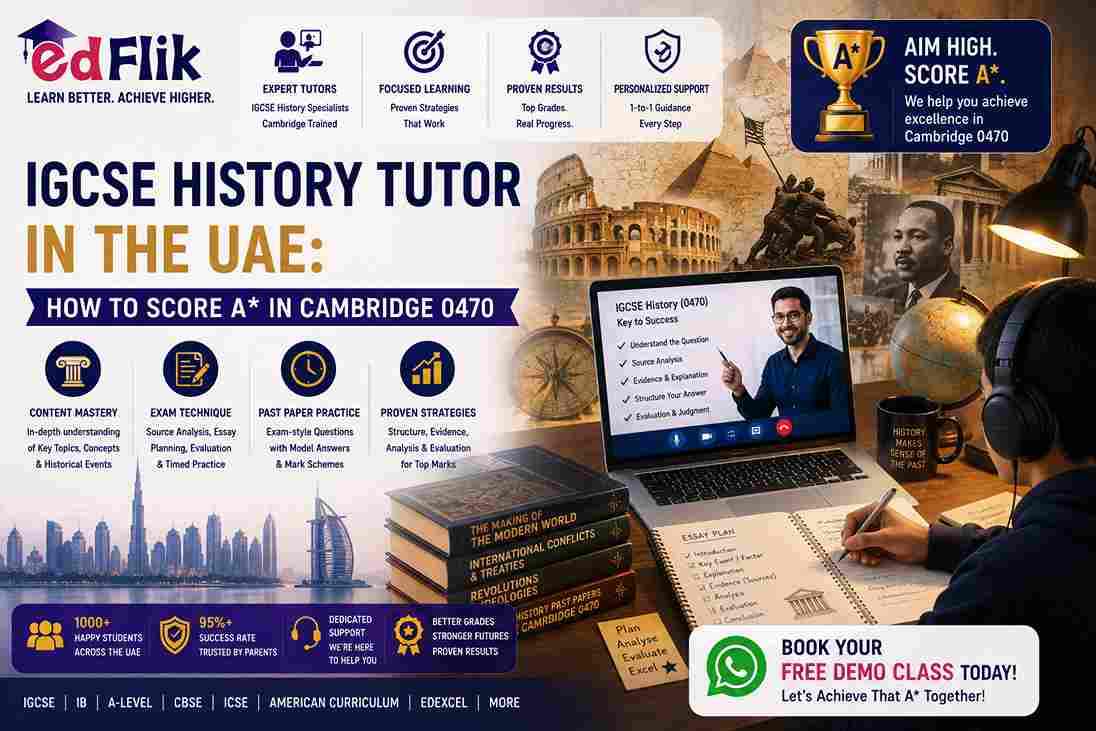
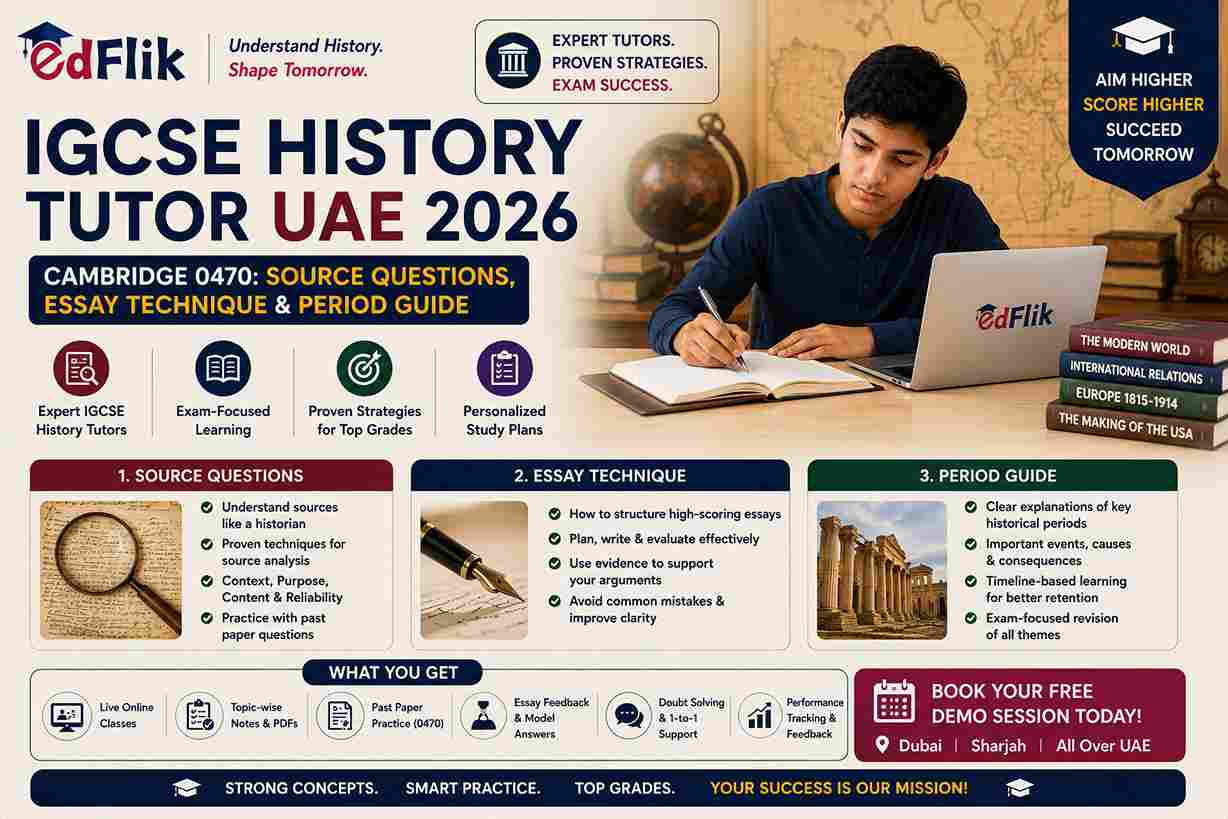
Cambridge IGCSE History (0470) is one of the most rewarding but also one of the most technically demanding subjects on the IGCSE timetable. Students across the UAE — at schools in Dubai, Abu Dhabi, Sharjah, and beyond — frequently find that a good understanding of historical content is not sufficient on its own to achieve top grades. The examination rewards specific analytical skills: source evaluation, structured essay writing, and the ability to explain causation and consequence with precision. This guide explains the structure of Cambridge IGCSE History, the skills that separate a Grade 7 or A* response from an average one, and how targeted tutoring can close the gap.
Understanding the Cambridge IGCSE History 0470 Examination
Cambridge IGCSE History 0470 is typically assessed through two papers, though some schools also offer a school-assessed coursework component:
· Paper 1: Source-based questions. Students are given a set of sources — written documents, photographs, cartoons, statistics, speeches — and must answer questions that test their ability to comprehend, compare, evaluate, and use those sources as historical evidence.
· Paper 2: Depth studies. Students answer structured questions requiring short factual responses, followed by essay-style questions that test their ability to explain, analyse, and evaluate historical events and causes.
· Component 3 (where offered): Coursework. Students produce a historical investigation responding to a set question, demonstrating research, source evaluation, and extended writing skills.
Most UAE schools following the Cambridge curriculum focus on a combination of modern world history topics — the First World War, the inter-war period, the Second World War, the Cold War, and various prescribed depth studies. The specific topics vary by school and exam series.
Paper 1: Source Analysis — Where Most Students Lose Marks
Paper 1 source-based questions follow a predictable structure, and yet students consistently lose marks in the same places. Understanding this structure is the first step toward improvement.
The questions typically progress through the following levels of demand:
· Comprehension questions: these ask what a source shows, tells, or suggests. Students must quote or paraphrase accurately from the source — marks are not given for background knowledge here.
· Inference questions: these ask what can be inferred from a source — what does it imply, suggest, or show beyond the literal content? Students must read between the lines of the source, not simply describe it.
· Source evaluation questions: these ask how useful a source is, or how reliable it is, as evidence about a particular event or claim. This is where many students underperform — they describe the content rather than evaluate it.
· Comparison and cross-referencing: these ask students to compare two or more sources, identify agreement or disagreement, and explain what this tells us about the topic.
· Extended evaluation questions (typically the final question): these ask students to use all the sources and their own knowledge to reach a conclusion about a historical claim — usually phrased as 'how far do the sources support the view that...'
How to Write a Strong Source Evaluation at IGCSE Level
Source evaluation is the skill that determines whether a student achieves an A or an A* in IGCSE History. Many students know they need to comment on the 'provenance' of a source — who wrote it, when, and why — but they do not know how to turn that observation into a mark-worthy evaluation.
A strong source evaluation answers three questions:
· What does the source show? (Brief summary of content, not lengthy description.)
· Why might this source be useful or reliable? (Consider the provenance: who produced it, when, and with what purpose. Primary sources from participants often have high value for showing contemporary attitudes.)
· Why might this source be limited or unreliable? (Consider bias, omission, purpose, and context. A government propaganda poster tells us what the government wanted people to believe — useful for understanding propaganda, but not necessarily reliable as factual evidence.)
The critical distinction for IGCSE History is that students must evaluate the source's usefulness for a specific purpose — not evaluate the source in general terms. A source might be unreliable as factual evidence but highly useful as evidence of attitudes or beliefs. Students who make this distinction consistently achieve the highest marks.
Paper 2: Essay Technique for IGCSE History
Paper 2 requires students to write historical essays — structured, analytical responses that explain causation, evaluate significance, and reach a supported conclusion. The mark scheme rewards:
· Factual knowledge used analytically — not narrative description of events, but explanation of why events happened, what caused them, and what their consequences were.
· Structured argumentation — a clear introduction that sets up the analytical framework, paragraphs that each develop one point with supporting evidence, and a conclusion that directly addresses the question.
· Balance — particularly in evaluation questions, acknowledging alternative causes or perspectives rather than presenting a one-sided argument.
· Specific detail — vague general statements score fewer marks than precisely named events, dates, people, and consequences.
The depth versus breadth challenge is real in IGCSE History essays. Students who cover many points superficially score lower than students who develop fewer points with genuine analytical depth. An IGCSE History tutor can help students identify which points to develop and how to transform their knowledge into analytical argument.
EdFlik's IGCSE History Tutoring in the UAE
EdFlik's IGCSE History tutors are experienced teachers who know the Cambridge 0470 syllabus thoroughly — including the specific depth studies most commonly taught in UAE international schools. Sessions focus on the skills the examination rewards: source evaluation, essay structure, analytical writing, and exam timing. A free trial class is available so you can assess the quality before committing. Sessions start from AED 45 and are delivered live, one-to-one, online. Visit edflik.com to book.
Frequently Asked Questions
What topics are most commonly covered in Cambridge IGCSE History in UAE schools?
The most commonly covered areas in UAE international schools following Cambridge IGCSE History 0470 include the core study on the causes and effects of the First and Second World Wars, the inter-war period (the rise of dictators and the failure of collective security), and the Cold War. Schools also select specific depth studies from the Cambridge list — common choices include Germany 1918–45, Russia 1905–41, and the Arab-Israeli conflict. The exact topics vary by school and examination series; it is important to confirm which depth studies your child's school has selected before tutoring begins.
How much factual knowledge does my child need for IGCSE History, and how much is technique?
Both matter, but technique is often the binding constraint for students who already have adequate knowledge. IGCSE History rewards analytical use of knowledge, not simply its recall. A student who knows a great deal but cannot structure an essay analytically, evaluate a source effectively, or respond to the specific question asked will score below their potential. An IGCSE History tutor focuses on developing the interpretive and writing skills that transform knowledge into marks. Most students who have studied the topics in class have sufficient content knowledge; what they need is to learn how to deploy it in the way examiners reward.
Is the Cambridge IGCSE History essay assessed differently from other humanities subjects?
Cambridge IGCSE History essay marking is analytical rather than narrative. Examiners use a levels-of-response mark scheme that rewards explanation, analysis, and evaluation — not storytelling or description of what happened. This differs from how students often write in other subjects or in earlier schooling. A History tutor helps students understand exactly what each level of the mark scheme requires and how to write responses that consistently reach the higher levels. Students who shift from narrative to analytical writing typically see the largest improvement in their marks.
Can an EdFlik tutor help my child with IGCSE History coursework as well as examination papers?
Yes. Where schools offer the IGCSE History coursework component (Component 3), EdFlik tutors can support students in planning their investigation, selecting and evaluating sources, structuring their written response, and meeting the assessment criteria for research, analysis, and evaluation. Coursework support is different from examination preparation — it is more iterative and document-focused — but EdFlik tutors are experienced with both components and can tailor sessions to whichever aspect of the course needs most attention.