IGCSE Chemistry 0620 UAE — Observation Language Every Student Must Memorise
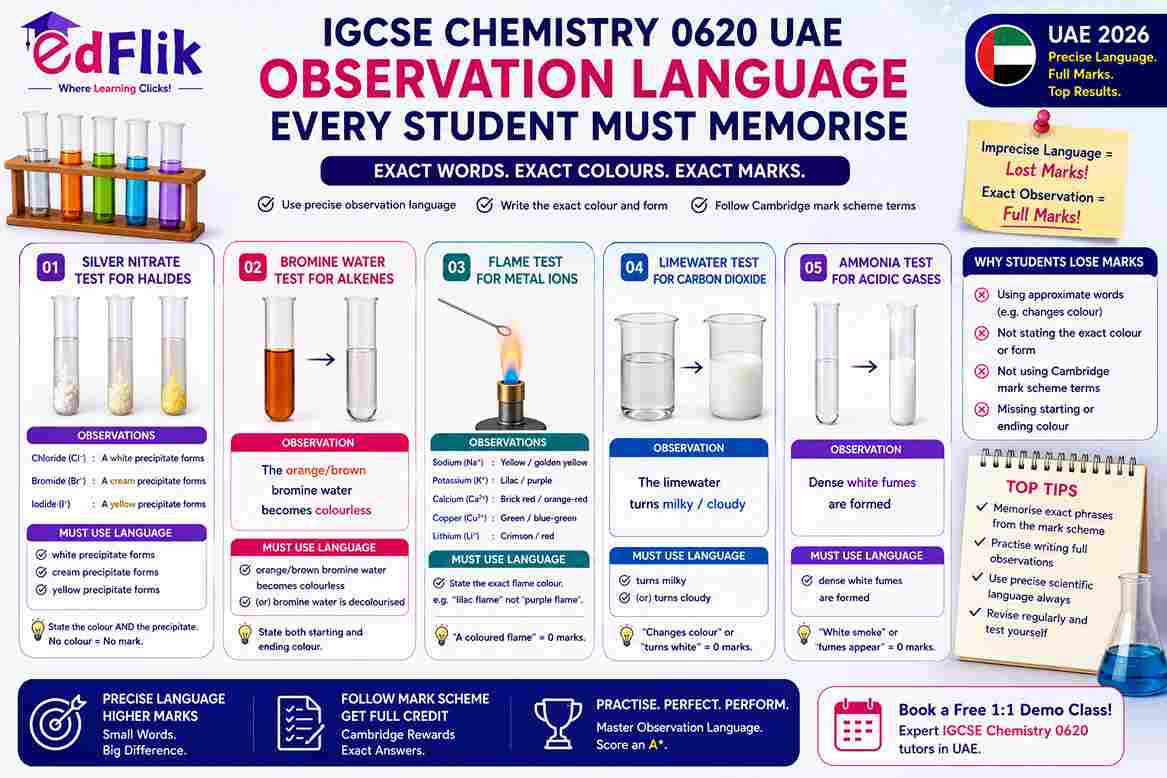
Cambridge IGCSE Chemistry 0620 mark schemes are precise to a degree that surprises many UAE students until they see the pattern in their own lost marks. A student who correctly understands that silver nitrate produces a precipitate with chloride ions, but writes 'a solid appears' instead of 'a white precipitate forms', earns zero marks for that observation. The chemistry is right. The language is wrong. The mark is lost. This is not a content knowledge issue — it is a language precision issue, and it is the most common avoidable cause of Chemistry mark loss across every UAE school that enters students for Cambridge 0620.
This guide provides the complete observation language table for Cambridge 0620 — every identification test, every gas test, every flame test — in the exact form the mark scheme requires. Memorise these before any other Chemistry revision.
Why Observation Language Matters More in Chemistry Than in Any Other IGCSE Subject
In IGCSE Maths, showing method earns marks. In IGCSE Physics, cause-effect chains earn marks. In IGCSE Chemistry, the exact description of what you observe in a chemical test earns the mark — and approximate language earns nothing. Three reasons why observation language is especially important in 0620:
• The mark scheme uses the words 'allow', 'accept', and 'do not accept' explicitly — meaning there is a defined list of acceptable phrasings and a defined list of unacceptable ones. 'A white solid forms' is on the do-not-accept list for many precipitate questions. 'A white precipitate forms' is on the accept list.
• The colour and form are separate mark points. On a 2-mark observation question, one mark may be for the colour and one for the precipitate description. Writing only the colour or only the precipitate form earns 1 out of 2.
• Identification tests are repeated across Papers 2, 4, and 6. A student who learns the exact phrases once applies them across every paper. The marks available from identification tests and gas tests are consistent across every 0620 paper series — typically 15 to 25 percent of Paper 4 marks.
The Complete Cambridge 0620 Observation Language Table
Memorise every entry in this table before any other Chemistry revision. The phrases in the 'Required Observation' column are what the Cambridge mark scheme accepts — approximate language earns zero marks.
|
Test Reagent |
Substance
Being Tested |
Required
Observation (Exact Cambridge Language) |
Common Wrong
Answer (Earns Zero) |
|
Silver nitrate solution (AgNO₃) |
Chloride ions (Cl⁻) |
A white precipitate forms [soluble in dilute ammonia] |
'A solid appears' / 'it goes cloudy' / 'a precipitate forms' (no
colour) |
|
Silver nitrate solution (AgNO₃) |
Bromide ions (Br⁻) |
A cream precipitate forms [partially soluble in concentrated
ammonia] |
'A white precipitate' (wrong colour) |
|
Silver nitrate solution (AgNO₃) |
Iodide ions (I⁻) |
A yellow precipitate forms [insoluble in ammonia] |
'A pale yellow precipitate' is acceptable; 'a white precipitate'
is not |
|
Barium chloride solution (acidified) |
Sulfate ions (SO₄²⁻) |
A white precipitate forms |
'It goes cloudy' / 'a solid forms' (no colour stated) |
|
Bromine water |
Alkene (C=C double bond) |
The orange/brown bromine water becomes colourless [decolourised] |
'The colour changes' / 'it turns clear' (not chemically precise) |
|
Limewater (Ca(OH)₂) |
Carbon dioxide (CO₂) |
The limewater turns milky / cloudy |
'It turns white' / 'it turns opaque' / 'changes colour' |
|
Damp litmus paper |
Chlorine gas (Cl₂) |
The litmus paper is bleached / turns white |
'The litmus paper turns red then white' is also acceptable; 'the
litmus paper changes colour' is not |
|
Burning splint |
Hydrogen gas (H₂) |
Burns with a squeaky pop |
'Makes a pop' (no mention of squeaky) / 'burns quietly' |
|
Glowing splint |
Oxygen gas (O₂) |
The glowing splint relights |
'The splint lights up' / 'the splint burns brighter' |
|
Damp red litmus paper |
Ammonia gas (NH₃) |
The litmus paper turns blue |
'The litmus paper changes colour' / 'it turns purple' |
|
Flame test — wire loop |
Sodium (Na⁺) compounds |
Yellow or golden yellow flame |
'Orange flame' / 'a bright flame' |
|
Flame test — wire loop |
Potassium (K⁺) compounds |
Lilac or purple flame |
'Pink flame' / 'violet flame' |
|
Flame test — wire loop |
Calcium (Ca²⁺) compounds |
Brick red or orange-red flame |
'Red flame' alone — must specify brick red or orange-red |
|
Flame test — wire loop |
Copper (Cu²⁺) compounds |
Green or blue-green flame |
'Blue flame' (copper sulfate solution burns blue but solid copper
compounds give green flame in direct flame test) |
|
Flame test — wire loop |
Lithium (Li⁺) compounds |
Crimson or red flame |
'Pink flame' / 'bright red flame' |
|
Acidified potassium dichromate(VI) |
Alcohol (oxidation test) |
Turns from orange to green |
'Changes colour' / 'turns yellow' (wrong colour stated) |
|
Universal indicator |
Any acid |
States the colour and approximate pH — e.g. red (pH 1–2), orange
(pH 3–4) |
'Turns red' alone — pH must also be stated for full marks on
extended questions |
|
Aqueous sodium hydroxide (NaOH) |
Copper(II) ions (Cu²⁺) |
A blue precipitate forms |
'A pale blue precipitate' is also accepted; 'it turns blue' is
not |
|
Aqueous sodium hydroxide (NaOH) |
Iron(II) ions (Fe²⁺) |
A green precipitate forms |
'A dirty green precipitate' is also accepted; 'a precipitate
forms' (no colour) is not |
|
Aqueous sodium hydroxide (NaOH) |
Iron(III) ions (Fe³⁺) |
A brown/rust-coloured precipitate forms |
'An orange precipitate' and 'a red-brown precipitate' are also
accepted |
The Five Observation Language Errors Cambridge Identifies Most Often
Based on Cambridge IGCSE Chemistry 0620 Principal Examiner Reports from 2019 to 2025, the five most frequently penalised observation language errors from UAE and global students:
1. Writing 'a precipitate forms' without stating the colour. Every precipitate question requires the colour. No colour = no mark for the precipitate description.
2. Writing 'it turns clear' for the bromine water test for alkenes. 'Clear' is not the same as 'colourless' in chemistry. The mark scheme requires 'colourless' or 'decolourised'.
3. Writing 'the litmus paper changes colour' for the chlorine gas test. This is insufficiently precise — the litmus paper is bleached to white (or turns white/colourless). The bleaching is the specific observation, not a colour change.
4. Writing 'a pop' instead of 'a squeaky pop' for the hydrogen test. The word 'squeaky' is required in the mark scheme — it distinguishes the hydrogen ignition sound from other combustion sounds.
5. Writing only the colour in flame tests without specifying the exact shade. For calcium, 'red' is insufficient — 'brick red' or 'orange-red' is required. For potassium, 'purple' is acceptable but 'pink' is not.
How to Memorise the Observation Language Table
Three practical methods for memorising the observation language table for Cambridge 0620:
• Flashcard method: one test per card — reagent on front, required observation on back. Cover the back, state the observation from memory, check. Repeat until correct for all 20 tests without hesitation. Daily review for two weeks.
• Blank table recall: cover the 'Required Observation' column completely. Write the observation for each test from memory. Check against the table. Circle every error. Revise the circled errors. Repeat until the entire table can be completed from memory in under 10 minutes.
• Past paper question practice: from PapaCambridge or PapersDaddy, extract all identification test questions from the last 5 years of 0620 Paper 4. Answer each one using only the table above. Mark against the official Cambridge mark scheme. Every mark lost is a language error — add that specific phrase to your flashcard deck.
Ionic Equations — The State Symbol Requirement
Ionic equations for reactions in solution are tested alongside identification questions. The most common error: writing a correct ionic equation but omitting state symbols. State symbols (aq), (s), (l), and (g) are mandatory in ionic equations — missing any one loses the mark for that equation regardless of whether the ionic equation itself is correct. Example — precipitation of silver chloride: Ag⁺(aq) + Cl⁻(aq) → AgCl(s). Every symbol must be present. 'Ag⁺ + Cl⁻ → AgCl' without state symbols earns zero for the equation.
Frequently Asked Questions — IGCSE Chemistry Observation Language UAE
Q: Why do UAE students lose marks on IGCSE Chemistry identification questions?
A: Imprecise language — writing approximate descriptions instead of the exact phrases the mark scheme requires. 'A solid appears' earns zero where 'a white precipitate forms' is required. The colour and physical form are both mandatory for every precipitate question. This is a language precision gap, not a chemistry knowledge gap.
Q: What is the correct observation for the silver nitrate test for halide ions?
A: Chloride: 'a white precipitate forms' (soluble in dilute ammonia). Bromide: 'a cream precipitate forms' (partially soluble in concentrated ammonia). Iodide: 'a yellow precipitate forms' (insoluble in ammonia). The colour is the key distinguishing observation — white, cream, or yellow must be stated precisely.
Q: What observation is required for the bromine water test for alkenes?
A: 'The orange/brown bromine water becomes colourless' (or 'is decolourised'). Both the starting colour (orange or brown) and the ending colour (colourless) must be stated. 'The colour changes' or 'it turns clear' earn zero marks.
Q: What are the flame test colours UAE IGCSE Chemistry students must memorise?
A: Sodium: yellow or golden yellow. Potassium: lilac or purple. Calcium: brick red or orange-red. Copper: green or blue-green. Lithium: crimson or red. The exact shade is required — 'a coloured flame' earns zero.
Q: What observation is required for the limewater test for carbon dioxide?
A: 'The limewater turns milky' or 'the limewater turns cloudy'. Both accepted. 'It turns white' or 'changes colour' earns zero.
How EdFlik Supports IGCSE Chemistry 0620 Students Across UAE
EdFlik IGCSE Chemistry tutors build the observation language table into the first session for every 0620 student — before any other content revision. Exact phrase drills, ionic equation technique, and Paper 6 Alt to Practical skills are session staples. From AED 60 per class. Free demo. www.edflik.com.