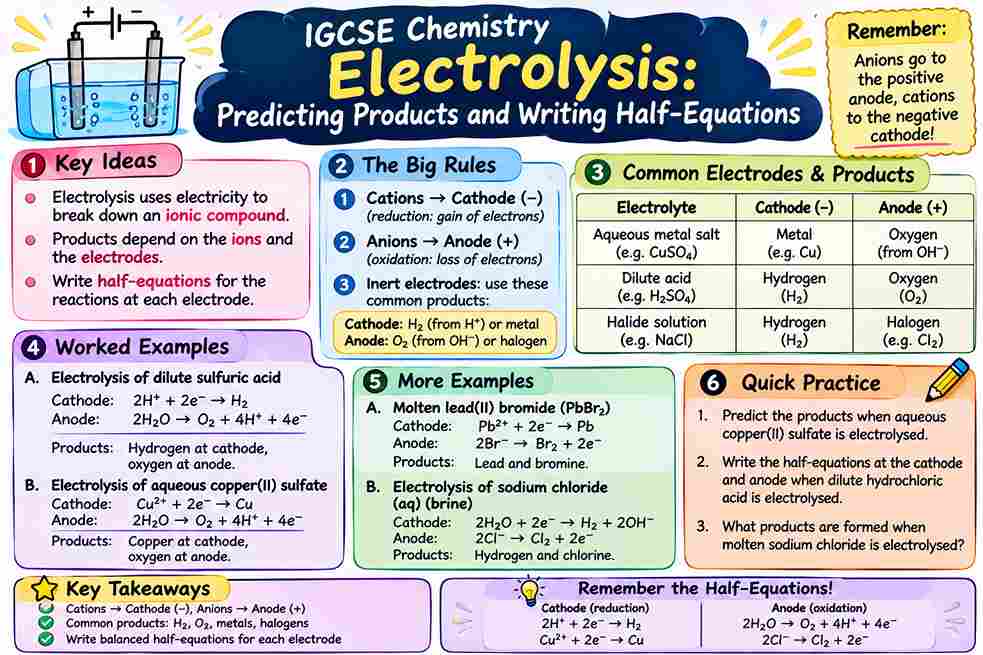
IGCSE Chemistry Electrolysis: Predicting Products and Writing Half-Equations
Last updated: November 2026 | By EdFlik Education Team
Electrolysis questions follow one logic: which ions are attracted to which electrode, and which one is discharged. Once students learn the decision rules, products can be predicted for any electrolyte. This guide gives the rules, the key half-equations and the applications that examiners ask about.
Key vocabulary
Term |
Meaning |
Electrolysis |
Breaking down an ionic compound, molten or in solution, using electricity |
Electrolyte |
The liquid or solution that conducts because its ions are free to move |
Cathode |
The negative electrode. Positive ions (cations) move here and gain electrons (reduction) |
Anode |
The positive electrode. Negative ions (anions) move here and lose electrons (oxidation) |
Inert electrode |
An electrode that does not react, such as graphite or platinum |
A memory aid: OIL RIG. Oxidation Is Loss of electrons (at the anode); Reduction Is Gain of electrons (at the cathode).
Molten electrolytes
The only ions present are those of the compound, so the metal forms at the cathode and the non-metal at the anode.
Worked example 1: molten lead(II) bromide
- Cathode: Pb²⁺ + 2e⁻ → Pb (grey lead metal).
- Anode: 2Br⁻ → Br₂ + 2e⁻ (brown bromine fumes).
- Carry out in a fume cupboard because bromine vapour is toxic.
Aqueous electrolytes: the decision rules
In solution, water also supplies H⁺ and OH⁻ ions, so there is a competition at each electrode.
Electrode |
Rule |
Cathode |
If the metal is more reactive than hydrogen (for example sodium, potassium, calcium), hydrogen is produced. If the metal is less reactive than hydrogen (for example copper, silver), the metal is produced. |
Anode (inert) |
If a halide ion (Cl⁻, Br⁻, I⁻) is present in a concentrated solution, the halogen is produced. Otherwise oxygen is produced from hydroxide ions. |
Worked examples
Example 2: concentrated sodium chloride (brine)
- Cathode: 2H⁺ + 2e⁻ → H₂ (sodium is more reactive than hydrogen).
- Anode: 2Cl⁻ → Cl₂ + 2e⁻.
- The solution left contains sodium hydroxide, because H⁺ and Cl⁻ have been removed.
Example 3: copper(II) sulfate with inert electrodes
- Cathode: Cu²⁺ + 2e⁻ → Cu (pink-brown solid).
- Anode: 4OH⁻ → 2H₂O + O₂ + 4e⁻ (bubbles of oxygen).
- The blue colour fades as Cu²⁺ ions are used up, and the solution becomes acidic.
Example 4: copper(II) sulfate with copper electrodes
- Cathode: Cu²⁺ + 2e⁻ → Cu, so the cathode gains mass.
- Anode: Cu → Cu²⁺ + 2e⁻, so the anode dissolves and loses mass.
- The blue colour stays the same, because copper ions removed at the cathode are replaced at the anode.
Example 5: dilute sulfuric acid
- Cathode: 2H⁺ + 2e⁻ → H₂.
- Anode: 4OH⁻ → 2H₂O + O₂ + 4e⁻.
- Hydrogen and oxygen are produced in a volume ratio of 2 : 1, the same as in water, so this is sometimes described as the electrolysis of water.
Applications
Application |
How it works |
Purifying copper |
Impure copper is the anode and pure copper the cathode in copper(II) sulfate solution. Copper dissolves from the anode and deposits as pure copper on the cathode. |
Electroplating |
The object to be plated is the cathode, the plating metal is the anode, and the electrolyte contains ions of the plating metal. |
Extracting aluminium |
Aluminium oxide has a very high melting point (over 2000 °C), so it is dissolved in molten cryolite to lower the temperature needed. Aluminium forms at the cathode; oxygen forms at the carbon anodes, which burn away and must be replaced. |
Common mistakes
- Mixing up anode and cathode. Remember: cations go to the cathode.
- Forgetting that water is also present in an aqueous solution.
- Writing electrons on the wrong side of a half-equation.
- Saying the "copper electrode dissolves" without stating that it is the anode.
- Not balancing charge in half-equations.
Practice questions
Question |
Answer |
1. What forms at the cathode when concentrated sodium chloride solution is electrolysed? |
Hydrogen |
2. What forms at the anode when molten lead(II) bromide is electrolysed? |
Bromine |
3. Write the half-equation for copper ions at the cathode. |
Cu²⁺ + 2e⁻ → Cu |
4. Why is aluminium oxide dissolved in cryolite? |
To lower the temperature needed, because pure aluminium oxide has a very high melting point |
Frequently asked questions
Q: What is produced at the cathode in electrolysis?
A metal if it is less reactive than hydrogen; otherwise hydrogen (in an aqueous solution). In a molten salt the metal is always produced.
Q: Why does the anode lose mass in copper purification?
Copper atoms at the anode lose electrons and dissolve as Cu²⁺ ions.
Q: Why are graphite anodes replaced in aluminium extraction?
The oxygen made at the anode reacts with the hot carbon to form carbon dioxide, so the anodes burn away.
Q: Is electrolysis in both the Cambridge and Edexcel specifications?
Yes, but the electrolytes and detail differ. Check your specification.
Try a free trial class with EdFlik. Live 1:1 IGCSE tutoring for Cambridge and Edexcel students in the UAE, matched to your child's board, subject and year group. Book at edflik.com or message us on WhatsApp. |
Related reading
- IGCSE Chemistry (0620 / 4CH1) Guide
- IGCSE Chemistry Mole Calculations
- IGCSE Acids, Bases and Salts: Preparing Salts
Sources
- Cambridge International IGCSE Chemistry 0620 syllabus 2026–2028
- Pearson Edexcel International GCSE Chemistry 4CH1 specification
More on IGCSE & GCSE