IGCSE Radioactivity and Half-Life: Types of Radiation, Decay Equations and Calculations
Last updated: November 2026 | By EdFlik Education Team
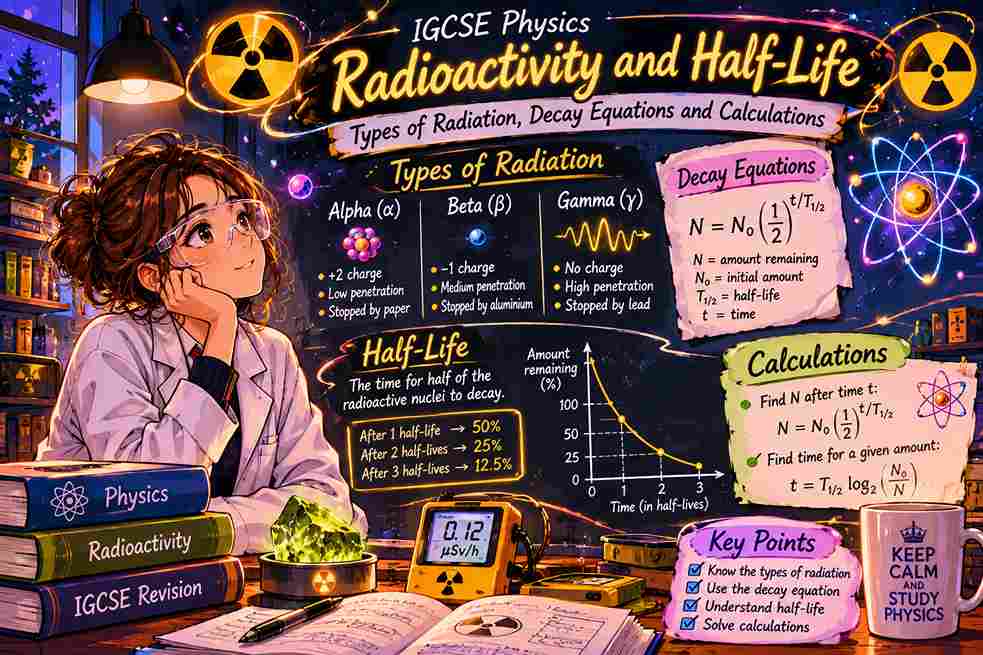
Radioactivity questions combine recall (which radiation does what) with two calculations: decay equations and half-life. Both follow fixed patterns. This guide covers the theory, the patterns and safety.
The three types of radiation
Property |
Alpha (α) |
Beta (β) |
Gamma (γ) |
What it is |
Helium nucleus: 2 protons + 2 neutrons |
Fast electron from the nucleus |
Electromagnetic wave |
Charge |
+2 |
−1 |
0 |
Stopped by |
Paper or a few centimetres of air |
A few millimetres of aluminium |
Thick lead or concrete reduces it |
Ionising power |
Strongest |
Medium |
Weakest |
Deflected by magnetic field |
Yes |
Yes (opposite way) |
No |
Background radiation comes from natural sources such as rocks and cosmic rays, and from man-made sources such as medical procedures. Always subtract it when measuring a source's count rate.
Decay equations
- Alpha decay: mass number goes down by 4, atomic (proton) number goes down by 2.
- Beta decay: mass number stays the same, atomic number goes up by 1 (a neutron becomes a proton and an electron is emitted).
- Gamma emission: no change to the numbers; the nucleus loses energy.
Worked example 1: alpha decay
Radium-226 (atomic number 88) emits an alpha particle. Mass number = 226 − 4 = 222 and atomic number = 88 − 2 = 86, so the product is radon-222:²²⁶₈₈Ra → ²²²₈₆Rn + ⁴₂He.
Worked example 2: beta decay
Carbon-14 (atomic number 6) emits a beta particle. Mass number stays 14 and atomic number becomes 7, so the product is nitrogen-14:¹⁴₆C → ¹⁴₇N + ⁰₋₁e.
Half-life
The half-life is the time taken for the activity (or the number of undecayed nuclei) to fall to half. It is random for each nucleus but predictable for a large sample.
Worked example 3: mass remaining
A sample has 80 g of a radioactive isotope with a half-life of 5 days. How much remains after 15 days?
- 15 ÷ 5 = 3 half-lives.
- 80 → 40 → 20 →10 g.
Worked example 4: count rate
A source has an activity of 640 counts per minute and a half-life of 4 days. What is the activity after 12 days?
- 12 ÷ 4 = 3 half-lives.
- 640 → 320 → 160 →80 counts per minute.
Worked example 5: reading from a graph
On a decay curve, find the time at which the activity has halved, then check that the next halving takes the same time. If the time differs, you have misread the graph.
Uses and safety
Use |
Radiation and why |
Smoke detectors |
Alpha source; smoke reduces the current in the detector |
Medical tracers |
Gamma emitter with short half-life, detected outside the body |
Thickness gauges for paper or foil |
Beta source; the amount that passes through depends on thickness |
Sterilising equipment |
Gamma rays kill bacteria |
- Ionising radiation damages cells and can cause cancer.
- Reduce risk by limiting time, increasing distance (use tongs) and shielding (lead).
- Store sources in lead-lined containers.
Common mistakes
- Changing the mass number in beta decay.
- Treating half-life as half the total time to decay.
- Forgetting to subtract background radiation.
- Confusing penetrating power with ionising power: alpha is the least penetrating but the most ionising.
Practice questions
Question |
Answer |
1. Uranium-238 (atomic number 92) emits an alpha particle. Give the product's mass and atomic numbers. |
Mass 234, atomic number 90 |
2. 800 g of an isotope with half-life 6 hours. How much remains after 18 hours? |
100 g |
3. Which radiation is most penetrating? |
Gamma |
4. Why is a medical tracer chosen with a short half-life? |
So the radiation does not stay active in the body for long |
Frequently asked questions
Q: What is half-life?
The time taken for the activity of a radioactive sample to fall to half its original value.
Q: Which radiation is the most dangerous?
It depends. Alpha is the most ionising but is stopped easily outside the body; gamma is the most penetrating. Inside the body, alpha is especially harmful.
Q: Why does beta decay increase the atomic number?
A neutron changes into a proton, and an electron is emitted.
Q: What is background radiation?
Radiation from natural and man-made sources that is always present.
Try a free trial class with EdFlik. Live 1:1 IGCSE tutoring for Cambridge and Edexcel students in the UAE, matched to your child's board, subject and year group. Book at edflik.com or message us on WhatsApp. |
Related reading
- IGCSE Physics Waves
- IGCSE Physics Electric Circuits
- IGCSE Physics (0625 / 4PH1) Guide
Sources
- Cambridge International IGCSE Physics 0625 syllabus 2026–2028
- Pearson Edexcel International GCSE Physics 4PH1 specification
More on IGCSE & GCSE
- IGCSE in the UAE: A Complete Guide to Boards, Subjects, Exams and Revision
- Mastering IGCSE Radioactivity and Half-Life Calculations: A Step-by-Step Problem Solving Guide
- IGCSE Chemistry Electrolysis: Predicting Products and Writing Half-Equations
- IGCSE Physics Equations: How to Use, Rearrange and Check Units
- All IGCSE & GCSE articles