IGCSE Chemistry Required Practicals and Experimental Questions Explained
By EdFlik Team | November 2, 2026
For candidates preparing for Cambridge CAIE IGCSE Chemistry (0625/0971) or Pearson Edexcel International GCSE Chemistry (4CH1) across the UAE and globally, experimental and practical skills carry massive weight.
In the Cambridge syllabus, Paper 5 (Practical Test) or Paper 6 (Alternative to Practical) contributes $20\%$ of your overall grade, while Pearson Edexcel integrates required core practicals and experimental design directly into Paper 1C and Paper 2C.
To score Grade 8/9 ($A^*$) marks on experimental questions, students must move beyond basic memory recall. Examiners test specific competency areas: qualitative chemical analysis (cation, anion, and gas testing), separation techniques, rate of reaction kinetics, titrations, enthalpy measurements, experimental planning, and error evaluation.
This comprehensive masterclass revision guide breaks down every core practical, provides structured testing tables, details experimental design steps
Part 1: Mandatory Qualitative Analysis (Salt Identification)
Qualitative analysis questions appear consistently on Paper 6 and Paper 2. Candidates must memorize the exact reagents, observations, and ionic chemical logic for identifying unknown cations, anions, and gases.
1. Testing for Cations (Positive Ions in Aqueous Solution)
Cation identification relies on adding dropwise and then excess aqueous sodium hydroxide ($\text{NaOH}$) or aqueous ammonia ($\text{NH}_3$):
| Cation | Effect of Adding Aqueous NaOH | Effect of Adding Aqueous NH3 |
| Aluminum ($\text{Al}^{3+}$) | White precipitate; dissolves in excess to form a colorless solution. | White precipitate; insoluble in excess. |
| Calcium ($\text{Ca}^{2+}$) | White precipitate; insoluble in excess. | Faint white precipitate or no precipitate. |
| Zinc ($\text{Zn}^{2+}$) | White precipitate; dissolves in excess to form a colorless solution. | White precipitate; dissolves in excess to form a colorless solution. |
| Copper(II) ($\text{Cu}^{2+}$) | Light blue precipitate; insoluble in excess. | Light blue precipitate; dissolves in excess giving a dark blue solution. |
| Iron(II) ($\text{Fe}^{2+}$) | Green precipitate; insoluble in excess; turns brown at surface. | Green precipitate; insoluble in excess. |
| Iron(III) ($\text{Fe}^{3+}$) | Red-brown precipitate; insoluble in excess. | Red-brown precipitate; insoluble in excess. |
| Ammonium ($\text{NH}_4^+$) | Ammonia gas produced on warming; turns damp red litmus paper blue. | N/A |
2. Testing for Anions (Negative Ions)
| Anion | Test Procedure | Positive Test Observation |
| Carbonate ($\text{CO}_3^{2-}$) | Add dilute acid (e.g., $\text{HCl}$). | Effervescence; gas produced turns limewater cloudy/milky ($\text{CO}_2$). |
| Chloride ($\text{Cl}^-$) | Acidify with dilute nitric acid ($\text{HNO}_3$), then add aqueous silver nitrate ($\text{AgNO}_3$). | White precipitate of silver chloride ($\text{AgCl}$). |
| Bromide ($\text{Br}^-$) | Acidify with dilute nitric acid ($\text{HNO}_3$), then add aqueous silver nitrate ($\text{AgNO}_3$). | Cream precipitate of silver bromide ($\text{AgBr}$). |
| Iodide ($\text{I}^-$) | Acidify with dilute nitric acid ($\text{HNO}_3$), then add aqueous silver nitrate ($\text{AgNO}_3$). | Yellow precipitate of silver iodide ($\text{AgI}$). |
| Sulfate ($\text{SO}_4^{2-}$) | Acidify with dilute nitric acid, then add aqueous barium nitrate ($\text{Ba(NO}_3\text{)}_2$) or $\text{BaCl}_2$. | White precipitate of barium sulfate ($\text{BaSO}_4$). |
| Nitrate ($\text{NO}_3^-$) | Add aqueous $\text{NaOH}$, then add aluminum foil and warm gently. | Ammonia gas produced; turns damp red litmus paper blue. |
Critical Exam Rule: Always acidify halide and sulfate test solutions with dilute nitric acid before adding testing reagents. This destroys any carbonate ions present that would otherwise produce false-positive white precipitates.
3. Testing for Gases
| Gas | Test Procedure | Positive Result |
| Ammonia ($\text{NH}_3$) | Expose to damp red litmus paper. | Damp red litmus paper turns blue. |
| Carbon Dioxide ($\text{CO}_2$) | Bubble gas through limewater ($\text{Ca(OH)}_2$). | Limewater turns cloudy / milky. |
| Chlorine ($\text{Cl}_2$) | Expose to damp blue litmus paper. | Litmus paper turns red, then bleaches white. |
| Hydrogen ($\text{H}_2$) | Hold a lighted splint at the mouth of the tube. | Gas burns with a squeaky pop. |
| Oxygen ($\text{O}_2$) | Insert a glowing splint into the gas sample. | Relights a glowing splint. |
| Sulfur Dioxide ($\text{SO}_2$) | Pass through acidified aqueous potassium manganate(VII). | Color changes from purple to colorless. |
Part 2: Core Physical & Quantitative Practicals
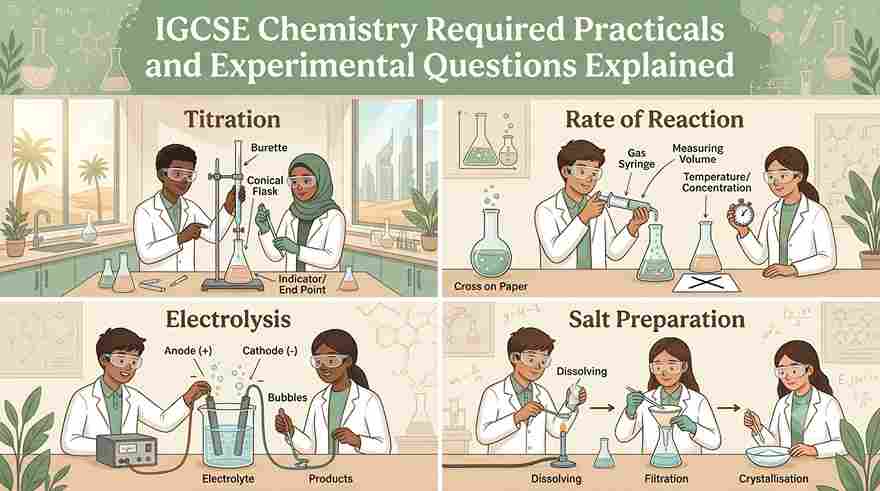
Examiners regularly evaluate procedural understanding across four foundational physical chemistry experiments:
                   CORE QUANTITATIVE PRACTICAL SETUPS
                                     |
  +----------------------------------+----------------------------------+
  |                                  |                                  |
1. ACID-BASE TITRATION             2. RATES OF REACTION
  • Determine concentration.         • Gas syringe volume vs time.
  • Pipette, burette, indicator.      • Disappearing cross ($\text{Na}_2\text{S}_2\text{O}_3$).
  +----------------------------------+----------------------------------+
  |                                  |                                  |
3. SEPARATION & PURIFICATION       4. ENTHALPY & CALORIMETRY
  • Simple & fractional distillation.• Temperature rise in polystyrene cup.
  • Paper chromatography ($R_f$).    • Flame calorimetry of fuels.
1. Acid-Base Titrations (Volumetric Analysis)
- Apparatus: A volumetric pipette measures exact fixed volumes (e.g., $25.0\text{ cm}^3$) of alkali into a conical flask. A burette measures variable acid delivery.
- Procedure: Add $2\text{–}3$ drops of indicator (methyl orange or phenolphthalein) to the flask. Place the flask on a white tile to observe clear color changes. Add acid from the burette dropwise near the end point until the indicator changes color permanently.
- Concordant Results: Repeat titrations until you achieve two results within $0.20\text{ cm}^3$ of each other (concordant volumes) to calculate the mean.
2. Measuring Rates of Reaction
- Gas Evolution Method: Reaction of calcium carbonate with hydrochloric acid ($\text{CaCO}_3 + 2\text{HCl} \rightarrow \text{CaCl}_2 + \text{H}_2\text{O} + \text{CO}_2$). Collect $\text{CO}_2$ using a gas syringe or a inverted measuring cylinder filled with water. Record gas volume at regular time intervals ($10\text{ seconds}$).
- Disappearing Cross Method: Reaction of sodium thiosulfate with acid producing colloidal sulfur precipitate ($\text{Na}_2\text{S}_2\text{O}_3 + 2\text{HCl} \rightarrow 2\text{NaCl} + \text{S} + \text{SO}_2 + \text{H}_2\text{O}$). Time how long it takes for the formed sulfur to obscure a black cross drawn beneath the beaker.
3. Chromatography & $R_f$ Values
To separate mixtures of soluble dyes or inks:
- Draw a baseline in pencil (not ink, which would dissolve and contaminate the chromatogram) $1\text{–}2\text{ cm}$ above the paper bottom.
- Apply small, concentrated spots of dye onto the baseline.
- Lower the paper into a beaker containing solvent, ensuring the solvent level remains below the pencil line.
- Allow solvent to travel up the paper, mark the solvent front in pencil, and calculate Retention Factors:
$$R_f = \frac{\text{Distance traveled by compound}}{\text{Distance traveled by solvent front}}$$
Part 3: How to Plan an Experimental Investigation (6-Mark Questions)
The final question on CAIE Paper 6 (and integrated Edexcel experimental prompts) asks you to design a valid scientific procedure. Follow this 6-step framework to secure full marks:
                 6-STEP EXPERIMENTAL DESIGN PROTOCOL
                                   |
  Step 1: State Variables       ---> Name Independent, Dependent, and 2 Controlled variables.
  Step 2: Apparatus List        ---> Specify exact tools (e.g., balance, burette, digital timer).
  Step 3: Step-by-Step Method   ---> Detail chronological actions using precise volumes and masses.
  Step 4: Measurements Taken    ---> State what values will be recorded and at what intervals.
  Step 5: Processing Results    ---> Explain how data will be evaluated (e.g., plot graph, compare times).
  Step 6: Control & Safety      ---> Include one key safety measure (e.g., fume cupboard for toxic gas).
Exemplar Planning Prompt:
“Design an investigation to compare the effectiveness of three different metal catalysts on the decomposition rate of hydrogen peroxide.”
- Independent Variable: Type of metal catalyst (e.g., Manganese(IV) oxide, Copper(II) oxide, Iron(III) oxide).
- Dependent Variable: Volume of oxygen gas collected in 60 seconds.
- Controlled Variables: Mass of catalyst ($1.0\text{ g}$), volume of $\text{H}_2\text{O}_2$ solution ($25\text{ cm}^3$), concentration of $\text{H}_2\text{O}_2$ ($1.0\text{ mol/dm}^3$), and temperature ($25^\circ\text{C}$).
- Method Summary: Measure $25\text{ cm}^3$ of $\text{H}_2\text{O}_2$ into a conical flask using a measuring cylinder. Add $1.0\text{ g}$ of the first catalyst, quickly seal with a delivery tube connected to a gas syringe, and start a stopwatch. Record oxygen volume collected after 60 seconds. Repeat using identical masses of the other catalysts. The catalyst yielding the largest gas volume in 60 seconds is the most effective.
Part 4: Top 4 Traps That Cost Students Marks
- Confusing Test Reagents for Halides: Using hydrochloric acid instead of nitric acid to acidify solutions before testing for chloride ions. Adding $\text{HCl}$ introduces chloride ions into the solution, causing a false-positive white precipitate.
- Improper Indicator Selection in Titrations: Using universal indicator for a titration. Universal indicator changes color gradually across a wide pH range, making it impossible to detect the precise equivalence point. Use single-stage indicators like phenolphthalein or methyl orange.
- Drawing Baseline in Ink for Chromatography: Drawing the starting line in pen ink. Ink dyes dissolve in the mobile phase and travel up the paper alongside test samples, ruining the chromatogram. Always use a graphite pencil.
- Vague Error Statements: Writing "human error" or "inaccurate measuring" when asked for experimental improvements. Always state the exact source of error and its mechanical fix (e.g., "Heat loss to surroundings; insulate the beaker with expanded polystyrene and add a lid").
For expert 1-on-1 tutoring support to master Cambridge and Pearson Edexcel IGCSE Chemistry practicals, qualitative salt analysis, and past-paper revision strategies, book a class on EdFlik.
Frequently Asked Questions (FAQs)
Q1: What is the difference between Paper 5 and Paper 6 in CAIE IGCSE Chemistry?
Ans: Paper 5 (Practical Test) is a 1-hour 15-minute hands-on laboratory examination conducted inside a school chemistry lab. Paper 6 (Alternative to Practical) is a written examination sat at a desk that tests identical experimental design, data interpretation, graph drawing, and qualitative analysis skills using diagrams and data tables.
Q2: How do I distinguish between Aluminum ($\text{Al}^{3+}$) and Zinc ($\text{Zn}^{2+}$) ions in qualitative tests?
Ans: Both $\text{Al}^{3+}$ and $\text{Zn}^{2+}$ form white precipitates with aqueous sodium hydroxide that dissolve in excess $\text{NaOH}$ to give a colorless solution. To distinguish them, add aqueous ammonia ($\text{NH}_3$): the white precipitate formed by $\text{Zn}^{2+}$ dissolves in excess $\text{NH}_3$, whereas the white precipitate formed by $\text{Al}^{3+}$ is insoluble in excess $\text{NH}_3$.
Q3: Why must test tubes be warmed gently when testing for ammonium ($\text{NH}_4^+$) or nitrate ($\text{NO}_3^-$) ions?
Ans: Warming increases kinetic energy, driving ammonia gas ($\text{NH}_3$) out of the liquid solution into the gas phase so it can react with damp red litmus paper placed at the tube mouth.
More on IGCSE & GCSE