IGCSE Grade Boundaries Explained: Cambridge vs Edexcel Maths (2026–27)
Last updated: November 2026 · Written by Monisha, Content Writer at EdFlik
"How many marks do I need for an A*?" is one of the most common IGCSE questions, and the honest answer is: it changes every exam series. This guide explains how grade boundaries work for Cambridge and Edexcel Maths, where to find the official figures, how to read them, and how to use them to set sensible targets.
What is a grade boundary?
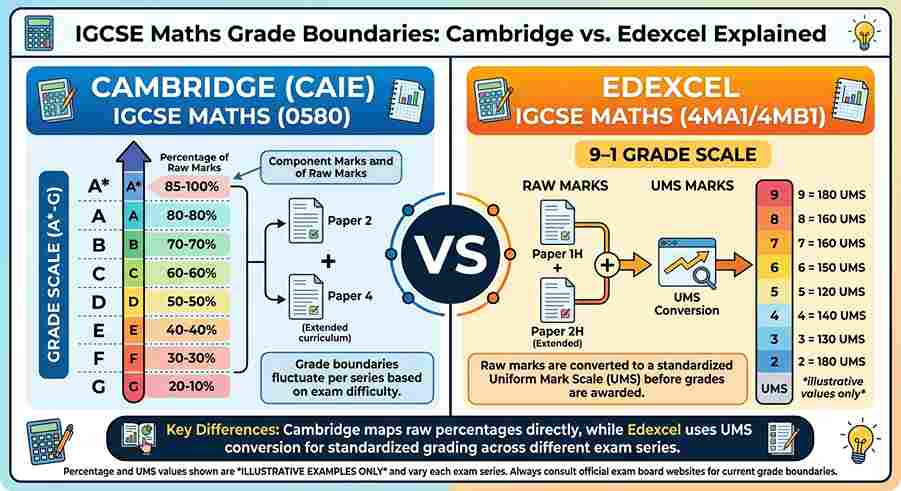
A grade boundary (Cambridge calls them grade thresholds) is the minimum total mark needed for each grade. Boundaries are set after each exam series, once papers are marked, so that a grade represents a similar standard even when a paper turns out harder or easier than usual. That is why the same raw mark can lead to different grades in different years.
How Cambridge sets out its thresholds
- Cambridge publishes grade threshold tables for each syllabus after every series (for example May/June and October/November).
- Tables show the marks for each component (paper) and for the overall qualification, for each option (Core or Extended).
- Cambridge often uses different paper variants in different time zones, and each variant can have its own thresholds. Use the table for the variant you sat (the variant number is on the paper, for example 0580/22).
- For 0580 Maths, Core candidates can achieve grades C to G, and Extended candidates A* to E.
Reading a Cambridge threshold table
- Find the row for your option (for example, the Extended option made up of Papers 2 and 4).
- Read across to the column for the grade you want. That figure is the minimum total of your two papers.
- Ignore the individual component thresholds when working out your overall grade: they are for information only. Your grade comes from your total.
How Edexcel sets out its boundaries
- Pearson publishes grade boundaries for International GCSE subjects on results day for each series.
- Edexcel International GCSE Maths (4MA1) is graded 9 to 1, with separate boundaries for Foundation and Higher tiers.
- Boundaries are given as total marks out of the qualification maximum (for 4MA1, two papers of 100 marks each, so 200 in total).
Why you cannot rely on a fixed percentage
Because boundaries move each series, any "70% = A" rule is only a rough guide. Differences come from:
- The difficulty of that series' papers
- The tier or option (Core/Extended, Foundation/Higher)
- The paper variant (Cambridge)
- Changes to the syllabus, such as the 2025 Cambridge 0580 update that made Papers 1 and 2 non-calculator
For more on this, read What grade is 70% in IGCSE?.
A worked example (illustrative numbers)
The figures below are made up to show the method. They are not real boundaries.
| Series A | Series B | Series C | |
|---|---|---|---|
| Minimum total for target grade (out of 200) | 142 | 150 | 136 |
- The range is 136 to 150 marks.
- A student scoring 140 on practice papers would have reached the target in Series A and C, but not in Series B.
- A safe target is therefore about 155 or more, slightly above the highest recent figure.
Now repeat the exercise with the real published figures for your own board, tier and variant.
How to use boundaries to set targets
- Find the last three series of official thresholds or boundaries for your exact board, syllabus, tier and (for Cambridge) variant.
- Note the range for your target grade, not just one number.
- Aim above the highest recent figure to build a safety margin.
- Score past papers against the matching series' boundaries, not against a generic percentage.
- Track your trend across several timed papers rather than reacting to one result.
Where marks are usually gained near a boundary
- Showing full working to earn method marks
- Reducing careless errors with a checking routine (reread the question, check units and rounding)
- Practising the non-calculator skills needed for Cambridge Papers 1 and 2
- Finishing the paper: unanswered final questions are lost marks
- Learning the standard methods for frequently tested topics
See our IGCSE Maths paper structure guide, the 10 topics that come up every year and the IGCSE exam preparation study plan.
A note for parents on mock results
Schools often convert mock marks into grades using boundaries from an earlier series. Treat these as estimates. If your child is within a few marks of a grade, the next steps matter more than the label: which question types lost marks, and is the same mistake repeating?
Getting help
EdFlik offers live 1:1 online IGCSE Maths tutoring for students in UAE schools. Tutors score practice papers against the correct boundaries and focus lessons on the marks your child is most likely to gain.
Frequently asked questions
When are IGCSE grade boundaries published?
After each exam series. Cambridge publishes grade threshold tables for each syllabus; Pearson publishes International GCSE boundaries on results day.
Are grade boundaries the same every year?
No. They change with paper difficulty, tier and (for Cambridge) paper variant.
Does each paper need to pass separately?
No. Your grade depends on your total across the papers for your tier or option.
What score should I aim for?
Aim comfortably above the highest boundary for your target grade in recent series, to allow for a harder paper.
For everything IGCSE, start at our IGCSE in the UAE guide.
More on IGCSE & GCSE
- IGCSE in the UAE: A Complete Guide to Boards, Subjects, Exams and Revision
- IGCSE Maths Grade Boundaries Explained: How UAE Students Can Set Realistic Targets
- Edexcel IGCSE Maths 4MA1 UAE 2026 — Paper Structure, Topics and Grade Boundaries
- IGCSE Tutor in Dubai: Live 1:1 Online Tutoring for Cambridge and Edexcel
- All IGCSE & GCSE articles