IGCSE Maths Grade Boundaries Explained: How UAE Students Can Set Realistic Targets
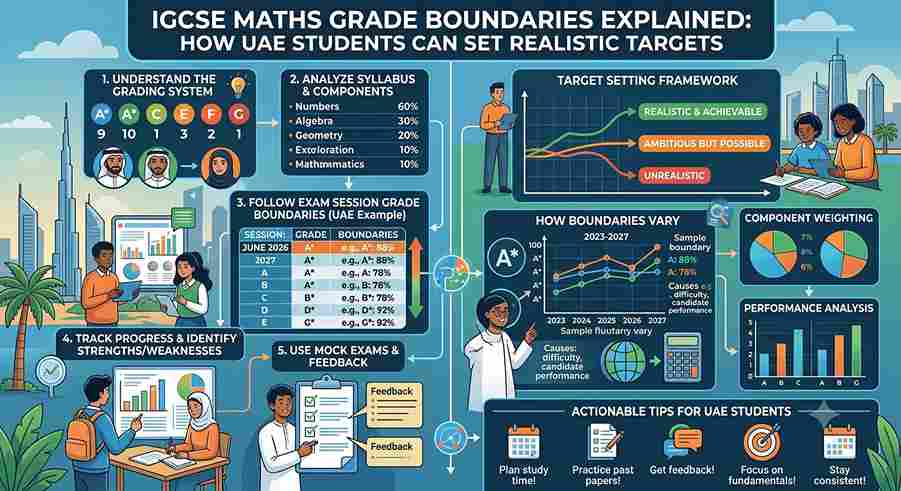
Who this is for: UAE private school students taking Cambridge IGCSE Mathematics (0580/0980) or Pearson Edexcel IGCSE Mathematics A (4MA1), along with parents tracking term targets for A-Level, IB Diploma, and university pathways.
What query it owns: how IGCSE Maths grade boundaries work and how UAE students can calculate realistic target scores.
Why this is safe: this page owns the comprehensive revision-guide and score-targeting angle, while EdFlik’s IGCSE Mathematics subtopic page owns the structured topic notes and the matching past-paper score tracker handles retrieval.
Mathematics is an indispensable benchmark across international secondary education in the United Arab Emirates. Whether your school in Dubai, Abu Dhabi, or Sharjah follows Pearson Edexcel (4MA1) using the 9–1 grading scale or Cambridge Assessment International Education (CAIE 0580/0980) using$A^*–G$ or 9–1, achieving a top grade in IGCSE Mathematics is essential for progressing to A-Level Further Maths, IB Higher Level (HL) Analysis & Approaches, and competitive university admissions.
However, the most common source of confusion among UAE students revising for their exams is the shifting nature of grade boundaries. A raw mark that yields a Grade 8 in an unusually challenging paper series might drop to a Grade 7 in an easier paper session.
This masterclass guide breaks down how exam boards set grade thresholds, analyzes historical boundaries for Pearson Edexcel and Cambridge, outlines a 4-step framework for setting realistic targets, and provides a 100% copy-paste JSON-LD schema markup script.
Key Takeaways
- Grade boundaries are dynamic: Exam boards establish boundaries after papers are marked to adjust for paper difficulty variations, ensuring consistent academic standards across exam series.
- Anchor grades align both scales: On the 9–1 scale, Grade 7 matches Grade A, Grade 4 matches Grade C (standard pass), and Grade 1 matches Grade G. Grade 9 represents performance above the traditional$A^*$ threshold.
- Aim for a safe buffer: Target a raw score$5\%\text{ to }10\%$ above historical grade thresholds during past paper practice to protect against exam-day stress or unexpected paper difficulty spikes.
- Focus on component totals: Calculate combined raw marks across all components (e.g., Paper 1F + 2F or Paper 1H + 2H for Edexcel; Paper 2 + Paper 4 for CAIE) rather than relying on a single paper score.
What are IGCSE Maths Grade Boundaries?
A grade boundary (or grade threshold) is the minimum total raw mark a student must achieve across all written exam components to be awarded a specific grade.
Because examination boards produce new paper variants for every exam session (May/June and October/November), paper difficulty naturally fluctuates. To prevent students from being penalized for sitting a harder paper—or unfairly advantaged by an easier one—senior examiners analyze global student performance statistics before setting official grade boundaries.
                THE GRADE BOUNDARY SETTING PROCESS
                                 |
  Step 1: Exam Administration  ---> Students sit papers globally (e.g., May/June series).
  Step 2: Marking & Statistical Review ---> Senior examiners evaluate paper difficulty & candidate distributions.
  Step 3: Threshold Determination  ---> Minimum raw marks for Grade 9/A*, 8, 7/A, 4/C are set.
  Step 4: Publication & Results ---> Grade boundaries published on results day alongside student certificates.
Comparing Grading Scales: 9–1 vs. $A^*–G$
Understanding how the Pearson Edexcel 9–1 scale aligns with the traditional Cambridge$A^*–G$ scale is critical for tracking progress:
| 9–1 Scale (Edexcel / CAIE 0980) | A∗–G Scale (CAIE 0580) | Performance Equivalent | Typical Academic Progression Benchmark |
| Grade 9 | $A^*$ (Top End) | Exceptional / Beyond $A^*$ | Required for top-tier STEM pathways / Further Maths |
| Grade 8 | $A^*$ | Outstanding | Strong preparation for A-Level Maths / IB Math AA HL |
| Grade 7 | Grade A | Excellent (Anchor Grade) | Standard requirement for A-Level Maths / Science HL |
| Grade 6 | Grade B | Very Good | Entry threshold for standard A-Level Maths courses |
| Grade 5 | High C / Low B | Strong Pass | Solid baseline for general A-Level / IB SL courses |
| Grade 4 | Grade C | Standard Pass (Anchor Grade) | Minimum passing grade for UAE school graduation / sixth-form |
Historical Grade Boundaries Analysis for UAE Students
Below is a breakdown of approximate raw mark targets for key exam boards based on historical series data.
1. Pearson Edexcel IGCSE Mathematics A (4MA1) – Higher Tier
- Total Available Marks: $200$ (Paper 1H: $100$ marks + Paper 2H: $100$ marks)
| Target Grade | Approx. Raw Mark Range (out of 200) | Approx. Percentage Target | Safe Buffer Target (Past Paper Practice) |
| Grade 9 | $165 – 175$ | $83\% – 88\%$ | $178+ \text{ marks } (\ge 89\%)$ |
| Grade 8 | $138 – 148$ | $69\% – 74\%$ | $152+ \text{ marks } (\ge 76\%)$ |
| Grade 7 | $111 – 122$ | $56\% – 61\%$ | $126+ \text{ marks } (\ge 63\%)$ |
| Grade 6 | $87 – 98$ | $44\% – 49\%$ | $102+ \text{ marks } (\ge 51\%)$ |
| Grade 5 / 4 | $41 – 64$ | $21\% – 32\%$ | $70+ \text{ marks } (\ge 35\%)$ |
2. Cambridge IGCSE Mathematics (0580) – Extended Tier
- Total Available Marks: $200$ (Paper 2:$70$ marks + Paper 4:$130$ marks)
| Target Grade | Approx. Raw Mark Range (out of 200) | Approx. Percentage Target | Safe Buffer Target (Past Paper Practice) |
| Grade $A^*$ | $175 – 188$ | $87.5\% – 94\%$ | $185+ \text{ marks } (\ge 92.5\%)$ |
| Grade A | $145 – 160$ | $72.5\% – 80\%$ | $162+ \text{ marks } (\ge 81\%)$ |
| Grade B | $115 – 130$ | $57.5\% – 65\%$ | $132+ \text{ marks } (\ge 66\%)$ |
| Grade C | $85 – 100$ | $42.5\% – 50\%$ | $105+ \text{ marks } (\ge 52.5\%)$ |
4-Step Framework to Set Realistic Score Targets
To ensure your revision is structured and effective, avoid aiming for "perfection" on every topic without tracking overall paper performance. Follow this 4-step target-setting framework:
                   THE 4-STEP TARGET-SETTING FRAMEWORK
                                    |
  Step 1: Identify Target Pathway ---> Determine sixth-form / university minimum entry requirements.
  Step 2: Establish Your Baseline ---> Complete 2 timed past papers and record combined raw marks.
  Step 3: Add a 5–10% Safety Buffer---> Add a margin above published historical boundaries.
  Step 4: Conduct Topic Gap Audits---> Isolate high-tariff question types where marks were dropped.
Step 1: Identify Your Academic Pathway Requirements
- Targeting A-Level Further Maths or IB HL Maths (AA): Require Grade 8 or 9 ($A^*$). Focus on high-level topics: functions, vectors, calculus basics, sequences, and advanced trigonometry.
- Targeting A-Level Maths or IB SL Maths (AA/AI): Require Grade 7 ($A$) or minimum Grade 6 ($B$). Secure core topics: algebra expansion, quadratics, probability, coordinate geometry, and mensuration.
- Targeting Standard Sixth-Form Entry: Require Grade 4 or 5 ($C$). Master basic arithmetic, linear equations, percentages, statistics, and basic angle rules.
Step 2: Establish Your Baseline Percentage
Never judge your readiness based on single topical worksheets. Complete a full past-paper set (e.g., Pearson Edexcel 4MA1 Paper 1H + Paper 2H) under timed exam conditions. Calculate your combined raw mark total out of 200.
$$\text{Baseline Percentage} = \left( \frac{\text{Paper 1 Mark} + \text{Paper 2 Mark}}{200} \right) \times 100\%$$
Step 3: Add a $5\% – 10\%$ Safety Buffer
If the historical boundary for a Grade 8 is$140/200$ ($70\%$), do not target 140 in practice. If your actual exam paper turns out to be slightly easier globally, the boundary may rise to $148$.
Targeting$150/200$ ($75\%$) ensures that even if grade thresholds shift upward, your result remains securely within your desired grade band.
Step 4: Conduct Topic-Wise Mark Extraction
Analyze your past paper attempts to identify where marks were lost:
- Methodology Errors: Did you drop marks by skipping steps in multi-mark algebraic proofs?
- Precision & Calculator Errors: Did you lose marks due to incorrect rounding (e.g., failing to round to 3 significant figures)?
- Unfamiliar Topic Strands: Did you leave advanced questions blank (e.g., transformation geometry, vector proofs, histogram frequency density)?
Top 4 Traps That Cost UAE Students Marks in IGCSE Maths
- Relying on a Single Year's Boundary: Assuming that because $160/200$ earned a Grade 9 in an unusually difficult exam year, it will guarantee a Grade 9 in your exam series. Always look at a 3- to 5-year boundary range.
- Ignoring Working Marks (Method Marks): Leaving final answers without showing intermediate algebraic steps. Mark schemes award $M$-marks (method) even if the final $A$-mark (accuracy) is wrong due to an arithmetic slip.
- Mismanaging Paper Time: Spending 15 minutes on a 3-mark hard problem at the start of Paper 2/Paper 4, leaving insufficient time for 6-mark structured questions at the end.
- Rounding Intermediate Calculations: Rounding numbers too early during multi-step trigonometry or mensuration calculations, which introduces rounding errors in the final answer.
Looking for expert 1-on-1 tutoring support to master IGCSE Mathematics, analyze past paper mark schemes, and secure top grade bands? Book a class on EdFlik.
Frequently Asked Questions (FAQs)
Q1: When are official IGCSE grade boundaries published?
Ans: Official grade boundaries are released by exam boards (Cambridge and Pearson Edexcel) on results day (August for the May/June series and January for the October/November series). They are not released prior to the exams being sat and marked.
Q2: Is it easier to get a Grade 9 in Pearson Edexcel than an $A^*$ in Cambridge?
Ans: No. Grade 9 on the 9–1 scale is statistically designed to represent performance above the traditional $A^*$ threshold. Consequently, fewer students globally achieve a Grade 9 compared to a traditional $A^*$.
Q3: What happens if I miss a grade boundary by 1 mark?
Ans: If your total raw mark falls 1 mark short of a grade boundary (e.g., scoring $137/200$ when Grade 8 requires $138$), you can request an official Review of Marking (Enquiry About Results) through your school's exams officer to check if additional method marks can be awarded.
More on IGCSE & GCSE