IGCSE Indices and Surds: Index Laws, Fractional Powers and Rationalising
Last updated: November 2026 | By EdFlik Education Team
Indices and surds are short topics with a high mark-to-effort ratio. Once the rules are secure, most questions take a minute. This guide sets out the rules, works through typical questions and lists the slips examiners see most.
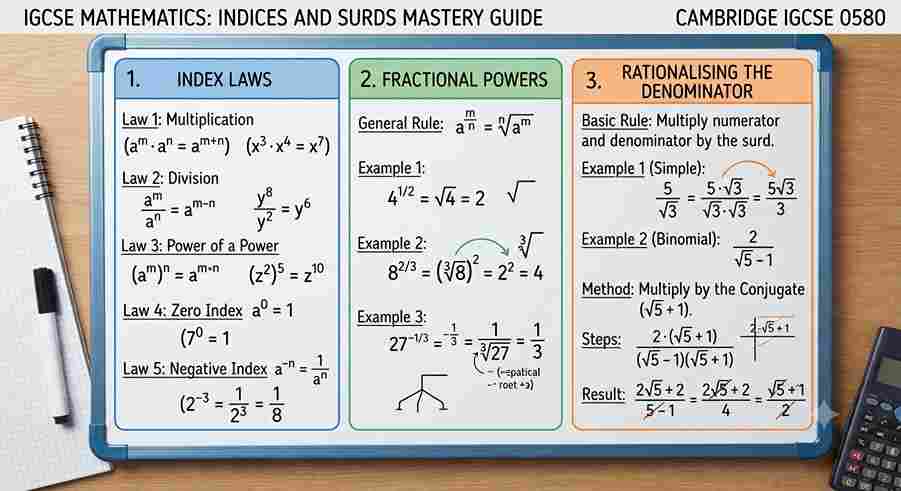
The index laws
Law |
Rule |
Example |
Multiply |
aᵐ × aⁿ = aᵐ⁺ⁿ |
2⁵ × 2³ = 2⁸ = 256 |
Divide |
aᵐ ÷ aⁿ = aᵐ⁻ⁿ |
x⁷ ÷ x² = x⁵ |
Power of a power |
(aᵐ)ⁿ = aᵐⁿ |
(x³)⁴ = x¹² |
Zero power |
a⁰ = 1 |
7⁰ = 1 |
Negative power |
a⁻ⁿ = 1 ÷ aⁿ |
2⁻³ = 1/8 |
Fractional power |
a^(1/n) = ⁿ√a |
25^(1/2) = 5 |
Fraction with numerator |
a^(m/n) = (ⁿ√a)ᵐ |
16^(3/4) = 2³ = 8 |
Worked examples: indices
Example 1: simplify with coefficients
Simplify (3x²)³.
- Cube both the number and the power: 3³ × (x²)³ = 27 × x⁶ =27x⁶.
Example 2: fractional power
Evaluate 16^(3/4).
- Take the root first: 16^(1/4) = 2 (since 2⁴ = 16).
- Then cube: 2³ =8.
Example 3: negative fractional power
Evaluate 8^(−2/3).
- Negative power means reciprocal: 1 ÷ 8^(2/3).
- 8^(1/3) = 2, so 8^(2/3) = 4.
- Answer:1/4.
Example 4: solve an equation
Solve 3^(x + 1) = 81.
- Write 81 as 3⁴.
- So x + 1 = 4 andx = 3.
Surds
A surd is a root that cannot be written as a whole number or simple fraction, such as √2 or √7. Leave answers as surds when the question asks for an exact value.
Rule |
Example |
√a × √b = √(ab) |
√2 × √8 = √16 = 4 |
√(a ÷ b) = √a ÷ √b |
√(9/4) = 3/2 |
Simplify by pulling out square factors |
√72 = √(36 × 2) = 6√2 |
(√a)² = a |
(2√3)² = 4 × 3 = 12 |
Example 5: expand with surds
Expand and simplify (3 + √2)(3 − √2).
- This is a difference of two squares: 3² − (√2)² = 9 − 2 =7.
Rationalising the denominator
Rationalising means removing the surd from the bottom of a fraction. Multiply top and bottom by the right thing.
Example 6: single surd
Rationalise 6 ÷ √3.
- Multiply top and bottom by √3: (6√3) ÷ 3 =2√3.
Example 7: binomial denominator
Rationalise 1 ÷ (2 + √3).
- Multiply by the conjugate (2 − √3) on top and bottom.
- Denominator: (2 + √3)(2 − √3) = 4 − 3 = 1.
- Answer:2 − √3.
Common mistakes
- Adding powers when you should multiply: (x³)⁴ is x¹², not x⁷.
- Treating 2⁻³ as −8 instead of 1/8.
- Writing √(a + b) = √a + √b. It is not.
- Stopping before the surd is fully simplified, for example leaving √72.
- Forgetting to apply the power to the coefficient in (3x²)³.
Practice questions
Question |
Answer |
1. Simplify √50. |
5√2 |
2. Evaluate 27^(2/3). |
9 |
3. Expand (2√3)². |
12 |
4. Rationalise 10 ÷ √5. |
2√5 |
5. Solve 2ˣ = 32. |
x = 5 |
Frequently asked questions
Q: What is a surd?
A root that cannot be written exactly as a fraction, such as √2. It is left in root form when an exact answer is needed.
Q: How do I deal with a negative or fractional index?
Negative means reciprocal. A fraction m/n means take the nth root, then raise to the power m.
Q: What does rationalising the denominator mean?
Rewriting a fraction so there is no surd on the bottom.
Q: Are surds on every tier?
Usually Extended or Higher. Check your specification.
Try a free trial class with EdFlik. Live 1:1 IGCSE tutoring for Cambridge and Edexcel students in the UAE, matched to your child's board, subject and year group. Book at edflik.com or message us on WhatsApp. |
Related reading
- IGCSE Maths Quadratic Equations: Worked Examples
- IGCSE Standard Form: Rules and Worked Examples
- IGCSE Maths Core vs Extended
Sources
- Cambridge International IGCSE Mathematics 0580 syllabus (number and algebra)
- Pearson Edexcel International GCSE Mathematics A 4MA1 specification
More on IGCSE & GCSE