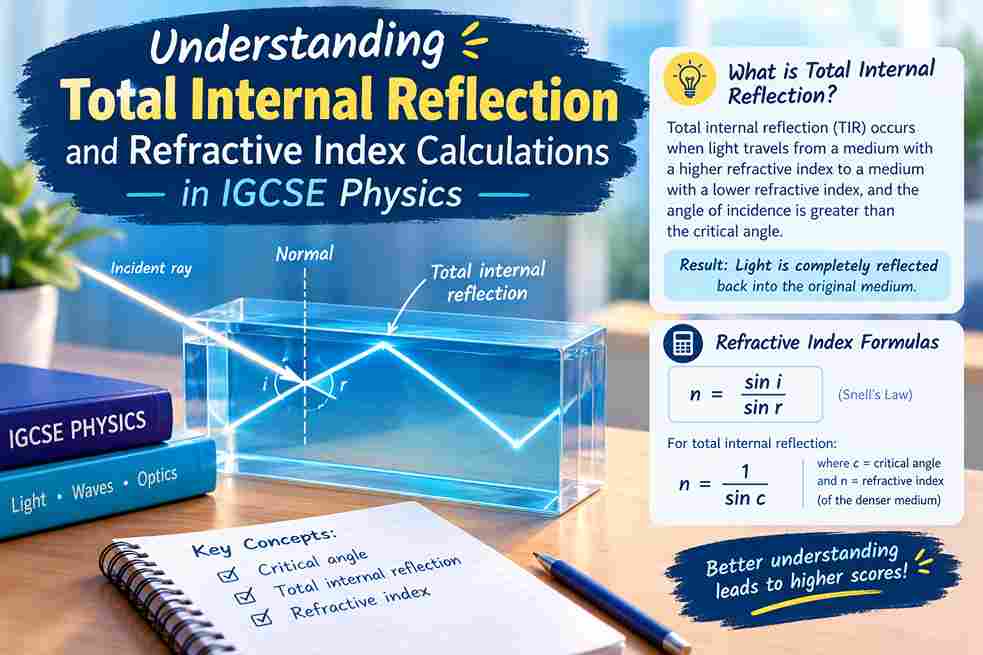
Understanding Total Internal Reflection and Refractive Index Calculations in IGCSE Physics
Last Updated: October 2026 | By EdFlik Education Team
For high school students completing the Cambridge IGCSE Physics (0625) or Pearson Edexcel IGCSE Physics (4PH1) qualifications, Waves and Light Optics represents one of the most high-yield core modules across both Paper 2 (Multiple Choice) and Paper 4 / Paper 1 (Extended Theory).
Among optical phenomena, Total Internal Reflection (TIR) and Refractive Index ($n$) calculations consistently feature in multi-step calculation items, ray diagram constructions, and practical application questions. Students often lose valuable marks not because they don't understand basic light behavior, but due to procedural errors: swapping angle definitions relative to the surface instead of the normal, miscalculating critical angles ($c$), or confusing the conditions required for total internal reflection to occur.
In this comprehensive, exam-focused masterclass guide, our expert IGCSE physics educators break down Snell’s Law, critical angle derivations, step-by-step calculation workflows, real-world optical fiber applications, common examiner traps, and supply a 100% copy-paste JSON-LD schema markup for your study resources.
Part 1: Foundations of Refraction and the Refractive Index ($n$)
When light travels from one transparent medium to another of different optical density, its speed changes. This change in speed causes the light ray to bend—a phenomenon known as refraction.
                         THE REFRACTIVE INDEX ($n$)
                                     |
        +----------------------------+----------------------------+
        |                                                         |
SPEED OF LIGHT FORMULA                                   SNELL'S LAW FORMULA
• $n = \frac{c}{v}$                                       • $n = \frac{\sin(i)}{\sin(r)}$
• $c$: Speed of light in vacuum ($3.0 \times 10^8 \text{ m/s}$) • $i$: Angle of incidence (in less dense medium/air)
• $v$: Speed of light in the medium                       • $r$: Angle of refraction (in denser medium)
1. The Physical Meaning of Refractive Index
The refractive index ($n$) is a dimensionless ratio that measures how much a medium slows down light relative to a vacuum or air ($n_{\text{air}} \approx 1.0$).
- A higher refractive index means the medium is more optically dense, slowing down light further and bending it more toward the normal line.
Step-by-Step Worked Refractive Index Example:
Question: A ray of light in air strikes a glass block at an angle of incidence $i = 45^\circ$. The angle of refraction inside the glass is $r = 28^\circ$. Calculate the refractive index $n$ of the glass block.
Step 1: Identify Given Values
- Angle of incidence in air, $i = 45^\circ$
- Angle of refraction in glass, $r = 28^\circ$
Step 2: Apply Snell’s Law
$$n = \frac{\sin(i)}{\sin(r)} = \frac{\sin(45^\circ)}{\sin(28^\circ)}$$$$\sin(45^\circ) = 0.7071$$$$\sin(28^\circ) = 0.4695$$$$n = \frac{0.7071}{0.4695} \approx 1.51$$
The refractive index of the glass block is $1.51$ (given to 3 significant figures).
Part 2: Total Internal Reflection (TIR) and the Critical Angle ($c$)
When light travels from an optically denser medium (e.g., glass or water) toward a less optically dense medium (e.g., air), the light ray bends away from the normal.
As the angle of incidence inside the denser medium increases, the angle of refraction in air approaches $90^\circ$.
                    TRANSITION FROM REFRACTION TO TIR
                                   |
      +----------------------------+----------------------------+
      |                            |                            |
1. $i < c$                    2. $i = c$                   3. $i > c$ (TIR)
• Refraction occurs           • Refracted ray travels       • NO refraction occurs!
• Ray bends AWAY from normal    along the boundary ($r=90^\circ$)• 100% of light reflects back
• Weak reflected ray present  • Defines Critical Angle ($c$)   into the denser medium
1. The Two Golden Conditions for Total Internal Reflection
Examiners frequently ask: "State two conditions required for total internal reflection to take place." You must write:
- Light must be traveling from an optically denser medium to a less optically dense medium (e.g., glass to air, water to air).
- The angle of incidence ($i$) in the denser medium must be greater than the critical angle ($c$) ($i > c$).
2. Deriving the Critical Angle Formula
At the critical angle ($i = c$), the angle of refraction in air is $r = 90^\circ$.
Applying Snell’s Law from denser medium ($n$) to air ($n_{\text{air}} = 1$):
$$n = \frac{\sin(90^\circ)}{\sin(c)}$$
Since $\sin(90^\circ) = 1$:
$$\sin(c) = \frac{1}{n} \quad \text{or} \quad c = \sin^{-1}\left(\frac{1}{n}\right)$$
Step-by-Step Worked Critical Angle Example:
Question: The refractive index of diamond is $n = 2.42$. Calculate the critical angle $c$ for light attempting to pass from diamond into air.
Step 1: Apply the Critical Angle Formula
$$\sin(c) = \frac{1}{n} = \frac{1}{2.42} \approx 0.4132$$
Step 2: Calculate the Inverse Sine
$$c = \sin^{-1}(0.4132) \approx 24.4^\circ$$
The critical angle for diamond is $24.4^\circ$.
Part 3: Real-World Applications of TIR in IGCSE Physics
IGCSE physics papers frequently evaluate how Total Internal Reflection is applied in modern technology and medicine:
                    PRACTICAL APPLICATIONS OF TIR
                                   |
        +--------------------------+--------------------------+
        |                                                     |
OPTICAL FIBERS (COMMUNICATIONS & ENDOSCOPES)              PRISMS IN PERISCOPES & BINOCULARS
• Thin glass core surrounded by lower-density cladding.    • $45^\circ-45^\circ-90^\circ$ right-angled glass prisms.
• Light enters at an angle $> c$, reflecting down the      • Light enters normal to one face ($i=0^\circ$), hits
  core with zero energy loss.                                hypotenuse at $45^\circ > c$ ($42^\circ$), reflecting $90^\circ$.
1. Optical Fibers
- Structure: Consists of a central glass core with a high refractive index surrounded by an outer cladding layer of lower refractive index.
- Mechanism: Light entering the core hits the core-cladding boundary at an angle of incidence greater than the critical angle ($i > c$), undergoing continuous total internal reflection along the fiber.
- Uses: High-speed internet telecommunications (data transfer via light signals) and medical endoscopes (allowing doctors to view internal organs non-invasively).
2. Right-Angled Prisms vs. Mirrors
- Right-angled glass prisms ($c \approx 42^\circ$) reflect light through $90^\circ$ or $180^\circ$ using TIR.
- Unlike silvered glass mirrors, prisms do not suffer from multiple internal reflections ("ghost images") and reflect $100\%$ of the incident light energy without deteriorating over time.
Part 4: Top 4 Traps That Cost Students Marks in IGCSE Physics
- Measuring Angles Relative to the Surface Instead of the Normal: Measuring $i$ or $r$ from the glass boundary plane rather than from the perpendicular normal line ($90^\circ$ to the surface). Always draw the normal line first!
- Reversing Snell's Law Fraction: Writing $n = \frac{\sin(r)}{\sin(i)}$ when calculating refractive index. Remember: $i$ is always the angle in the less dense medium (air), which is larger than $r$.
- Forgetting to State Both Conditions for TIR: Mentioning only $i > c$ while forgetting to state that light must travel from a more dense to a less dense medium. Both statements are required for full marks.
- Degree vs. Radian Mode Errors on Calculators: Setting scientific calculators to Radian ($\text{R}$) mode instead of Degree ($\text{D}$) mode during inverse sine ($\sin^{-1}$) calculations.
Preparing for Cambridge (0625) or Edexcel (4PH1) IGCSE Physics exams and aiming for an $8/9$ ($A^$) grade? EdFlik connects international school students globally with expert, 1-to-1 online IGCSE physics tutors, helping you master optics, ray diagrams, waves, electricity, and past-paper exam strategies. *Book a Free Demo Class Today!
Frequently Asked Questions (FAQs)
Q1: What happens to a ray of light if the angle of incidence equals the critical angle ($i = c$)?
Ans: When $i = c$, the refracted light ray travels along the boundary surface between the two media at an angle of refraction of $r = 90^\circ$. A weak reflected ray also appears inside the denser medium.
Q2: Does light change its frequency or wavelength during refraction?
Ans: When light enters a denser medium, its speed decreases and its wavelength decreases ($\lambda = \frac{v}{f}$). However, its frequency ($f$) remains constant because frequency is determined solely by the wave source.
Q3: Why is cladding needed on optical fibers?
Ans: Cladding protects the core from scratches, prevents light from leaking into neighboring fibers (crosstalk), and ensures that the boundary interface maintains a precise step-down in refractive index required for TIR.
Q4: How does EdFlik support IGCSE Physics students?
Ans: EdFlik connects international school students worldwide with vetted, expert 1-to-1 online tutors specializing in Cambridge (0625) and Pearson Edexcel (4PH1) IGCSE Physics. Our personalized coaching focuses on simplifying wave optics, practicing quantitative calculations, drawing accurate ray diagrams, and building exam confidence under timed conditions.
More on IGCSE & GCSE