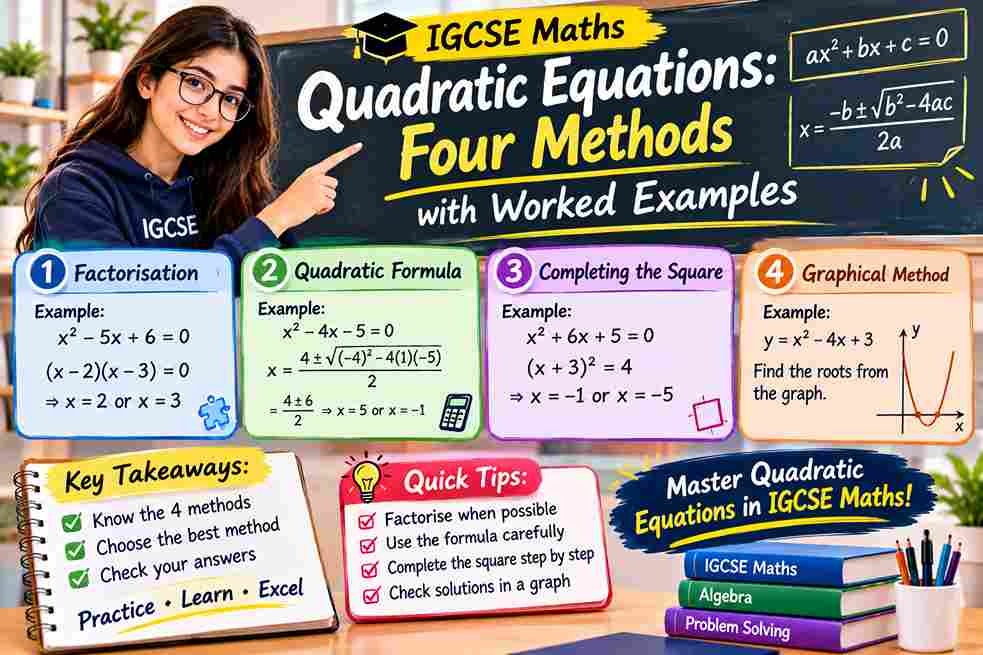
IGCSE Maths Quadratic Equations: Four Methods with Worked Examples
Last updated: November 2026 | By EdFlik Education Team
Quadratic equations appear on almost every IGCSE Maths paper, and they are worth many marks because they combine algebra, accuracy and method. This guide covers the four methods students are expected to know, shows when to use each, and finishes with practice questions and full answers.
Check your tier: factorising is tested at all levels, while the quadratic formula and completing the square are usually Cambridge Extended or Edexcel Higher content. Your specification is the final word.
What is a quadratic equation?
A quadratic equation can be written asax² + bx + c = 0, where a is not zero. It has up to two solutions (roots). Always rearrange so that one side is zero before you start; this single habit prevents a large share of lost marks.
Which method should I use?
Situation |
Best method |
Why |
Numbers are small and it factorises quickly |
Factorising |
Fastest, exact answers |
The question says "give your answer to 2 decimal places" |
Quadratic formula |
Designed for answers that are not whole numbers or simple fractions |
The question says "by completing the square" or asks for turning points |
Completing the square |
Also reveals the minimum or maximum |
The question is a word problem |
Form the equation first, then factorise or use the formula |
Setting it up is where most marks lie |
Method 1: Factorising
Worked example 1: a = 1
Solve x² + 5x + 6 = 0.
- Find two numbers that multiply to give6and add to give5: they are 2 and 3.
- Write (x + 2)(x + 3) = 0.
- Either x + 2 = 0 or x + 3 = 0, sox = −2 or x = −3.
Worked example 2: a is not 1
Solve 2x² − 7x + 3 = 0.
- Multiply a and c: 2 × 3 = 6. Find two numbers that multiply to 6 and add to −7: they are −6 and −1.
- Split the middle term: 2x² − 6x − x + 3 = 0.
- Factorise in pairs: 2x(x − 3) − 1(x − 3) = 0, so (2x − 1)(x − 3) = 0.
- x = 1/2 or x = 3.
Worked example 3: difference of two squares
Factorise 9x² − 16. Both terms are perfect squares (3x)² and 4², so the answer is(3x − 4)(3x + 4). Spot this pattern: it saves time and appears often.
Method 2: The quadratic formula
For ax² + bx + c = 0,x = (−b ± √(b² − 4ac)) ÷ 2a. Write the formula down first, substitute carefully using brackets for negative numbers, and keep the full calculator value until the last step.
Worked example 4
Solve x² + 3x − 5 = 0, giving answers to 2 decimal places. Here a = 1, b = 3, c = −5.
- b² − 4ac = 9 − 4(1)(−5) = 9 + 20 = 29.
- x = (−3 ± √29) ÷ 2.
- x = (−3 + 5.385…) ÷ 2 = 1.19 (2 d.p.) or x = (−3 − 5.385…) ÷ 2 =−4.19(2 d.p.).
The part under the root, b² − 4ac, is the discriminant. If it is positive there are two real solutions, if it is zero there is one repeated solution, and if it is negative there are none. Checking it first tells you whether your answer can be right. |
Method 3: Completing the square
Write x² + bx + c as(x + b/2)² − (b/2)² + c. This form shows the turning point and solves equations that do not factorise.
Worked example 5
Solve x² + 6x + 2 = 0 by completing the square.
- x² + 6x = (x + 3)² − 9, so the equation becomes (x + 3)² − 9 + 2 = 0, i.e. (x + 3)² = 7.
- x + 3 = ±√7, so x = −3 ± √7.
- x = −0.35 or x =−5.65(2 d.p.).
The completed-square form (x + 3)² − 7 also tells you the minimum value of the expression is −7, reached when x = −3.
Method 4: Word problems
Worked example 6
A rectangle has length 3 cm more than its width. Its area is 40 cm². Find the width and length.
- Let the width be x cm, so the length is (x + 3) cm.
- Area: x(x + 3) = 40, so x² + 3x − 40 = 0.
- Factorise: (x + 8)(x − 5) = 0, so x = −8 or x = 5.
- A length cannot be negative, so reject −8.Width 5 cm, length 8 cm.Check: 5 × 8 = 40 ✓.
Always state which solution you reject and why. Examiners award a mark for that sentence.
Five mistakes that lose marks
- Forgetting to make one side zero before factorising or using the formula.
- Sign errors with b when b is negative: write −(−5) as +5.
- Rounding too early inside the formula.
- Giving only one of the two solutions.
- Not rejecting an impossible solution in a context question.
Practice questions
Question |
Answer |
1. Solve x² − x − 12 = 0. |
(x − 4)(x + 3) = 0, so x = 4 or x = −3. |
2. Solve 3x² + 2x − 4 = 0 to 2 d.p. |
x = (−2 ± √52) ÷ 6, so x = 0.87 or x = −1.54. |
3. Factorise 4x² − 25. |
(2x − 5)(2x + 5) |
4. Write x² + 8x + 5 in the form (x + p)² + q. |
(x + 4)² − 11 |
How to practise
Do ten questions on each method, mark them, and record which step you got wrong: setting up, algebra or arithmetic. Then try mixed sets, where choosing the method is part of the task. EdFlik's live 1:1 teachers help students who keep losing marks at the same step.
Frequently asked questions
Q: When should I use the quadratic formula instead of factorising?
Use the formula when the quadratic does not factorise neatly or the question asks for decimal answers. If you can factorise in under a minute, factorising is faster and exact.
Q: Is the quadratic formula given in the IGCSE exam?
Check your board's formula list for the paper. Do not rely on it: learn the formula, since formula sheets differ by board and series.
Q: How many solutions can a quadratic have?
Two different real solutions, one repeated solution, or none, depending on whether the discriminant b² − 4ac is positive, zero or negative.
Q: Do I need to show working?
Yes. Method marks are awarded for the formula, substitution and intermediate steps even if the final answer is wrong.
Q: Is completing the square on the Foundation or Core paper?
It is usually Extended (Cambridge) or Higher (Edexcel) content. Check your specification.
Try a free trial class with EdFlik. Live 1:1 IGCSE tutoring for Cambridge and Edexcel students in the UAE, matched to your child's board, subject and year group. Book at edflik.com or message us on WhatsApp. |
Related reading
- IGCSE Maths Sequences and nth Term: Worked Examples
- IGCSE Maths Core vs Extended: Which Tier?
- IGCSE Maths 8-Week Mock Revision Plan
Sources
- Cambridge International IGCSE Mathematics 0580 syllabus (algebra content)
- Pearson Edexcel International GCSE Mathematics A 4MA1 specification
More on IGCSE & GCSE
- IGCSE in the UAE: A Complete Guide to Boards, Subjects, Exams and Revision
- IGCSE Maths Online Tutoring: A Complete Guide (2026)
- IGCSE Simultaneous Equations: Elimination, Substitution and Linear–Quadratic Pairs
- IGCSE Maths Sequences and nth Term: Linear, Quadratic and Geometric
- All IGCSE & GCSE articles