IGCSE Maths Sequences and nth Term: Linear, Quadratic and Geometric
Last updated: November 2026 | By EdFlik Education Team
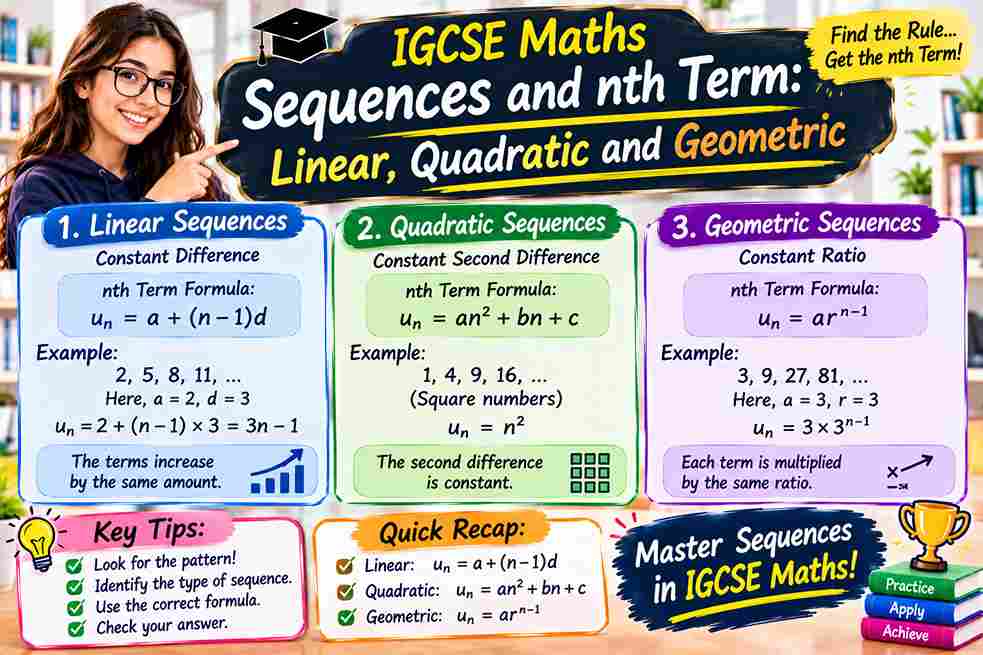
A sequence question usually asks for the nth term, a specific term, or whether a number is in the sequence. The method is mechanical once you know which type you have. This guide covers linear, quadratic and geometric sequences.
Step 1: Identify the type
Check |
If this is true |
Type |
First differences |
Constant |
Linear (arithmetic) |
First differences |
Not constant, but second differences are constant |
Quadratic |
Ratio between terms |
Constant (multiply each time) |
Geometric |
Linear sequences
If the common difference is d, the nth term isdn + (first term − d).
Worked example 1
Find the nth term of 5, 8, 11, 14, … and the 20th term.
- d = 3, so the nth term starts 3n.
- 3n gives 3, 6, 9, 12. To reach 5, 8, 11, 14 add 2.
- nth term =3n + 2. 20th term = 3(20) + 2 =62.
Worked example 2: is a number in the sequence?
Is 101 in the sequence 7, 11, 15, 19, …?
- nth term = 4n + 3.
- 4n + 3 = 101 gives 4n = 98, n = 24.5.
- n must be a whole number, so101 is not in the sequence.
Quadratic sequences
When the second difference is constant, the nth term is an² + bn + c, wherea = second difference ÷ 2.
Worked example 3
Find the nth term of 3, 8, 15, 24, 35.
- First differences: 5, 7, 9, 11. Second differences: 2, 2, 2, so a = 1.
- Subtract n²: sequence minus (1, 4, 9, 16, 25) = 2, 4, 6, 8, 10.
- That is a linear sequence 2n. nth term =n² + 2n.
Worked example 4: a not equal to 1
Find the nth term of 2, 9, 20, 35.
- First differences: 7, 11, 15. Second differences: 4, so a = 2.
- Subtract 2n²: 2 − 2 = 0, 9 − 8 = 1, 20 − 18 = 2, 35 − 32 = 3, which is n − 1.
- nth term =2n² + n − 1. Check n = 3: 18 + 3 − 1 = 20 ✓.
Geometric sequences
Each term is multiplied by a common ratio r. The nth term isa × rⁿ⁻¹.
Worked example 5
Find the nth term and the 10th term of 3, 6, 12, 24, …
- r = 2 and a = 3, so nth term = 3 × 2ⁿ⁻¹.
- 10th term = 3 × 2⁹ = 3 × 512 =1536.
Optional extension: sum of an arithmetic sequence
If your specification includes it, the sum of the first n terms isSₙ = n ÷ 2 × (2a + (n − 1)d).
- For 5, 8, 11, … with n = 10: S₁₀ = 5 × (10 + 27) =185.
- Check: the 10th term is 32 and (5 + 32) × 10 ÷ 2 = 185 ✓.
Common mistakes
- Writing the common difference as the first term, such as "3 + 2n" for 5, 8, 11.
- Forgetting the second step in quadratics: after subtracting an², find the linear sequence left over.
- Using the second difference as a instead of halving it: a = second difference ÷ 2.
- Not checking the formula with n = 1 and n = 2.
Practice questions
Question |
Answer |
1. Find the nth term of 2, 9, 16, 23. |
7n − 5 |
2. Using your answer to Q1, find the 10th term. |
65 |
3. Find the nth term of 4, 11, 22, 37. |
2n² + n + 1 |
4. Find the 8th term of 5, 10, 20, 40, … |
5 × 2⁷ = 640 |
Frequently asked questions
Q: How do I find the nth term of a linear sequence?
Find the common difference d. The nth term is dn plus whatever is needed to match the first term.
Q: How do I find the nth term of a quadratic sequence?
Halve the second difference to get a, subtract an² from the sequence, then find the linear nth term of what remains.
Q: How do I check my nth term?
Substitute n = 1, 2 and 3 and compare with the given terms.
Q: Are quadratic sequences on every tier?
They are usually Extended or Higher content. Check your specification.
Try a free trial class with EdFlik. Live 1:1 IGCSE tutoring for Cambridge and Edexcel students in the UAE, matched to your child's board, subject and year group. Book at edflik.com or message us on WhatsApp. |
Related reading
- IGCSE Maths Quadratic Equations: Worked Examples
- IGCSE Maths Core vs Extended: Which Tier?
- Cambridge 0580 Past Papers
Sources
- Cambridge International IGCSE Mathematics 0580 syllabus (sequences content)
- Pearson Edexcel International GCSE Mathematics A 4MA1 specification
More on IGCSE & GCSE
- IGCSE in the UAE: A Complete Guide to Boards, Subjects, Exams and Revision
- IGCSE Maths Vectors: Column Vectors, Magnitude and Geometric Problems
- IGCSE Maths Online Tutoring: A Complete Guide (2026)
- IGCSE Simultaneous Equations: Elimination, Substitution and Linear–Quadratic Pairs
- All IGCSE & GCSE articles