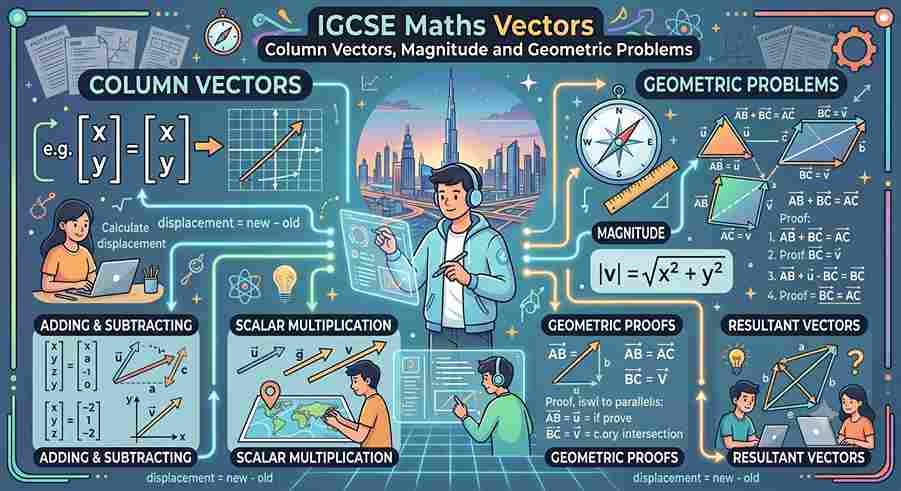
IGCSE Maths Vectors: Column Vectors, Magnitude and Geometric Problems
Last updated: November 2026 | By EdFlik Education Team
Vectors combine algebra and geometry, and the longer questions can feel unfamiliar. The rules are few. This guide builds from column vectors to the ratio and parallel-line problems that appear at the end of the paper.
Column vectors
A vector (x, y) written as a column describes a move of x units right (left if negative) and y units up (down if negative). It has both size and direction.
Worked example 1: adding and scaling
a = (2, 3) and b = (−1, 4), both written as columns. Find a + b and 2a − b.
- a + b = (2 + (−1), 3 + 4) =(1, 7).
- 2a = (4, 6), so 2a − b = (4 − (−1), 6 − 4) =(5, 2).
Magnitude
The magnitude (length) of (x, y) is√(x² + y²), from Pythagoras.
- |(3, 4)| = √(9 + 16) =5.
- |a| for a = (2, 3): √(4 + 9) = √13 =3.61(3 s.f.).
Parallel vectors
Vectors are parallel if one is a multiple of the other. (4, 6) = 2(2, 3), so (4, 6) is parallel to a. A negative multiple points the opposite way.
Geometric vectors
In a diagram, a vector from point A to point B is writtenAB. Two rules do most of the work:
- AB = −BA(reverse the direction, reverse the sign).
- AB = OB − OA, where O is the origin: "go to B, but start from A".
Worked example 2: a point dividing a line
In triangle OAB, OA =aand OB =b. P lies on AB so that AP : PB = 2 : 1. Find OP in terms ofaandb.
- AB = AO + OB = −a+b=b−a.
- AP is 2/3 of AB, so AP = 2/3(b−a).
- OP = OA + AP =a+ 2/3(b−a) =1/3 a + 2/3 b.
Worked example 3: midpoint
M is the midpoint of AB. Find OM.
- AM = 1/2 AB = 1/2(b−a).
- OM =a+ 1/2(b−a) =1/2(a + b).
Worked example 4: proving points are collinear
To show A, B and C lie on a straight line, find AB and BC and show one is a multiple of the other. Because they share point B, the points are on one line. State this conclusion in words.
A reliable method for geometric questions
- Write down every vector given in the diagram.
- Find a route from the start to the end using only vectors you know, going along sides.
- Write the route as a sum, simplify, and factorise.
- If asked for a ratio or parallel, show one vector as a multiple of another.
Common mistakes
- Writing AB = OA − OB instead of OB − OA.
- Dropping a sign when a vector is reversed.
- Giving a vector as a pair without brackets or column form when asked for a column vector.
- Forgetting to explain the conclusion ("so the lines are parallel").
Practice questions
Question |
Answer |
1. a = (1, 2), b = (3, −1). Find a + b. |
(4, 1) |
2. Same vectors: find 3a − 2b. |
(3 − 6, 6 + 2) = (−3, 8) |
3. Find |b| for b = (3, −1). |
√10 = 3.16 |
4. P lies on OA, with OP : PA = 1 : 3, and OA = a. Find OP. |
OP = 1/4 a |
Frequently asked questions
Q: What is a vector in IGCSE Maths?
A quantity with magnitude and direction, written as a column vector or as a letter such as a or as AB.
Q: How do I find the magnitude of a vector?
Use Pythagoras: the magnitude of (x, y) is the square root of x² + y².
Q: How do I prove lines are parallel using vectors?
Show that one vector is a scalar multiple of the other.
Q: Are geometric vectors on every tier?
Column vectors appear at lower tiers; geometric proofs are mostly Extended or Higher. Check your specification.
Try a free trial class with EdFlik. Live 1:1 IGCSE tutoring for Cambridge and Edexcel students in the UAE, matched to your child's board, subject and year group. Book at edflik.com or message us on WhatsApp. |
Related reading
- IGCSE Maths Trigonometry: Worked Examples
- IGCSE Circle Theorems
- Edexcel 4MA1 Past Papers
Sources
- Cambridge International IGCSE Mathematics 0580 syllabus (vectors content)
- Pearson Edexcel International GCSE Mathematics A 4MA1 specification
More on IGCSE & GCSE