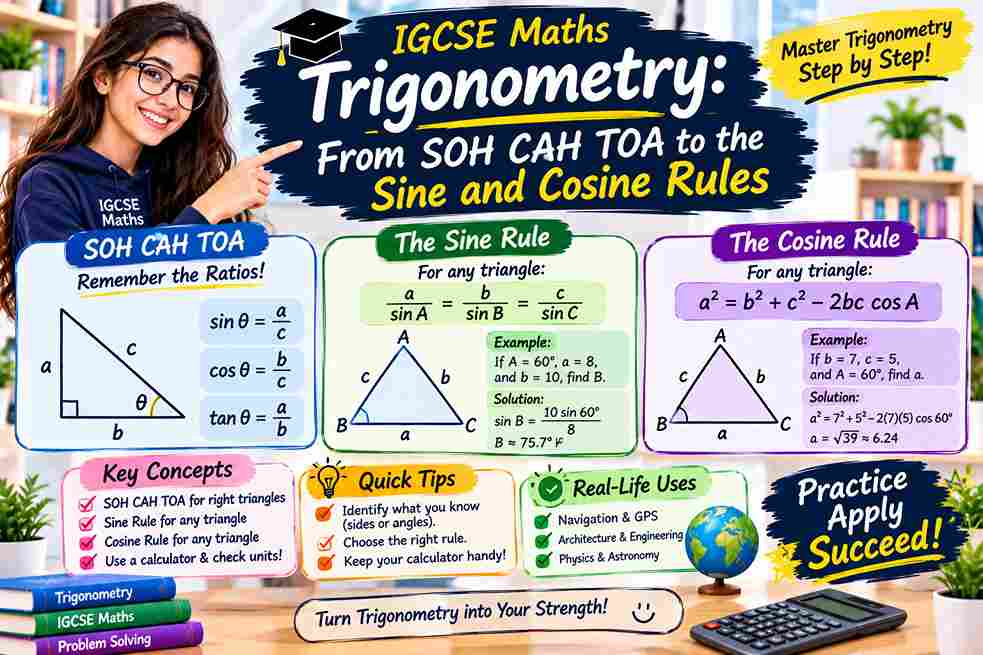
IGCSE Maths Trigonometry: From SOH CAH TOA to the Sine and Cosine Rules
Last updated: November 2026 | By EdFlik Education Team
Trigonometry is a favourite source of longer questions at IGCSE. This guide moves from right-angled triangles to the sine rule, cosine rule, area formula and 3D problems, with a worked example at each level.
Right-angled trigonometry is tested at all tiers. The sine rule, cosine rule, area formula and 3D problems are usually Extended (Cambridge) or Higher (Edexcel) content.
Before you start
- Put your calculator indegree mode. This is the most common cause of wrong answers.
- Label the triangle: hypotenuse(opposite the right angle),opposite(facing the angle) and adjacent(next to the angle).
- Keep three significant figures for lengths and one decimal place for angles unless told otherwise.
Level 1: SOH CAH TOA
Ratio |
Formula |
Use when you know or want |
Sine |
sin θ = opposite ÷ hypotenuse |
Opposite and hypotenuse |
Cosine |
cos θ = adjacent ÷ hypotenuse |
Adjacent and hypotenuse |
Tangent |
tan θ = opposite ÷ adjacent |
Opposite and adjacent |
Worked example 1: finding a side
A 5 m ladder leans against a wall at 65° to the ground. How high up the wall does it reach?
- The ladder is the hypotenuse; the height is opposite the 65° angle, so use sine.
- height = 5 × sin 65° = 5 × 0.9063 =4.53 m(3 s.f.).
Worked example 2: finding an angle
A right-angled triangle has opposite side 7 cm and adjacent side 10 cm. Find the angle.
- tan θ = 7 ÷ 10 = 0.7.
- θ = tan⁻¹(0.7) =35.0°(1 d.p.).
Level 2: The sine rule
For any triangle with sides a, b, c opposite angles A, B, C:a ÷ sin A = b ÷ sin B. Use it when you have a matching pair (a side and the angle opposite it) plus one more angle or side.
Worked example 3
In triangle ABC, angle A = 40°, angle B = 65° and side a = 8 cm. Find side b.
- b ÷ sin 65° = 8 ÷ sin 40°.
- b = 8 × sin 65° ÷ sin 40° = 8 × 0.9063 ÷ 0.6428 =11.3 cm(3 s.f.).
Level 3: The cosine rule
a² = b² + c² − 2bc cos A.Use it when you know two sides and the angle between them (to find the third side), or all three sides (to find an angle, rearranged as cos A = (b² + c² − a²) ÷ 2bc).
Worked example 4: finding a side
Two sides are 7 cm and 9 cm with an included angle of 50°. Find the third side.
- c² = 7² + 9² − 2(7)(9)cos 50° = 49 + 81 − 126 × 0.6428 = 130 − 80.99 = 49.01.
- c =7.00 cm(3 s.f.).
Worked example 5: finding an angle
A triangle has sides 5, 6 and 7 cm. Find the largest angle, opposite the 7 cm side.
- cos C = (5² + 6² − 7²) ÷ (2 × 5 × 6) = (25 + 36 − 49) ÷ 60 = 12 ÷ 60 = 0.2.
- C = cos⁻¹(0.2) =78.5°(1 d.p.).
Level 4: Area of a triangle
Area = ½ab sin C, where C is the angle between sides a and b.
- Example: sides 7 cm and 9 cm with included angle 50°: area = ½ × 7 × 9 × sin 50° = 31.5 × 0.7660 =24.1 cm²(3 s.f.).
Level 5: 3D trigonometry
Worked example 6
A cuboid measures 3 cm by 4 cm by 12 cm. Find the angle between the space diagonal and the base.
- Base diagonal = √(3² + 4²) = 5 cm.
- Draw the right-angled triangle formed by the base diagonal (5), the height (12) and the space diagonal. The space diagonal is √(25 + 144) = 13 cm.
- tan θ = 12 ÷ 5, so θ =67.4°(1 d.p.).
The trick in 3D problems is to pull out one flat right-angled or general triangle, redraw it, and then use the rules above.
Which rule do I use?
You know |
Use |
Right-angled triangle, two pieces of information |
SOH CAH TOA (or Pythagoras) |
A side and its opposite angle, plus one more piece |
Sine rule |
Two sides and the included angle |
Cosine rule (side) or area formula |
Three sides |
Cosine rule (angle) |
Common mistakes
- Calculator in radians or gradians.
- Using the sine rule when no matching side-angle pair is known.
- Rounding early. Keep full calculator values until the end.
- Forgetting to square-root after the cosine rule.
Practice questions
Question |
Answer |
1. Hypotenuse 12 cm, angle 30°. Find the side opposite. |
12 × sin 30° = 6 cm |
2. Opposite 5, adjacent 12. Find the angle. |
tan⁻¹(5 ÷ 12) = 22.6° |
3. Sides 8 and 5 with included angle 60°. Find the third side. |
c² = 64 + 25 − 80 cos 60° = 49, so c = 7 cm |
4. Sides 10 and 12 with included angle 30°. Find the area. |
½ × 10 × 12 × sin 30° = 30 cm² |
Frequently asked questions
Q: What does SOH CAH TOA stand for?
Sin = Opposite ÷ Hypotenuse, Cos = Adjacent ÷ Hypotenuse, Tan = Opposite ÷ Adjacent.
Q: When do I use the sine rule or cosine rule?
Use the sine rule with a matching side-angle pair. Use the cosine rule with two sides and the included angle, or with all three sides.
Q: Are the sine and cosine rules on the Core or Foundation paper?
They are usually Extended or Higher content. Check your specification.
Q: Why is my answer wrong when my method is right?
Check that your calculator is in degree mode first.
Q: Do I need to memorise the formulas?
Check your board's formula sheet policy and learn them regardless.
Try a free trial class with EdFlik. Live 1:1 IGCSE tutoring for Cambridge and Edexcel students in the UAE, matched to your child's board, subject and year group. Book at edflik.com or message us on WhatsApp. |
Related reading
- IGCSE Circle Theorems: Worked Examples
- IGCSE Maths Paper Structure: 0580 vs 4MA1
- Cambridge 0580 Past Papers
Sources
- Cambridge International IGCSE Mathematics 0580 syllabus (trigonometry content)
- Pearson Edexcel International GCSE Mathematics A 4MA1 specification
More on IGCSE & GCSE
- IGCSE in the UAE: A Complete Guide to Boards, Subjects, Exams and Revision
- Mastering Sine and Cosine Rules: Essential IGCSE Trigonometry Problem-Solving Framework
- IGCSE Mathematics Extended — Trigonometry Beyond Right Triangles: Sine Rule, Cosine Rule & Area
- IGCSE Maths Online Tutoring: A Complete Guide (2026)
- All IGCSE & GCSE articles