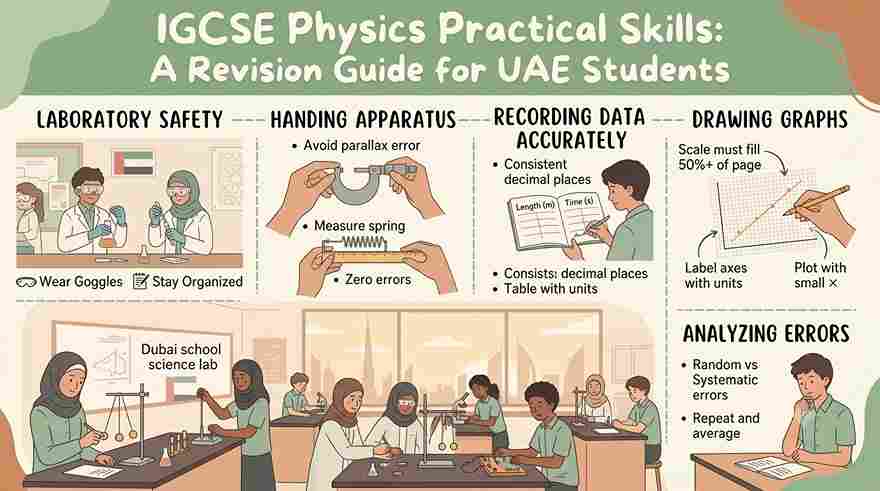
IGCSE Physics Practical Skills: A Revision Guide for UAE Students
By EdFlik Team | November 2, 2026
For students in private international schools across the United Arab Emirates—whether taking Cambridge CAIE IGCSE Physics (0625/0972) or Pearson Edexcel International GCSE Physics (4PH1)—mastering practical skills is essential for securing a Grade 8/9 ($A^*$).
In the Cambridge syllabus, experimental competency is assessed directly through Paper 5 (Practical Test) or Paper 6 (Alternative to Practical), which accounts for $20\%$ of your overall IGCSE grade. For Pearson Edexcel candidates, core practical skills are integrated straight into Paper 1P and Paper 2P.
Many candidates incorrectly assume that practical papers only test basic laboratory memory. In reality, examiners evaluate a rigorous set of skills: experimental design, variable control, graph plotting rules, precisions, measuring instrument evaluation, source-of-error identification, and practical safety precautions.
This masterclass revision guide details the essential practical skills needed for IGCSE Physics, complete with structural frameworks, mathematical calculations, graph rules, and 100% copy-paste JSON-LD schema markup.
Part 1: Core Physics Practical Experiments You Must Know
Across both CAIE and Edexcel specifications, practical questions revolve around five recurring laboratory setups:
                      CORE IGCSE PHYSICS EXPERIMENTS
                                    |
  +---------------------------------+---------------------------------+
  |                                 |                                 |
1. MECHANICS & DENSITY           2. THERMAL PHYSICS               3. OPTICS & RAYS
  • Simple pendulum period.        • Cooling curves & insulation.    • Reflection & refraction.
  • Density of irregular solids.   • Specific heat capacity.         • Focal length of lenses.
  +---------------------------------+---------------------------------+
  |                                 |                                 |
4. ELECTRICITY & CIRCUITS        5. WAVES & SOUND
  • Resistance of wires ($V/I$).   • Speed of sound in air.
  • Filament lamp vs resistor.     • Ripple tank wave properties.
1. Mechanics & Density Experiments
- Irregular Solid Density: Measuring volume via displacement of water in a measuring cylinder. Read the bottom of the meniscus at eye level to eliminate parallax error.
- Period of a Pendulum ($T$): Timing 10 or 20 complete oscillations ($20T$) using a stopwatch, then dividing the total time by the number of oscillations ($T = t/20$). This minimizes the percentage uncertainty caused by human reaction time.
2. Thermal Physics Experiments
- Cooling Curves: Measuring temperature drops of heated water over time. Key precautions include stirring the water before taking a reading and keeping the thermometer bulb fully submerged without touching the beaker walls.
- Insulation Effectiveness: Comparing different insulating materials by keeping starting temperature, water volume, and container dimensions constant.
3. Ray Optics Experiments
- Refraction through a Glass Block: Tracing ray paths using optical pins. Pins must be placed at least $5\text{ cm}$ apart to ensure accurate alignment lines when drawing normals and measuring angles of incidence ($i$) and refraction ($r$) with a protractor.
4. Electrical Circuit Experiments
- Determining Resistance ($R = V/I$): Connecting a voltmeter in parallel across the component and an ammeter in series. A variable resistor (rheostat) is adjusted to alter potential difference and current, or switched off between readings to prevent wire heating (which alters resistance).
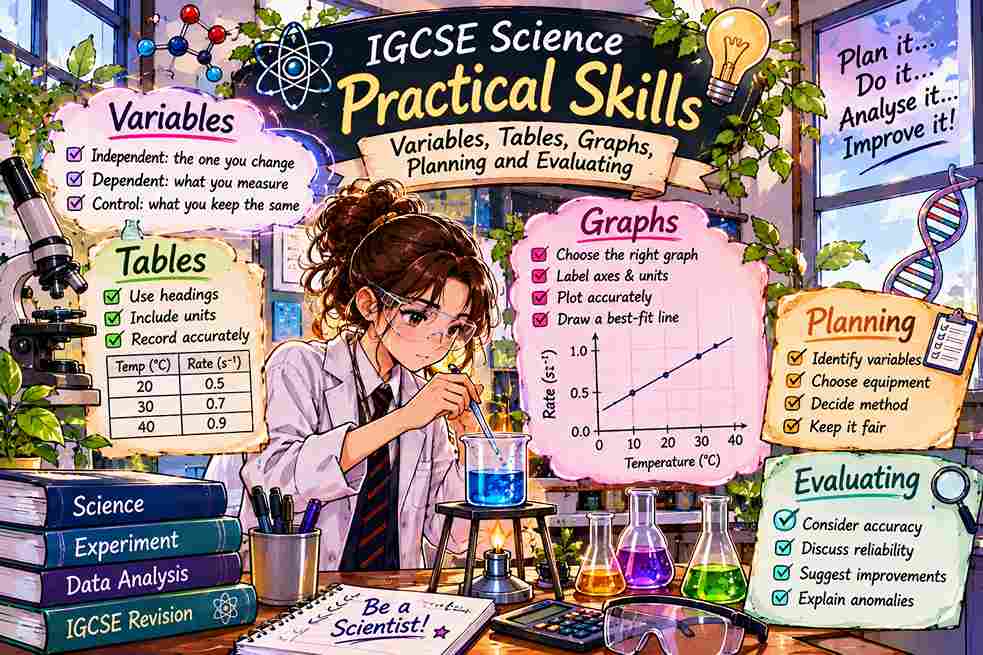
Part 2: Rules for Graph Plotting & Data Presentation
Graph questions carry high mark tariffs on practical papers. Following strict exam board rules guarantees full marks:
                  THE 5 COMMANDMENTS OF IGCSE GRAPH PLOTTING
                                       |
  1. Axis Orientation  ---> Dependent variable on Y-axis, Independent variable on X-axis.
  2. Scale & Coverage  ---> Use simple scales (1, 2, 5, 10); plot must cover >50% of grid.
  3. Axis Labeling     ---> Label both axes with "Quantity / Unit" (e.g., "Length, L / cm").
  4. Plotting Precision---> Plot points cleanly with fine 'x' or encircled dots within <0.5 small square.
  5. Line of Best Fit  ---> Draw a single, smooth line or curve with balanced points on both sides.
Calculating Gradients Correctly:
When finding the gradient ($m$) of a linear graph:
- Show your working by drawing a large right-angled triangle on the graph grid.
- The hypotenuse of the triangle must cover more than half the length of your drawn line.
- Read coordinates accurately and apply the gradient formula:
$$m = \frac{\Delta y}{\Delta x} = \frac{y_2 - y_1}{x_2 - x_1}$$
Part 3: Identifying Errors and Suggesting Improvements
Examiners frequently ask candidates to identify sources of experimental error and propose practical improvements.
| Experimental Area | Common Source of Error | Standard Practical Improvement |
| Length Measurements | Parallax error when reading a ruler. | View the scale perpendicularly; use a set-square to align. |
| Timing Experiments | Human reaction time uncertainty. | Time $20$ oscillations instead of $1$; use digital fiducial markers. |
| Thermal Loss | Heat escaping into surrounding air. | Add a lid to the beaker; lag/wrap container in insulation. |
| Ray Tracing | Thick pencil lines or pins placed too close. | Use a sharp pencil ($0.5\text{ mm}$); place pins $>5\text{ cm}$ apart. |
| Circuit Readings | Resistance changes due to temperature rise. | Open the switch between readings to allow wire to cool. |
Part 4: How to Plan a Physics Investigation (Paper 6 / Paper 2)
The final question on CAIE Paper 6 (and integrated Edexcel practical prompts) asks you to design an experiment from scratch. This question is worth $7\text{ marks}$ and follows a standard scoring template:
                  7-STEP EXPERIMENTAL DESIGN TEMPLATE
                                   |
  Step 1: Identify Variables    ---> State Independent, Dependent, and 2 Controlled variables.
  Step 2: List Equipment        ---> Name specific apparatus (e.g., stopwatch, micrometer, ammeter).
  Step 3: Diagram (Optional)    ---> Draw a clean, labeled circuit or laboratory setup.
  Step 4: Step-by-Step Method   ---> Describe sequential procedure logically.
  Step 5: Tabulate Data         ---> Sketch a table with headers and units (no raw data needed).
  Step 6: Graph & Analysis      ---> State which plot to draw (e.g., plot Y vs X) and expected trend.
  Step 7: Safety & Accuracy     ---> Include one specific precaution (e.g., wear safety goggles).
Part 5: Top 4 Traps That Cost Students Marks
- Omitting Units in Tables: Writing numbers in data tables without units in the column headings. Units must be written as
Quantity / Unit(e.g.,Time / sorPotential Difference / V). - Inconsistent Decimal Precision: Recording raw measurements to varying decimal places (e.g., mixing
12.0,12.45, and13). Keep all raw values in a single column to the same precision. - Forcing Best-Fit Lines Through the Origin: Forcing a best-fit line to pass through $(0,0)$ when the data points clearly show a non-zero $y$-intercept.
- Confusing Precision with Accuracy: Vague statements like "use a better instrument" score zero marks. Always name the specific apparatus (e.g., "Use a digital micrometer screw gauge instead of a ruler").
For expert 1-on-1 tutoring support to master Cambridge and Pearson Edexcel IGCSE Physics practical skills, past-paper drills, and graph techniques, book a class on EdFlik.
Frequently Asked Questions (FAQs)
Q1: What is the difference between Paper 5 and Paper 6 in CAIE IGCSE Physics?
Ans: Paper 5 (Practical Test) is a hands-on laboratory examination sat inside a school physics lab using real apparatus. Paper 6 (Alternative to Practical) is a written examination taken at a desk that tests identical experimental skills, data handling, and planning using diagrams, tables, and graphs.
Q2: How do I avoid losing marks on ray tracing optics questions?
Ans: Always use a sharp hard ($2\text{H}$) pencil, ensure optical pins are spaced at least $5\text{ cm}$ apart, draw normals at exactly $90^\circ$ using a protractor, and include arrows on ray lines to show the direction of light propagation.
Q3: What measuring instruments give the highest precision for small lengths?
Ans: For lengths under $2.5\text{ cm}$ (such as wire diameter or sheet thickness), use a micrometer screw gauge (precision to $0.01\text{ mm}$) or digital vernier calipers (precision to $0.1\text{ mm}$), rather than a standard meter ruler ($1\text{ mm}$ precision).
More on IGCSE & GCSE