IGCSE Rates of Reaction: Collision Theory, Graphs and Practical Methods
Last updated: November 2026 | By EdFlik Education Team
Rates of reaction is a topic where precise wording earns the marks. Students who only say "more collisions" lose marks to those who say "more frequent collisions" or "more collisions with enough energy". This guide gives the theory, the four factors, graph skills and the experiments commonly examined.
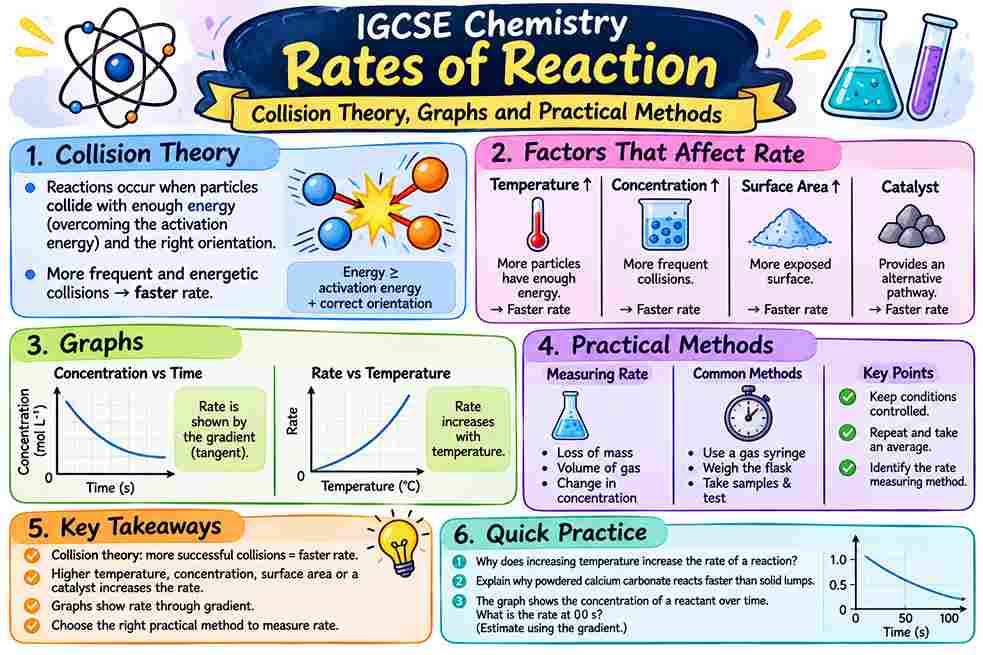
Collision theory
Particles must collide with enough energy to react. The minimum energy needed is the activation energy. A faster reaction means moresuccessful collisions per second.
The four factors
Factor |
Effect on rate |
Explanation to write |
Concentration (or pressure for gases) |
Increases |
More particles in the same volume, so more frequent collisions |
Temperature |
Increases |
Particles move faster, so collide more often, and more have energy above the activation energy |
Surface area (smaller pieces) |
Increases |
More particles exposed at the surface, so more frequent collisions |
Catalyst |
Increases |
Provides an alternative pathway with a lower activation energy; it is not used up |
Exam tip: for temperature, give both reasons: more frequent collisions and more collisions with energy greater than or equal to the activation energy. The second reason matters most. |
Measuring rate
Method |
What you measure |
Used when |
Gas syringe or upturned measuring cylinder |
Volume of gas against time |
A gas is made (for example, magnesium with acid) |
Mass on a balance |
Mass loss against time |
A gas escapes (for example, marble chips with acid) |
Disappearing cross |
Time for a cross under the flask to vanish |
A precipitate forms (for example, sodium thiosulfate with acid) |
Calculating mean rate
Mean rate = amount of reactant used or product formed ÷ time taken.
Worked example 1
A reaction produces 24 cm³ of gas in the first 30 seconds and 36 cm³ in the first 60 seconds. Find the mean rate over the first 30 seconds and over the second 30 seconds.
- First 30 s: 24 ÷ 30 =0.8 cm³/s.
- Second 30 s: (36 − 24) ÷ 30 = 12 ÷ 30 =0.4 cm³/s.
- The rate has fallen because reactant is being used up and its concentration is dropping.
Worked example 2: the disappearing cross
The cross disappears after 25 s. Rate is proportional to 1 ÷ time, so rate = 1 ÷ 25 =0.04 s⁻¹. If the cross disappears after 50 s in a second experiment, its rate is 0.02 s⁻¹, half as fast.
Reading rate graphs
- The steepest part of a curve is the fastest rate, usually at the start.
- The curve levels off when one reactant is used up and the reaction stops.
- A steeper curve for the same final volume means a faster reaction but the same amount of product.
- If the final volume is lower, less reactant was used, not just a slower reaction.
- To find the rate at a time, draw a tangent to the curve and calculate its gradient.
Worked example 3: explaining a graph
Powdered marble gives a steeper curve than marble chips with the same mass and acid. Explanation: the powder has a larger surface area, so more particles are exposed to the acid, so collisions are more frequent, so the rate is higher. The final volume is the same because the mass of marble is the same.
Common mistakes
- Saying a catalyst "speeds up" without saying it lowers the activation energy.
- Saying particles "move faster" without linking to collisions.
- Confusing rate with amount produced.
- Describing a curve as "faster" when it only reaches the same plateau sooner.
Practice questions
Question |
Answer |
1. 60 cm³ of gas forms in 40 s. Find the mean rate. |
1.5 cm³/s |
2. Explain why a powder reacts faster than lumps. |
Larger surface area, so more frequent collisions |
3. What stays the same after a reaction in the presence of a catalyst? |
The mass and chemical identity of the catalyst |
4. A cross disappears after 25 s. State the rate as 1 ÷ time. |
0.04 s⁻¹ |
Frequently asked questions
Q: What are the four factors affecting rate?
Concentration (or pressure), temperature, surface area and the presence of a catalyst.
Q: What is activation energy?
The minimum energy particles need for a collision to result in a reaction.
Q: How does a catalyst work?
It provides an alternative pathway with a lower activation energy and is not used up.
Q: How do I find the rate from a graph?
Draw a tangent at the point and calculate its gradient.
Try a free trial class with EdFlik. Live 1:1 IGCSE tutoring for Cambridge and Edexcel students in the UAE, matched to your child's board, subject and year group. Book at edflik.com or message us on WhatsApp. |
Related reading
- IGCSE Chemistry (0620 / 4CH1) Guide
- IGCSE Chemistry Mole Calculations
- IGCSE Practical Skills: Planning and Evaluating Experiments
Sources
- Cambridge International IGCSE Chemistry 0620 syllabus 2026–2028
- Pearson Edexcel International GCSE Chemistry 4CH1 specification
More on IGCSE & GCSE
- IGCSE in the UAE: A Complete Guide to Boards, Subjects, Exams and Revision
- IGCSE Science Practical Skills: Variables, Tables, Graphs, Planning and Evaluating
- IGCSE Physics Practical Skills: A Revision Guide for UAE Students
- IGCSE Maths Revision: A Practical Study Plan for UAE Students
- All IGCSE & GCSE articles