IGCSE Similar Shapes: Length, Area and Volume Scale Factors
Last updated: November 2026 | By EdFlik Education Team
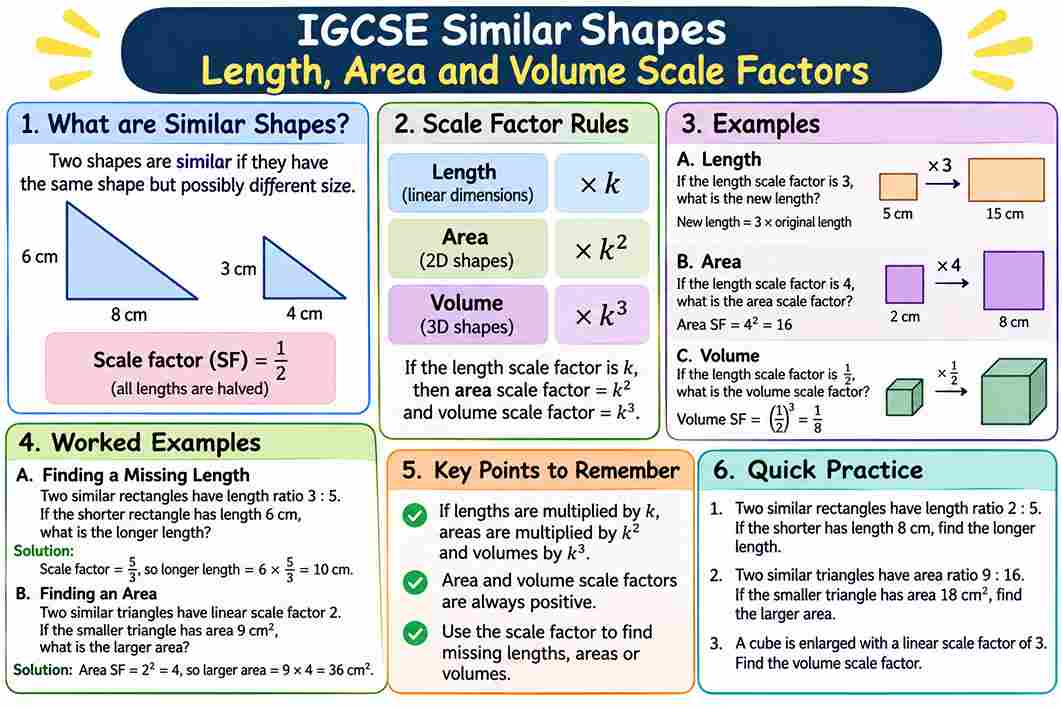
Two shapes are similar if one is an enlargement of the other: the same shape, different size. Similarity questions are short once you remember one rule: lengths scale by k, areas by k² and volumes by k³. This guide explains how to use that rule and covers congruence for completeness.
The key rule
Quantity |
Scale factor |
If k = 1.5 |
Length |
k |
× 1.5 |
Area |
k² |
× 2.25 |
Volume |
k³ |
× 3.375 |
Worked examples
Example 1: missing side
Two similar triangles have corresponding sides 6 cm and 9 cm. A side of 8 cm on the smaller triangle matches which side on the larger?
- Scale factor = 9 ÷ 6 = 1.5.
- Missing side = 8 × 1.5 =12 cm.
Example 2: area
The smaller triangle has area 20 cm². Find the area of the larger.
- Area factor = 1.5² = 2.25.
- Area = 20 × 2.25 =45 cm².
Example 3: volume
Two similar cones have heights 4 cm and 6 cm. The smaller has volume 32 cm³. Find the volume of the larger.
- k = 6 ÷ 4 = 1.5, so volume factor = 1.5³ = 3.375.
- Volume = 32 × 3.375 =108 cm³.
Example 4: from area ratio to volume ratio
Two similar solids have surface areas in the ratio 4 : 9. Find the ratio of their volumes.
- Area ratio 4 : 9 means length ratio √4 : √9 = 2 : 3.
- Volume ratio = 2³ : 3³ =8 : 27.
Example 5: a context question
A bottle holds 500 ml. A similar bottle is 1.5 times as tall. How much does it hold?
- Volume factor = 1.5³ = 3.375.
- Capacity = 500 × 3.375 =1687.5 ml, about 1.69 litres.
Steps for any similarity question
- Identify the matching pair of lengths and find the length scale factor k.
- Decide whether the question is about length, area or volume.
- Apply k, k² or k³.
- If you are given an area or volume ratio, take a square root or cube root first to find k.
Congruence
Two shapes are congruent if they are exactly the same shape and size. Triangles are congruent if one of these holds:
Condition |
Meaning |
SSS |
All three sides equal |
SAS |
Two sides and the angle between them equal |
ASA (or AAS) |
Two angles and a corresponding side equal |
RHS |
A right angle, the hypotenuse and one other side equal |
Use these names as reasons in proof questions. AAA proves similarity, not congruence.
Common mistakes
- Using k instead of k² for area.
- Using the ratio of areas as the ratio of lengths.
- Matching the wrong pair of sides.
- Treating "congruent" and "similar" as the same.
Practice questions
Question |
Answer |
1. Two similar shapes have k = 3. The smaller area is 12 cm². Find the larger area. |
12 × 9 = 108 cm² |
2. Volume ratio is 8 : 27. What is the area ratio? |
4 : 9 |
3. Area ratio is 25 : 36. What is the length ratio? |
5 : 6 |
4. Two similar cubes have volumes 27 cm³ and 64 cm³. Find the scale factor. |
k = 4 ÷ 3 |
Frequently asked questions
Q: What is a scale factor?
The number by which every length in the original shape is multiplied to get the similar shape.
Q: How do area and volume change in similar shapes?
Areas change by k² and volumes by k³.
Q: What is the difference between similar and congruent?
Similar shapes have the same shape but may differ in size. Congruent shapes are identical in size and shape.
Q: Is similarity on every tier?
Length scale factors appear widely; area and volume scale factors are usually Extended or Higher.
Try a free trial class with EdFlik. Live 1:1 IGCSE tutoring for Cambridge and Edexcel students in the UAE, matched to your child's board, subject and year group. Book at edflik.com or message us on WhatsApp. |
Related reading
- IGCSE Transformations: Reflection, Rotation, Enlargement
- IGCSE Ratio and Proportion: Worked Examples
- IGCSE Circle Theorems
Sources
- Cambridge International IGCSE Mathematics 0580 syllabus (geometry content)
- Pearson Edexcel International GCSE Mathematics A 4MA1 specification
More on IGCSE & GCSE