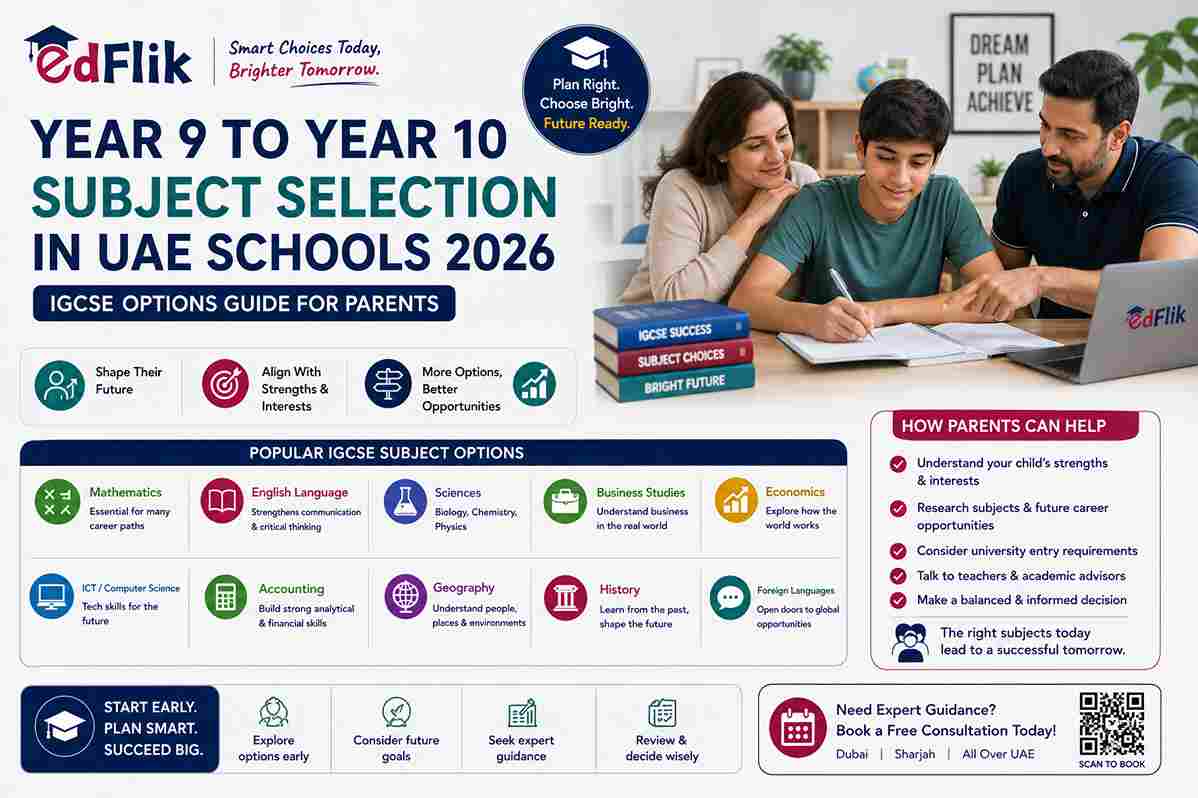
Year 10 Tutor UAE 2026 — How to Use the First IGCSE Year Strategically
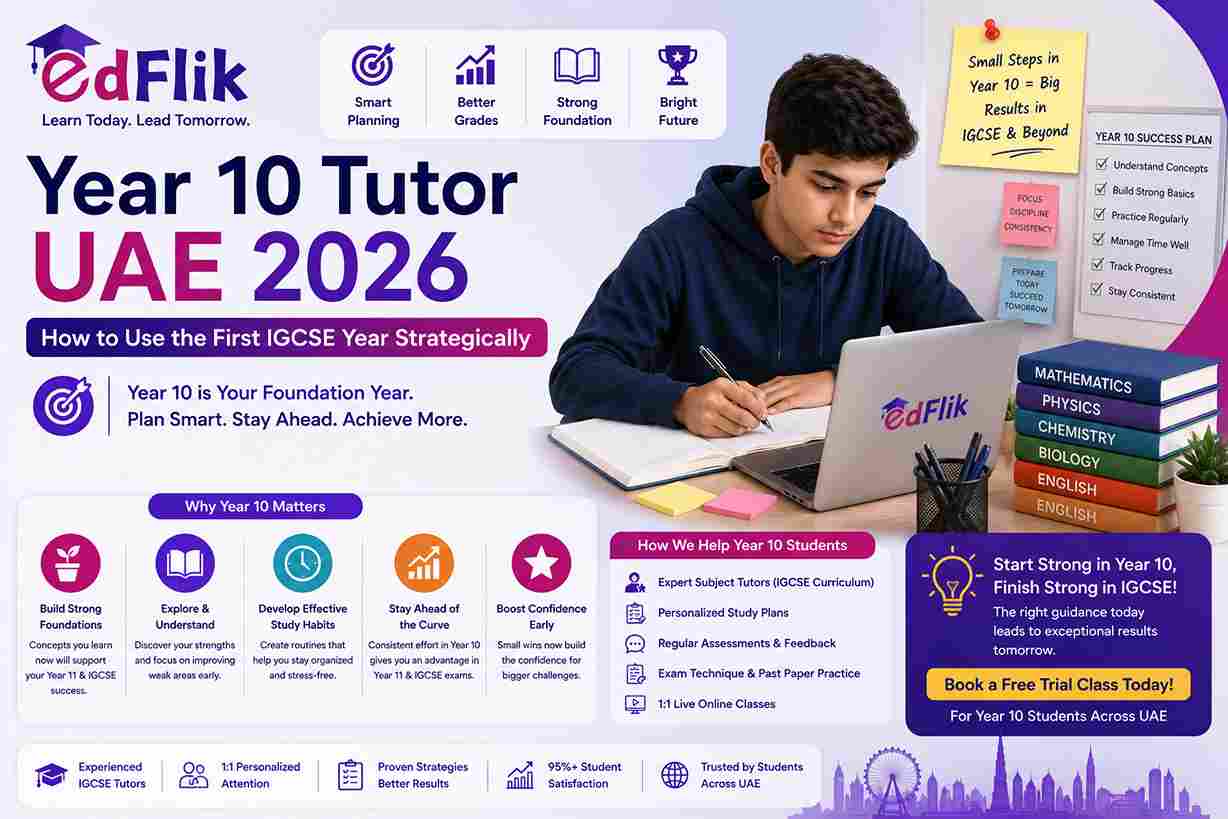
Year 10 is the year that determines whether Year 11 is manageable or overwhelming. Students who use Year 10 strategically — building secure content foundations in their priority subjects, developing early examination technique habits, and identifying gaps before they compound — arrive at Year 11 in a position where technique refinement is the main task. Students who drift through Year 10 without specific targets arrive at Year 11 needing both content learning and technique development simultaneously, with only one year of teaching time to achieve both. This guide covers how to use Year 10 most effectively.
Year 10 vs Year 11 — The Content Distribution Pattern
|
Subject |
Year 10
Content |
Year 11
Content |
Foundation
Risk if Year 10 Gaps Remain |
|
IGCSE Maths
(0580) |
Number
properties; algebra (expressions, equations); coordinate geometry; basic
trigonometry; fractions, decimals, percentages |
Quadratic
equations; functions; vectors; statistics and probability; similarity and
congruence; advanced trigonometry |
Algebraic
manipulation weakness blocks Year 11 quadratics, functions, and trig —
compounds rapidly |
|
IGCSE
Chemistry (0620) |
Atomic
structure; bonding (ionic, covalent, metallic); the mole concept; reactions;
basic organic chemistry |
Electrochemistry;
rates of reaction; industrial chemistry; organic chemistry completion;
quantitative chemistry continuation |
Mole concept
weakness in Year 10 makes every Year 11 quantitative topic inaccessible —
foundational blocking point |
|
IGCSE Biology
(0610) |
Cell
structure; photosynthesis; respiration; human physiology (digestion, heart,
lungs) |
Genetics and
inheritance; homeostasis; ecology; reproduction; biotechnology |
Cell biology
vocabulary gaps mean Year 11 genetics content builds on unstable terminology
— mark-scheme language errors multiply |
|
IGCSE Physics
(0625) |
Waves;
electricity; thermal physics; properties of matter |
Magnetism and
electromagnetism; nuclear physics; space physics; forces and motion revision |
Electricity
equations in Year 10 must be fluent — Year 11 magnetism requires all Year 10
electricity as prerequisite |
The Strategic Year 10 Tutoring Plan
Term 1 (September — December): Diagnosis and Foundation
The most effective Year 10 tutoring begins with a diagnostic session in September — not a general subject review but a targeted assessment of which specific Year 9 and early Year 10 skills are not yet secure. At EdFlik, the Year 10 diagnostic identifies:
• Which algebraic operations the student cannot perform fluently (for Maths)
• Whether the student can correctly use mark-scheme language for basic processes already covered (for Sciences)
• Where reading speed and comprehension accuracy sit relative to IGCSE paper requirements (for English and Humanities)
Term 1 tutoring targets those specific foundations — not Year 11 content, not past papers — the Year 10 foundations that Year 11 will build upon.
Term 2 (January — March): Content Consolidation and Early Technique
By Term 2 of Year 10, Year 10 content is largely complete in most subjects. This is the right time to introduce past paper questions at Year 10 difficulty level — not full past papers (which include Year 11 content), but individual questions from the easier sections of Cambridge past papers that test Year 10 content specifically. The goal: by the end of Year 10, the student can correctly answer the first 40-60% of a typical IGCSE paper, which consists mostly of Year 10 content.
Term 3 and Summer (April — August): Year 11 Preview
For students who have strong Year 10 foundations by April, tutoring in Term 3 and summer can begin introducing Year 11 content — giving a significant head start. The highest-ROI Year 11 preview topics: quadratic equations and functions (Maths), mole calculations extended to full stoichiometry problems (Chemistry), genetics and Punnett squares (Biology), and electromagnetic induction basics (Physics).
|
EdFlik Year
10 tutoring begins with a diagnostic in September and is structured to secure
Year 10 content foundations before shifting to Year 11 examination technique.
Every session includes formative assessment of the previous week's learning.
From AED 55 per session. Free diagnostic. Book at www.edflik.com or WhatsApp
+91 88788 96600. |
Frequently Asked Questions
Q: Why is Year 10 a critical year for IGCSE students?
Year 10 is the first IGCSE teaching year — content taught in Year 10 is examined in Year 11. Students who build strong Year 10 foundations arrive at Year 11 needing only technique refinement. Students with Year 10 content gaps spend Year 11 learning content AND developing examination technique simultaneously.
Q: What IGCSE content is covered in Year 10?
Maths: algebra foundations, coordinate geometry, basic trigonometry. Chemistry: atomic structure, bonding, mole concept, basic organic. Biology: cell biology, photosynthesis, respiration, human physiology basics. Physics: waves, electricity, thermal physics. Year 11 builds directly on all of this.
Q: Should UAE students start IGCSE tutoring in Year 10 or wait until Year 11?
Year 10 is significantly more effective — diagnostic and preventive rather than emergency catch-up. Addressing gaps as they form in Year 10 prevents compounding in Year 11 when examination pressure is high and time is limited.
Q: How many subjects should a Year 10 UAE student receive tutoring in?
1-3 subjects depending on the student's profile. Students struggling in specific subjects should start in September of Year 10. Solid students may need only 1 subject in Year 10 and scale to 2-3 in Year 11.
Q: What is the most important Year 10 IGCSE Maths topic to secure?
Algebraic manipulation — rearranging formulae, solving equations with fractions, forming equations from word problems. Every advanced Year 11 Maths topic builds on algebraic fluency. Gaps here compound into every subsequent topic.