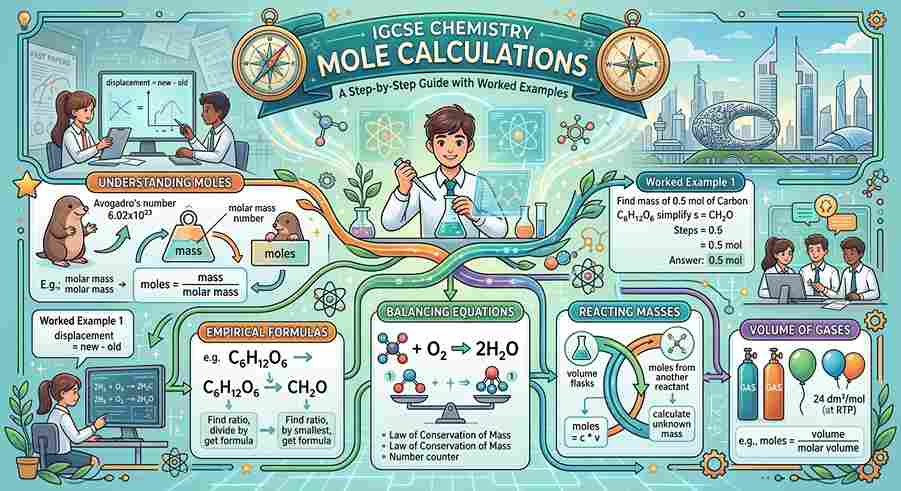
IGCSE Chemistry Mole Calculations: A Step-by-Step Guide with Worked Examples
Last updated: November 2026 | By EdFlik Education Team
Mole calculations are where many IGCSE Chemistry marks are lost, mostly because students try to jump to the answer. This guide gives one routine that works for every type of question, then applies it six times.
The core formulae
Quantity |
Formula |
Units |
Moles from mass |
n = mass ÷ Mr |
mass in g |
Moles of gas |
n = volume ÷ 24 |
volume in dm³ at room temperature and pressure |
Moles in solution |
n = concentration × volume |
concentration in mol/dm³, volume in dm³ |
Concentration |
c = n ÷ V |
mol/dm³ |
Percentage yield |
actual ÷ theoretical × 100 |
% |
Remember:cm³ ÷ 1000 = dm³. Forgetting this is the most common error.
The four-step routine
- Writethe balanced equation.
- Convertthe quantity you are given into moles.
- Use the ratioin the equation to find moles of the substance you want.
- Convertmoles into the quantity asked for (mass, volume, concentration).
Worked examples
Example 1: moles from mass
How many moles are in 4.9 g of H₂SO₄? (Ar: H = 1, S = 32, O = 16)
- Mr = 2(1) + 32 + 4(16) = 98.
- n = 4.9 ÷ 98 =0.05 mol.
Example 2: mass from moles
What is the mass of 0.25 mol of NaOH? (Mr = 40)
- mass = n × Mr = 0.25 × 40 =10 g.
Example 3: reacting masses and gas volume
Mg + 2HCl → MgCl₂ + H₂. What volume of hydrogen forms from 2.4 g of magnesium? (Ar Mg = 24)
- n(Mg) = 2.4 ÷ 24 = 0.1 mol.
- Ratio Mg : H₂ = 1 : 1, so n(H₂) = 0.1 mol.
- Volume = 0.1 × 24 =2.4 dm³.
Example 4: concentration
5.85 g of NaCl (Mr = 58.5) is dissolved to make 250 cm³ of solution. Find the concentration.
- n = 5.85 ÷ 58.5 = 0.1 mol.
- V = 250 ÷ 1000 = 0.25 dm³.
- c = 0.1 ÷ 0.25 =0.4 mol/dm³.
Example 5: percentage yield
Fe₂O₃ + 3CO → 2Fe + 3CO₂. 16 g of Fe₂O₃ (Mr = 160) gives 9.0 g of iron. Find the percentage yield. (Ar Fe = 56)
- n(Fe₂O₃) = 16 ÷ 160 = 0.1 mol. Ratio Fe₂O₃ : Fe = 1 : 2, so n(Fe) = 0.2 mol.
- Theoretical mass = 0.2 × 56 = 11.2 g.
- Yield = 9.0 ÷ 11.2 × 100 =80.4%(3 s.f.).
Example 6: titration
25.0 cm³ of 0.100 mol/dm³ NaOH is neutralised by 20.0 cm³ of HCl. HCl + NaOH → NaCl + H₂O. Find the concentration of the HCl.
- n(NaOH) = 0.100 × 0.0250 = 0.00250 mol.
- Ratio HCl : NaOH = 1 : 1, so n(HCl) = 0.00250 mol.
- c(HCl) = 0.00250 ÷ 0.0200 =0.125 mol/dm³.
Empirical formula
A hydrocarbon contains 2.4 g of carbon and 0.4 g of hydrogen. Divide each mass by Ar: C = 2.4 ÷ 12 = 0.2, H = 0.4 ÷ 1 = 0.4. The ratio is 1 : 2, so the empirical formula isCH₂.
Common mistakes
- Using the wrong Mr, or forgetting to multiply by a subscript.
- Not balancing the equation before using the ratio.
- Leaving the volume in cm³ in a concentration calculation.
- Rounding Mr or intermediate answers too early.
- Giving an answer without units.
Practice questions
Question |
Answer |
1. How many moles in 11 g of CO₂ (Mr = 44)? |
0.25 mol |
2. What is the mass of 0.5 mol of CaCO₃ (Mr = 100)? |
50 g |
3. What volume does 0.25 mol of gas occupy at room temperature and pressure? |
0.25 × 24 = 6 dm³ |
4. 4.0 g of NaOH (Mr = 40) is dissolved in 500 cm³. Find the concentration. |
0.1 mol ÷ 0.5 dm³ = 0.2 mol/dm³ |
5. 2H₂ + O₂ → 2H₂O. What mass of water forms from 4 g of hydrogen (Mr = 2; water Mr = 18)? |
2 mol H₂ gives 2 mol H₂O = 36 g |
Frequently asked questions
Q: What is a mole in IGCSE Chemistry?
A mole is a fixed amount of substance. Its mass in grams equals the relative formula mass.
Q: What is the molar volume of a gas at room temperature and pressure?
24 dm³ per mole, which is the value used in IGCSE papers. Use the value given in your exam.
Q: How do I convert cm³ to dm³?
Divide by 1000.
Q: Do I need to show working?
Yes. Method marks are awarded for each step, and a correct answer without units can lose a mark.
Q: Why does my answer differ slightly from the mark scheme?
Different Ar values or early rounding. Keep full values until the end and use the data sheet's Ar values.
Try a free trial class with EdFlik. Live 1:1 IGCSE tutoring for Cambridge and Edexcel students in the UAE, matched to your child's board, subject and year group. Book at edflik.com or message us on WhatsApp. |
Related reading
- IGCSE Chemistry (0620 / 4CH1) Guide
- IGCSE Science Papers: Cambridge vs Edexcel
- IGCSE Physics Equations
Sources
- Cambridge International IGCSE Chemistry 0620 syllabus 2026–2028
- Pearson Edexcel International GCSE Chemistry 4CH1 specification
More on IGCSE & GCSE