IGCSE Circle Theorems: Every Rule Explained with Worked Examples
Last updated: November 2026 | By EdFlik Education Team
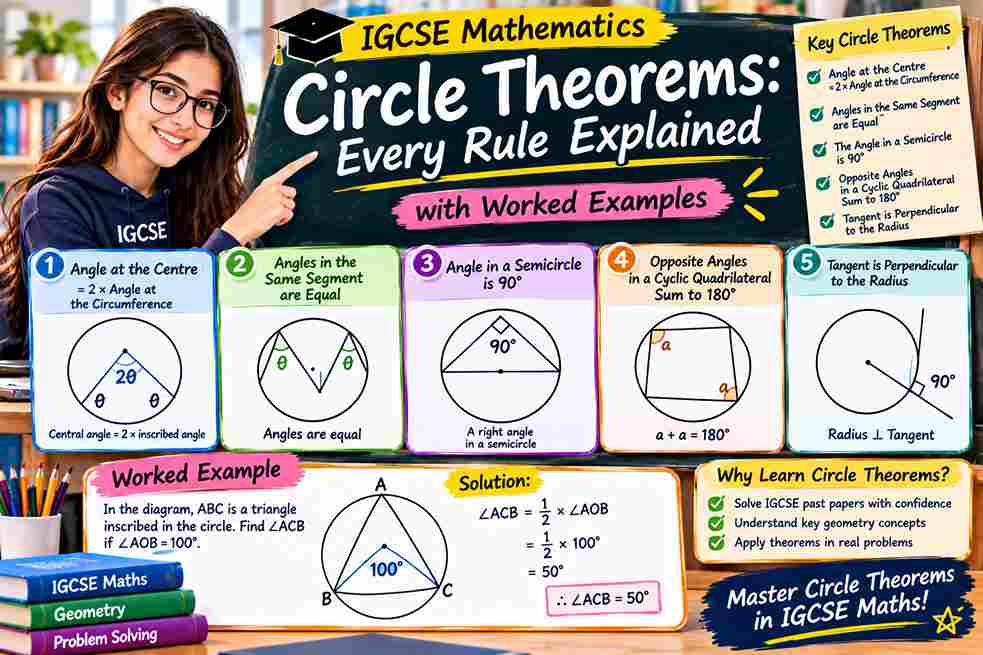
Circle theorem questions ask students to find an angle and justify it with a named reason. The maths is simple; the skill is recognising which theorem applies and writing the reason in words. This guide lists each theorem, gives one worked example, and ends with practice questions.
Most of these theorems are Extended (Cambridge) or Higher (Edexcel) content, though some appear on lower tiers. Check your specification.
The theorems at a glance
Theorem |
What it says |
Wording for the exam |
1. Angle at the centre |
The angle at the centre is twice the angle at the circumference, from the same arc. |
"Angle at the centre is twice the angle at the circumference." |
2. Angle in a semicircle |
An angle in a semicircle is 90°. |
"Angle in a semicircle is a right angle." |
3. Same segment |
Angles in the same segment are equal. |
"Angles in the same segment are equal." |
4. Cyclic quadrilateral |
Opposite angles add up to 180°. |
"Opposite angles in a cyclic quadrilateral add up to 180°." |
5. Tangent and radius |
A tangent meets the radius at 90°. |
"Angle between tangent and radius is 90°." |
6. Two tangents |
Tangents from an outside point are equal in length. |
"Tangents from an external point are equal." |
7. Alternate segment |
The angle between a tangent and a chord equals the angle in the alternate segment. |
"Alternate segment theorem." |
8. Chord and centre |
A line from the centre perpendicular to a chord bisects it. |
"Perpendicular from the centre bisects the chord." |
Worked examples
Example 1: angle at the centre
Angle AOB at the centre is 140°. Find angle ACB at the circumference, on the same arc.
- Angle at the circumference = 140° ÷ 2 =70°.
- Reason: the angle at the centre is twice the angle at the circumference.
Example 2: cyclic quadrilateral
ABCD is a cyclic quadrilateral and angle ABC = 110°. Find angle ADC.
- Opposite angles add to 180°, so angle ADC = 180° − 110° =70°.
- Reason: opposite angles of a cyclic quadrilateral add up to 180°.
Example 3: two tangents
Tangents from P touch a circle, centre O, at A and B. Angle APB = 50°. Find angle AOB.
- Angles OAP and OBP are both 90° (tangent meets radius at 90°).
- Angles in quadrilateral OAPB add to 360°: 90° + 90° + 50° + AOB = 360°.
- Angle AOB =130°.
Example 4: alternate segment theorem
A tangent touches a circle at T. The angle between the tangent and chord TB is 38°. Find the angle in the alternate segment, at any point C on the opposite arc.
- The angle between a tangent and a chord equals the angle in the alternate segment.
- Angle TCB =38°.
Example 5: chord and centre
A circle has radius 13 cm. A chord is 5 cm from the centre. Find the length of the chord.
- The perpendicular from the centre bisects the chord, forming a right-angled triangle with hypotenuse 13 (the radius) and one side 5.
- Half-chord = √(13² − 5²) = √144 = 12 cm.
- Chord = 2 × 12 =24 cm.
How to write a full-marks answer
- Write the angle you found, then the reason in words, in that order.
- Use one reason per step. Two theorems in one line usually loses the mark.
- Add extra lines to the diagram: join centre to points on the circumference to create isosceles triangles with two equal radii.
- Remember that radii are equal, so a triangle with two radii is isosceles.
Common mistakes
- Applying angle at the centre when the angles stand on different arcs.
- Forgetting that the angle in a semicircle needs the line to be a diameter.
- Quoting "Z-angles" or "F-angles" instead of a circle theorem.
- Choosing the wrong angle in the alternate segment theorem. It is the angle on the opposite side of the chord from the tangent angle.
Practice questions
Question |
Answer |
1. Angle at the centre is 100°. Find the angle at the circumference on the same arc. |
50° (angle at the centre is twice the angle at the circumference) |
2. In a cyclic quadrilateral, one angle is 85°. Find the opposite angle. |
95° (opposite angles add to 180°) |
3. PT is a tangent at T, O is the centre, angle TOP = 62°. Find angle TPO. |
28° (angle OTP = 90°, so 180° − 90° − 62°) |
4. Radius 10 cm; a chord is 6 cm from the centre. Find its length. |
16 cm (half-chord = √(100 − 36) = 8) |
Frequently asked questions
Q: How many circle theorems are there in IGCSE?
Specifications list about eight: angle at the centre, angle in a semicircle, angles in the same segment, cyclic quadrilaterals, tangent and radius, equal tangents, alternate segment, and chord bisection. Check your syllabus.
Q: Do I have to name the theorem?
Yes, in "show that" and "give a reason" questions. Write the reason in words next to each angle.
Q: Which circle theorem is hardest?
Most students find the alternate segment theorem hardest because the correct segment is easy to confuse.
Q: Are circle theorems on the Foundation or Core paper?
Some basic ones may be; most are Extended or Higher content. Check your specification.
Try a free trial class with EdFlik. Live 1:1 IGCSE tutoring for Cambridge and Edexcel students in the UAE, matched to your child's board, subject and year group. Book at edflik.com or message us on WhatsApp. |
Related reading
- IGCSE Maths Trigonometry: Worked Examples
- IGCSE Maths Paper Structure: 0580 vs 4MA1
- Edexcel 4MA1 Past Papers
Sources
- Cambridge International IGCSE Mathematics 0580 syllabus (geometry content)
- Pearson Edexcel International GCSE Mathematics A 4MA1 specification
More on IGCSE & GCSE