IGCSE Physics Electric Circuits: Series, Parallel, Resistance and Energy
Last updated: November 2026 | By EdFlik Education Team
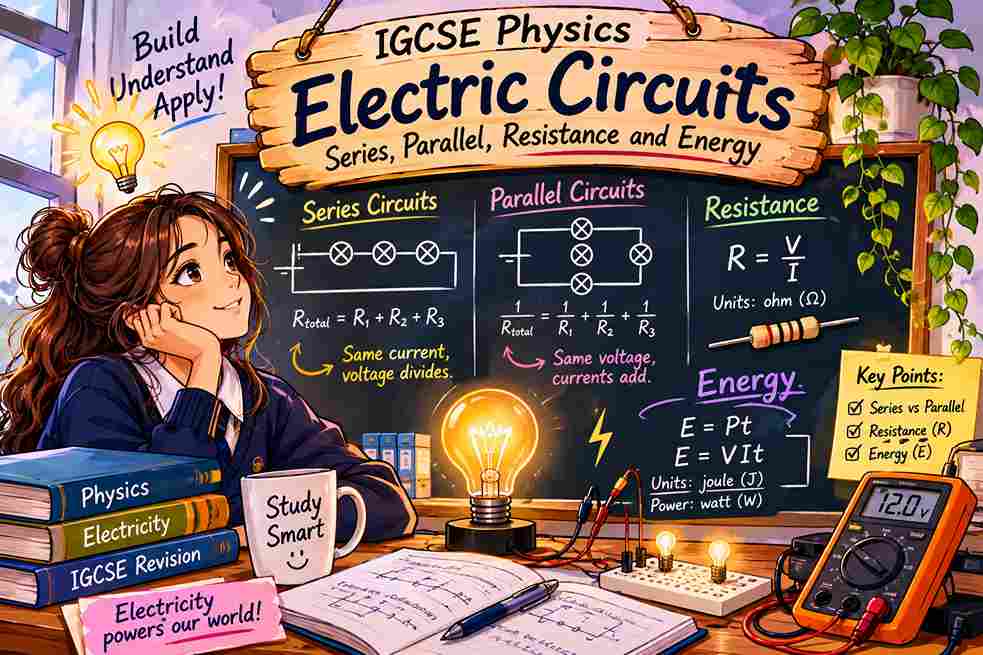
Circuit questions give students many easy marks if they know three things: how current and voltage behave in series and parallel, how to combine resistors, and the equations linking charge, energy and power. This guide covers all three.
Current, voltage and resistance
Quantity |
Symbol and unit |
Measured with |
Connected |
Current |
I, ampere (A) |
Ammeter |
In series |
Potential difference (voltage) |
V, volt (V) |
Voltmeter |
In parallel |
Resistance |
R, ohm (Ω) |
Calculated from V ÷ I |
— |
V = I × R. A voltmeter in parallel has very high resistance, so little current flows through it; an ammeter in series has very low resistance.
Series and parallel rules
Rule |
Series circuit |
Parallel circuit |
Current |
Same everywhere |
Splits between branches; branch currents add to the total |
Voltage |
Shared between components; adds up to the supply |
Same across each branch |
Total resistance |
R = R₁ + R₂ |
1 ÷ R = 1 ÷ R₁ + 1 ÷ R₂ (total is less than the smallest) |
If one component fails |
The circuit breaks |
Other branches keep working |
Worked examples
Example 1: series
A 4 Ω and an 8 Ω resistor are in series with a 12 V supply. Find the current and the voltage across each.
- R = 4 + 8 = 12 Ω.
- I = V ÷ R = 12 ÷ 12 =1 A.
- V across 4 Ω = 1 × 4 =4 V; V across 8 Ω = 1 × 8 =8 V. Check: 4 + 8 = 12 ✓.
Example 2: parallel
A 6 Ω and a 3 Ω resistor are in parallel across 12 V. Find the total resistance and the current in each branch.
- 1 ÷ R = 1/6 + 1/3 = 1/6 + 2/6 = 3/6 = 1/2, soR = 2 Ω.
- Branch currents: 12 ÷ 6 =2 Aand 12 ÷ 3 =4 A. Total current = 6 A, which equals 12 ÷ 2 ✓.
Example 3: potential divider (if on your specification)
12 V is applied across 4 Ω and 8 Ω in series. Voltage across the 8 Ω resistor = 12 × 8 ÷ (4 + 8) =8 V.
Components
Component |
Behaviour |
Fixed resistor |
Current is directly proportional to voltage (straight line through the origin) |
Filament lamp |
Resistance increases as it gets hotter, so the I–V graph curves |
Diode |
Current flows in one direction only |
LDR (light-dependent resistor) |
Resistance decreases as light intensity increases |
Thermistor (NTC) |
Resistance decreases as temperature increases |
Fuse |
Melts if the current exceeds its rating, breaking the circuit |
Charge, energy and power
Equation |
Meaning |
Q = I × t |
Charge (coulomb) = current × time |
E = V × I × t |
Energy transferred (joule) |
P = I × V |
Power (watt) |
- 2 A for 30 s moves Q = 2 × 30 =60 Cof charge.
- A 12 V supply driving 3 A for 60 s transfers E = 12 × 3 × 60 =2160 J.
Common mistakes
- Adding resistances in parallel instead of using the reciprocal.
- Connecting the voltmeter in series.
- Forgetting that voltage is the same across parallel branches.
- Mixing up the symbols for energy and charge.
- Writing 1/R = … and forgetting to invert at the end.
Practice questions
Question |
Answer |
1. Find the resistance of 5 Ω and 10 Ω in series. |
15 Ω |
2. Find the resistance of 6 Ω and 3 Ω in parallel. |
2 Ω |
3. A 230 V appliance draws 5 A. Find its power. |
1150 W |
4. 3 A flows for 20 s. How much charge moves? |
60 C |
Frequently asked questions
Q: Why is total resistance in parallel less than the smallest resistor?
Adding a branch gives the current an extra path, so overall the circuit conducts more.
Q: What is the difference between current and voltage?
Current is the flow of charge; voltage (potential difference) is the energy transferred per unit charge.
Q: How does an LDR behave?
Its resistance falls as light increases.
Q: What equation links energy, voltage, current and time?
E = V × I × t.
Try a free trial class with EdFlik. Live 1:1 IGCSE tutoring for Cambridge and Edexcel students in the UAE, matched to your child's board, subject and year group. Book at edflik.com or message us on WhatsApp. |
Related reading
- IGCSE Physics Equations: Rearranging and Units
- IGCSE Physics (0625 / 4PH1) Guide
- IGCSE Radioactivity and Half-Life
Sources
- Cambridge International IGCSE Physics 0625 syllabus 2026–2028
- Pearson Edexcel International GCSE Physics 4PH1 specification
More on IGCSE & GCSE