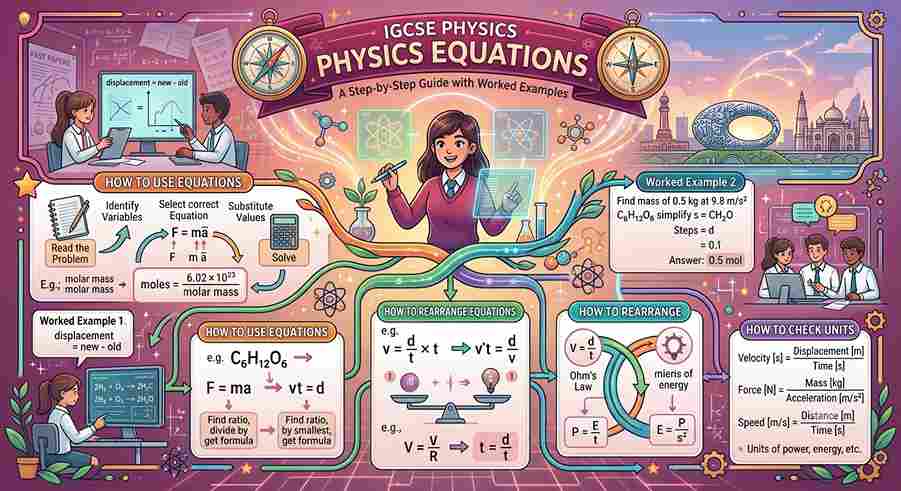
IGCSE Physics Equations: How to Use, Rearrange and Check Units
Last updated: November 2026 | By EdFlik Education Team
Physics marks depend on choosing the right equation, rearranging it, and giving the answer with the correct unit. This guide lists the equations most IGCSE papers use, a routine for every calculation, and worked examples.
The key equations
Topic |
Equation |
Unit of answer |
Speed |
speed = distance ÷ time |
m/s |
Acceleration |
a = (v − u) ÷ t |
m/s² |
Force |
F = m × a |
N |
Weight |
W = m × g |
N |
Work done |
W = F × d |
J |
Power |
P = W ÷ t, or P = E ÷ t |
W |
Kinetic energy |
KE = ½ × m × v² |
J |
Gravitational potential energy |
GPE = m × g × h |
J |
Pressure |
p = F ÷ A |
Pa (N/m²) |
Density |
ρ = m ÷ V |
g/cm³ or kg/m³ |
Ohm's law |
V = I × R |
V |
Electrical power |
P = I × V |
W |
Your board may give some of these on the paper and expect others from memory. Learn them all and what each symbol means.
The five-step routine
- Write the equation first.
- Convert all quantities to standard units (kg, m, s, A, V).
- Rearrange before substituting numbers.
- Substitute and calculate.
- Write the answer with a unit, and sense-check the size.
Rearranging with the triangle method
For three-quantity equations such as V = I × R, put V on top and I and R at the bottom of a triangle. Cover the one you want: covering V leaves I × R; covering I leaves V ÷ R. This works for F = ma, p = F ÷ A, ρ = m ÷ V and similar.
Worked examples
Example 1: force and acceleration
A 1200 kg car accelerates from rest to 20 m/s in 8 s. Find the acceleration and the resultant force.
- a = (20 − 0) ÷ 8 =2.5 m/s².
- F = m × a = 1200 × 2.5 =3000 N.
Example 2: kinetic energy
Find the kinetic energy of the same car at 20 m/s.
- KE = ½ × 1200 × 20² = ½ × 1200 × 400 =240 000 J(240 kJ).
Example 3: gravitational potential energy
A 2 kg book is lifted 5 m. Find the gain in GPE, using g = 10 N/kg.
- GPE = 2 × 10 × 5 =100 J. If your paper uses g = 9.8 N/kg, the answer is 98 J.
Example 4: electricity
A 12 V supply is connected across a 4 Ω resistor. Find the current and the power.
- I = V ÷ R = 12 ÷ 4 =3 A.
- P = I × V = 3 × 12 =36 W.
Example 5: pressure
A force of 600 N acts on an area of 0.03 m². Find the pressure.
- p = F ÷ A = 600 ÷ 0.03 =20 000 Pa.
Example 6: density with unit conversion
A block has mass 540 g and volume 200 cm³. Find its density.
- ρ = 540 ÷ 200 =2.7 g/cm³.
- In kg/m³: 2.7 g/cm³ = 2700 kg/m³ (multiply by 1000).
Units you must convert
From |
To |
How |
cm³ |
m³ |
÷ 1 000 000 |
g |
kg |
÷ 1000 |
km/h |
m/s |
÷ 3.6 |
minutes |
seconds |
× 60 |
kJ |
J |
× 1000 |
Common mistakes
- Substituting numbers before rearranging, which causes algebra slips.
- Leaving mass in grams or time in minutes inside an equation that needs SI units.
- Forgetting to square the velocity in kinetic energy.
- Writing J for a force or N for an energy.
- Using the wrong value of g for your paper.
Practice questions
Question |
Answer |
1. A runner covers 150 m in 12.5 s. Find the speed. |
12 m/s |
2. A force of 60 N acts on a 15 kg trolley. Find the acceleration. |
4 m/s² |
3. A kettle runs at 230 V and draws 5 A. Find the power. |
1150 W |
4. Find the KE of a 0.2 kg ball moving at 10 m/s. |
10 J |
5. A force of 500 N acts on 0.25 m². Find the pressure. |
2000 Pa |
Frequently asked questions
Q: Do I need to memorise IGCSE Physics equations?
It depends on the board and paper. Some equations are provided; others must be recalled. Check your specification and learn them all.
Q: What value of g should I use?
Use the value given in the paper, commonly 9.8 or 10 N/kg.
Q: Why do I keep losing unit marks?
Write the unit on every final answer and check it is correct for the quantity.
Q: How do I rearrange an equation quickly?
Use the triangle method for three-quantity equations, or do the same operation to both sides.
Try a free trial class with EdFlik. Live 1:1 IGCSE tutoring for Cambridge and Edexcel students in the UAE, matched to your child's board, subject and year group. Book at edflik.com or message us on WhatsApp. |
Related reading
- IGCSE Physics (0625 / 4PH1) Guide
- IGCSE Chemistry Mole Calculations
- IGCSE Command Words Explained
Sources
- Cambridge International IGCSE Physics 0625 syllabus 2026–2028
- Pearson Edexcel International GCSE Physics 4PH1 specification
More on IGCSE & GCSE