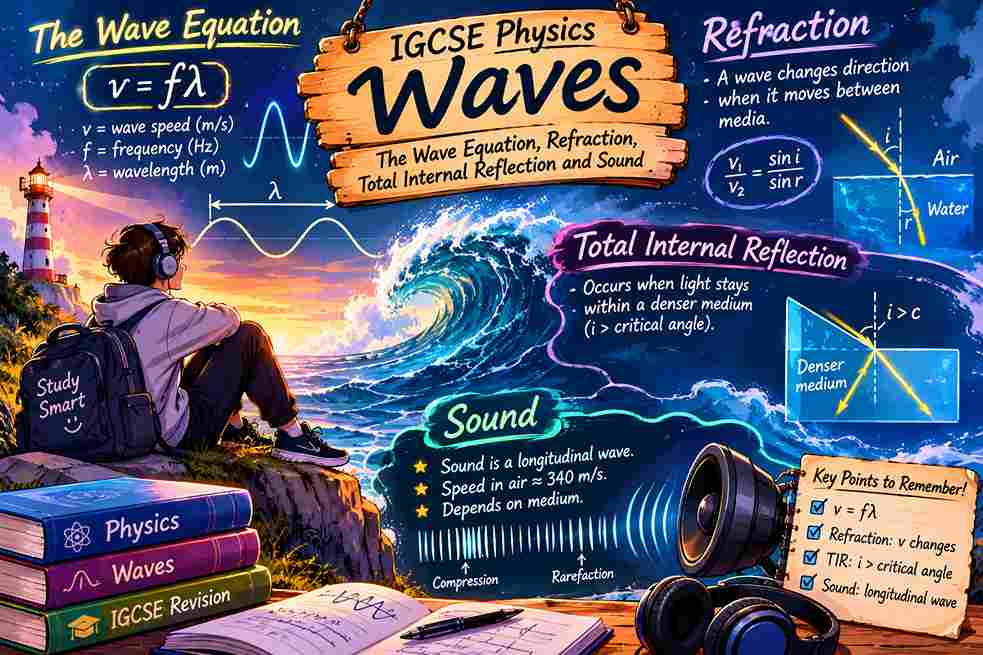
IGCSE Physics Waves: The Wave Equation, Refraction, Total Internal Reflection and Sound
Last updated: November 2026 | By EdFlik Education Team
Waves link several parts of IGCSE Physics: light, sound, the electromagnetic spectrum and communications. The calculations are short, and the descriptions follow patterns. This guide covers both.
Wave basics
Term |
Meaning |
Amplitude |
Maximum displacement from the rest position |
Wavelength (λ) |
Distance between matching points on consecutive waves |
Frequency (f) |
Number of waves per second, in hertz (Hz) |
Wave speed (v) |
Distance travelled per second |
- Transverse waves(light, water ripples) vibrate at right angles to the direction of travel.
- Longitudinal waves(sound) vibrate parallel to the direction of travel, with compressions and rarefactions.
The wave equation
v = f × λ
Worked example 1: sound
Sound travels at 340 m/s in air. Find the wavelength of a 50 Hz sound: λ = v ÷ f = 340 ÷ 50 =6.8 m.
Worked example 2: light
Light travels at 3 × 10⁸ m/s. Light of wavelength 6 × 10⁻⁷ m has frequency f = 3 × 10⁸ ÷ 6 × 10⁻⁷ =5 × 10¹⁴ Hz.
Reflection and refraction
- Reflection: angle of incidence = angle of reflection, both measured from the normal.
- Refraction: a wave changes speed when it enters a different medium. Entering a denser medium, light slows down and bends towards the normal.
Refractive index n = sin i ÷ sin r.
Worked example 3
A ray enters glass at an angle of incidence of 45° and refracts at 28°. Find n.
- n = sin 45° ÷ sin 28° = 0.7071 ÷ 0.4695 =1.51(3 s.f.).
Total internal reflection
When light travels from a denser to a less dense medium and the angle of incidence exceeds the critical angle, all of the light is reflected. The critical angle c satisfies sin c = 1 ÷ n.
Worked example 4
Glass has n = 1.5. Then sin c = 1 ÷ 1.5 = 0.667, soc = 41.8°. Uses include optical fibres and prisms in binoculars.
The electromagnetic spectrum
In order of increasing frequency (and decreasing wavelength): radio waves, microwaves, infrared, visible light, ultraviolet, X-rays and gamma rays. All travel at the same speed in a vacuum.
Wave |
Example use |
Radio |
Broadcasting and communications |
Microwaves |
Cooking, satellite signals |
Infrared |
Remote controls, thermal imaging |
Visible light |
Vision, photography |
Ultraviolet |
Sterilisation, detecting fake banknotes |
X-rays |
Medical imaging |
Gamma rays |
Sterilising equipment, treating cancer |
High-frequency waves (ultraviolet, X-rays, gamma) can damage living cells, so exposure must be limited.
Sound and echoes
Sound needs a medium and cannot travel through a vacuum. Speed is usually fastest in solids, slower in liquids and slowest in gases.
Worked example 5: echo
An echo is heard 0.5 s after a shout. At 340 m/s the sound travels 340 × 0.5 = 170 m in total, there and back, so the wall is 170 ÷ 2 =85 m away.
Common mistakes
- Measuring angles from the surface instead of the normal.
- Saying light "speeds up" when entering glass; it slows down.
- Mixing up transverse and longitudinal waves.
- Forgetting to halve the time or distance in echo problems.
- Putting the electromagnetic spectrum in the wrong order.
Practice questions
Question |
Answer |
1. A wave has f = 50 Hz and λ = 6.8 m. Find v. |
340 m/s |
2. A ray enters glass; sin i = 0.7071 and sin r = 0.4695. Find n. |
1.51 |
3. Find the critical angle if n = 1.5. |
41.8° |
4. Name the type of wave sound is. |
Longitudinal |
Frequently asked questions
Q: What is the wave equation?
v = f × λ: wave speed equals frequency times wavelength.
Q: What is total internal reflection?
All light is reflected at a boundary when it travels from a denser to a less dense medium at an angle above the critical angle.
Q: Why does light bend when it enters glass?
Its speed changes, which makes the wavefront change direction.
Q: Do all electromagnetic waves travel at the same speed?
Yes, in a vacuum, at about 3 × 10⁸ m/s.
Try a free trial class with EdFlik. Live 1:1 IGCSE tutoring for Cambridge and Edexcel students in the UAE, matched to your child's board, subject and year group. Book at edflik.com or message us on WhatsApp. |
Related reading
- IGCSE Physics Equations: Rearranging and Units
- IGCSE Radioactivity and Half-Life
- IGCSE Physics (0625 / 4PH1) Guide
Sources
- Cambridge International IGCSE Physics 0625 syllabus 2026–2028
- Pearson Edexcel International GCSE Physics 4PH1 specification
More on IGCSE & GCSE