IGCSE Straight-Line Graphs: Gradient, Equation of a Line, Parallel and Perpendicular
Last updated: November 2026 | By EdFlik Education Team
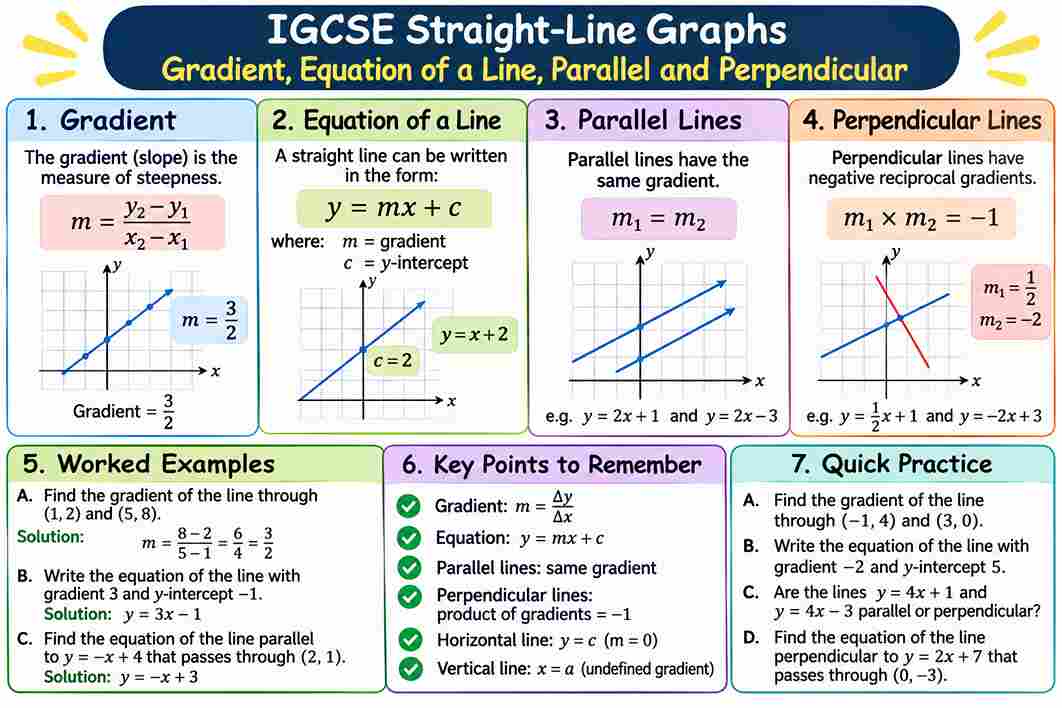
Straight-line graph questions use a small toolkit: gradient, y-intercept, midpoint and distance. Once you know when to use each, the questions are routine. This guide runs through the toolkit with examples.
The toolkit
Need |
Formula |
Gradient between (x₁, y₁) and (x₂, y₂) |
m = (y₂ − y₁) ÷ (x₂ − x₁) |
Equation of a line |
y = mx + c |
Midpoint |
((x₁ + x₂) ÷ 2, (y₁ + y₂) ÷ 2) |
Length of a line segment |
√((x₂ − x₁)² + (y₂ − y₁)²) |
Parallel lines |
Same gradient |
Perpendicular lines |
m₁ × m₂ = −1 |
Gradient and the equation of a line
Worked example 1
Find the equation of the line through (1, 2) and (5, 10).
- m = (10 − 2) ÷ (5 − 1) = 8 ÷ 4 = 2.
- Use (1, 2) in y = 2x + c: 2 = 2 + c, so c = 0.
- y = 2x.
Worked example 2: negative gradient
Find the equation of the line through (2, 7) and (6, −1).
- m = (−1 − 7) ÷ (6 − 2) = −8 ÷ 4 = −2.
- 7 = −2(2) + c, so c = 11.
- y = −2x + 11. Check with (6, −1): −12 + 11 = −1 ✓.
Parallel and perpendicular lines
Worked example 3: parallel
Find the line parallel to y = 3x − 1 passing through (0, 5). It has gradient 3 and y-intercept 5, soy = 3x + 5.
Worked example 4: perpendicular
Find the line perpendicular to y = 2x + 3 through (4, 1).
- The gradient of the perpendicular is −1 ÷ 2 = −1/2.
- 1 = −1/2(4) + c, so c = 3.
- y = −1/2 x + 3.
Midpoint and length
Worked example 5
A is (2, 3) and B is (8, 9). Find the midpoint and the length of AB.
- Midpoint = ((2 + 8) ÷ 2, (3 + 9) ÷ 2) =(5, 6).
- Length = √(6² + 6²) = √72 = 6√2 =8.49(3 s.f.).
Reading a graph
- The gradient is the rate of change: on a distance–time graph it is speed.
- The y-intercept is the starting value.
- To find where two lines meet, solve their equations simultaneously.
Common mistakes
- Subtracting coordinates in different orders in the numerator and denominator.
- Forgetting to flip and negate for a perpendicular gradient.
- Giving the gradient as a fraction with the wrong sign.
- Reading the scale on the axes incorrectly.
Practice questions
Question |
Answer |
1. Gradient of the line through (0, 1) and (4, 9). |
2 |
2. Equation of the line with gradient 3 through (1, 5). |
y = 3x + 2 |
3. Distance between (1, 2) and (4, 6). |
5 |
4. Midpoint of (−2, 4) and (6, 10). |
(2, 7) |
Frequently asked questions
Q: How do I find the equation of a line from two points?
Find the gradient, then substitute one point into y = mx + c to find c.
Q: What is the gradient of a perpendicular line?
The negative reciprocal. If m = 2, the perpendicular gradient is −1/2.
Q: How do I find where two lines meet?
Set the equations equal or solve them as simultaneous equations.
Q: What does the gradient mean in a real situation?
It is the rate of change, for example speed on a distance–time graph.
Try a free trial class with EdFlik. Live 1:1 IGCSE tutoring for Cambridge and Edexcel students in the UAE, matched to your child's board, subject and year group. Book at edflik.com or message us on WhatsApp. |
Related reading
- IGCSE Simultaneous Equations: Worked Examples
- IGCSE Functions: Composite and Inverse
- IGCSE Maths Trigonometry: Worked Examples
Sources
- Cambridge International IGCSE Mathematics 0580 syllabus (coordinate geometry)
- Pearson Edexcel International GCSE Mathematics A 4MA1 specification
More on IGCSE & GCSE
- IGCSE in the UAE: A Complete Guide to Boards, Subjects, Exams and Revision
- IGCSE Physics Electric Circuits: Series, Parallel, Resistance and Energy
- IGCSE Rates of Reaction: Collision Theory, Graphs and Practical Methods
- IGCSE Science Practical Skills: Variables, Tables, Graphs, Planning and Evaluating
- All IGCSE & GCSE articles