IGCSE Transformations: Translation, Reflection, Rotation and Enlargement
Last updated: November 2026 | By EdFlik Education Team
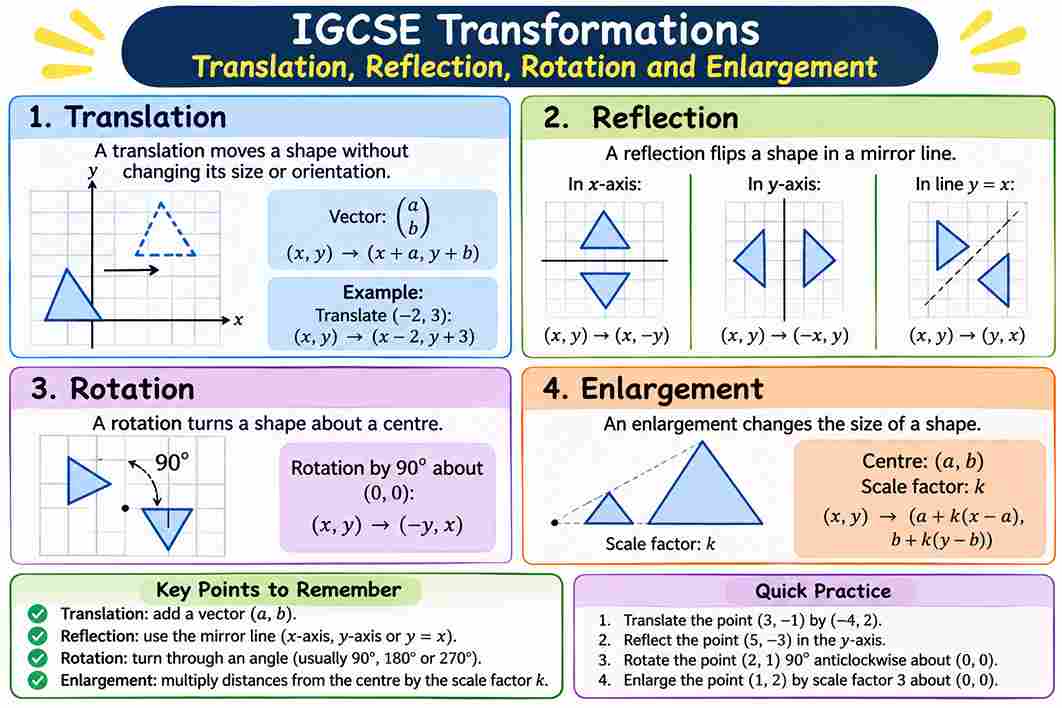
Transformation questions ask you either to draw an image or to describe a transformation fully. Describing fully is where marks are lost, because each transformation needs specific details. This guide gives both skills, using one triangle throughout.
What to include when you describe
Transformation |
You must state |
Translation |
The column vector |
Reflection |
The equation of the mirror line |
Rotation |
The angle, the direction (clockwise or anticlockwise) and the centre |
Enlargement |
The scale factor and the centre |
A "describe" question usually says "describe fully" or "a single transformation". Naming the transformation without the details earns only the first mark.
Worked examples using triangle ABC
Triangle ABC has vertices A(1, 1), B(3, 1) and C(3, 2).
Translation by the vector (4, −3)
Add 4 to each x and subtract 3 from each y:A′(5, −2), B′(7, −2), C′(7, −1).
Reflection in the y-axis
Change the sign of each x coordinate:A′(−1, 1), B′(−3, 1), C′(−3, 2).
Reflection in the line y = x
Swap x and y:A′(1, 1), B′(1, 3), C′(2, 3). A on the line stays where it is.
Rotation 90° clockwise about the origin
The rule is (x, y) goes to (y, −x):A′(1, −1), B′(1, −3), C′(2, −3). For 90° anticlockwise the rule is (x, y) goes to (−y, x).
Enlargement, scale factor 2, centre the origin
Multiply each coordinate by 2:A′(2, 2), B′(6, 2), C′(6, 4).
Enlargement, scale factor −2, centre the origin
Multiply by −2:A′(−2, −2), B′(−6, −2), C′(−6, −4). A negative scale factor puts the image on the opposite side of the centre and inverts it.
Scale factors, lengths, area and volume
- Lengths in the image are multiplied by the scale factor k.
- Areas are multiplied by k². An enlargement of scale factor 3 makes the area 9 times bigger.
- Angles do not change.
- A fractional scale factor between 0 and 1 makes the image smaller.
Finding the centre of enlargement
Draw a line through each pair of matching points (for example A and A′). The lines meet at the centre of enlargement. The scale factor is the length of A′B′ divided by AB.
Common mistakes
- Writing "rotation" without the angle, direction and centre.
- Describing a translation as "move 4 right" instead of the vector.
- Reflecting in the wrong axis.
- Giving a reflection as "flip" instead of the equation of the line.
- Using an enlargement scale factor from the wrong shape (image divided by object, not object divided by image).
Practice questions
Question |
Answer |
1. Reflect (2, 5) in the x-axis. |
(2, −5) |
2. Rotate (2, 5) 90° anticlockwise about the origin. |
(−5, 2) |
3. Enlarge (2, 5) by scale factor 3 about the origin. |
(6, 15) |
4. Translate (2, 5) by the vector (−3, 1). |
(−1, 6) |
Frequently asked questions
Q: How do I describe a transformation fully?
Name it and give its details: vector for translation, mirror line for reflection, angle, direction and centre for rotation, scale factor and centre for enlargement.
Q: What happens to area in an enlargement?
It is multiplied by the scale factor squared.
Q: What does a negative scale factor do?
It places the image on the opposite side of the centre and inverts it.
Q: Can one transformation replace two?
Sometimes. Questions that ask for a "single transformation" expect you to identify it from the object and the final image.
Try a free trial class with EdFlik. Live 1:1 IGCSE tutoring for Cambridge and Edexcel students in the UAE, matched to your child's board, subject and year group. Book at edflik.com or message us on WhatsApp. |
Related reading
- IGCSE Similarity: Area and Volume Scale Factors
- IGCSE Vectors: Worked Examples
- IGCSE Straight-Line Graphs: Gradient and Equations
Sources
- Cambridge International IGCSE Mathematics 0580 syllabus (transformations)
- Pearson Edexcel International GCSE Mathematics A 4MA1 specification
More on IGCSE & GCSE